

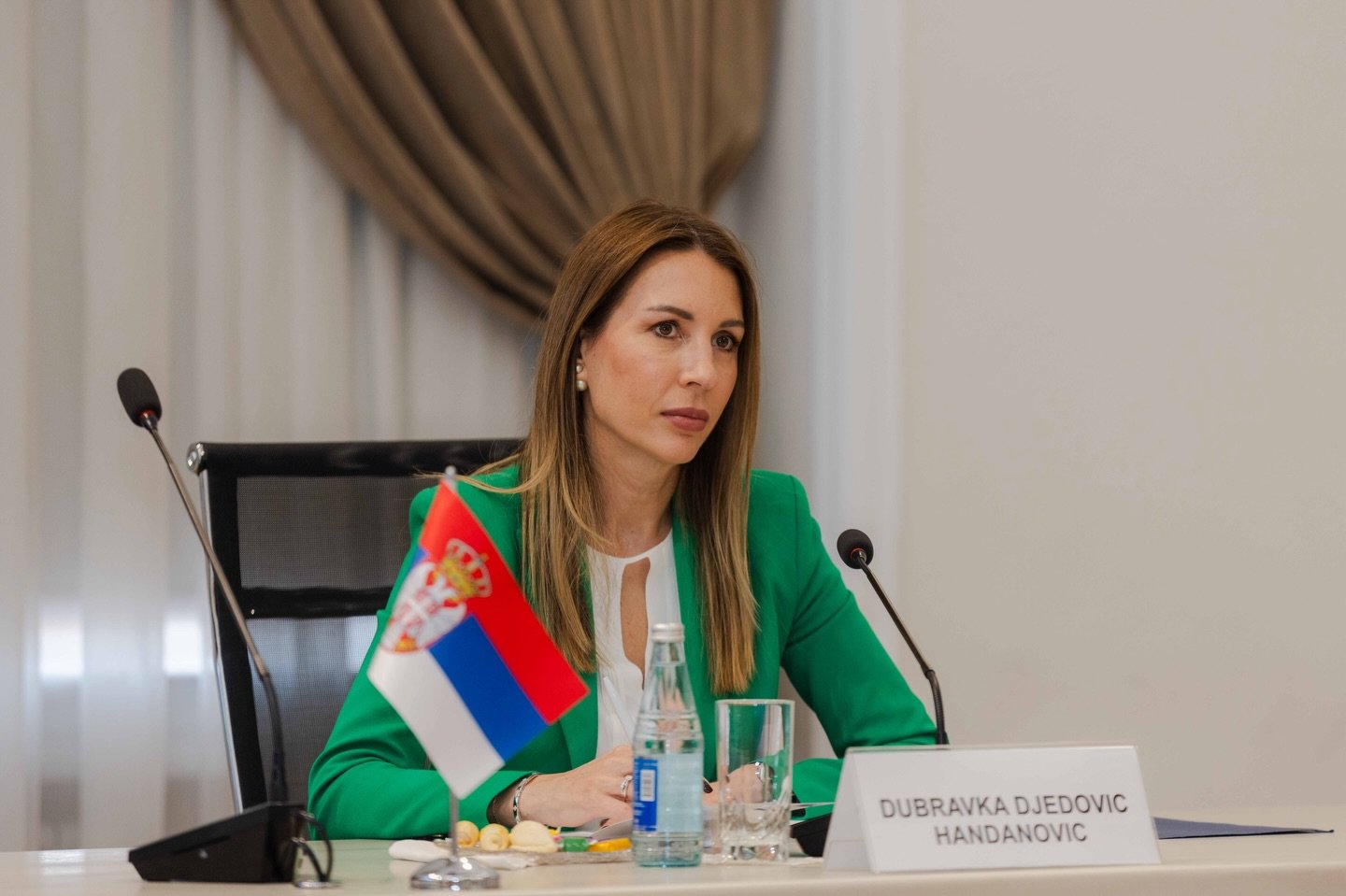
BAKU, Azerbaijan, April 24. Serbia is discussing with Azerbaijan the possibility of flexible gas supply of up to 0.9 billion cubic meters per year, with a potential increase to up to 1.4 billion cubic meters annually after the completion of the gas-fired power plant in Niš in 2030, Minister of Mining and Energy of the Republic of Serbia, Dubravka Djedovic Handanovic said in an exclusive interview with TurkicWorld, as she has recently visited Baku.
"During our visit to Baku, we held high-level meetings with the ministers of finance, economy, and energy of Azerbaijan, as well as with representatives of Azerbaijan's state oil company SOCAR. This visit represents a continuation of strengthening friendly relations and the strategic partnership between our two countries. During the meetings, we discussed the long-standing successful cooperation in gas supply, with a particular focus on the project to build a gas-fired power plant in Serbia, which President Ilham Aliyev described during the first session of the Strategic Partnership Council, held in Belgrade on February 15, as one of the major Azerbaijani investments in Europe in recent years.
As President Aleksandar Vučić pointed out, that session marked a turning point in relations between the two countries and reflected our shared commitment to elevating cooperation to an even higher level. At that time, we agreed to continue intensive communication and dedicated work on the gas power plant project, which is one of Serbia’s priority projects. Its construction will enhance the country’s energy security, especially in light of growing electricity consumption, increased use of artificial intelligence, and the development of data centers," she said.
Handanovic pointed out that Serbia is currently undergoing an energy transition process, where, alongside integrating new renewable energy capacities, it is necessary to strengthen base-load capacities.
"Therefore, we have recognized gas-fired power plants as an important component in our key strategic documents. We are aware that Azerbaijan generates a significant share of its electricity from gas-fired power plants, and we have recognized its experience as valuable for cooperation on the project in Serbia, particularly with SOCAR, which will participate in this project not only as a gas supplier but also as a strategic partner in developing the generation capacity," noted the minister.
She went on to add that the Republic of Serbia, through the construction and commissioning of the gas interconnector with Bulgaria, has become part of the Southern Gas Corridor by connecting to the TAP and TANAP gas pipelines.
"This has, for the first time, enabled us to diversify our gas supply sources. For the past three years, we have been reliably supplied with gas from Azerbaijan, and we regularly participate in ministerial meetings of the Southern Gas Corridor Advisory Council in Baku, as well as in other formats of energy cooperation in the country. Gas deliveries have doubled since the beginning of our cooperation, reaching approximately 2 million cubic meters per day last year. In discussions with representatives of SOCAR, we are considering the possibility of flexible gas supply of up to 0.9 billion cubic meters per year, with a potential increase to up to 1.4 billion cubic meters annually after the completion of the gas-fired power plant in Niš in 2030. We expect that the operation of the gas-fired power plant will require securing around 600 million cubic meters of gas annually from Azerbaijan, which is why we see SOCAR as a long-term partner in ensuring Serbia’s energy security," added Handanovic.
The Serbian minister noted that her country sees Azerbaijan's state oil company SOCAR as a reliable gas supplier and a partner in the construction and operation of the gas-fired power plant that will be built in Serbia in cooperation with Srbijagas and EPS.
"There is also potential for the exchange of experience in the field of energy transition, in line with the intentions of both countries and their energy companies to develop new renewable energy capacities," she said.
Handanovic recalled that at the first session of the Strategic Partnership Council in Belgrade, the sides signed an Agreement on the development, design, construction, and operation of a combined-cycle gas-fired power plant in the Republic of Serbia.
"A joint working group has also been established and has begun work on the project’s development. In the coming month, we plan to harmonize and formalize the key provisions and commercial terms for the construction of the gas-fired power plant, as well as the design and construction timelines," the Serbian minister added.
Further, Handanovic noted that Serbia is developing ambitious investments in its electricity transmission infrastructure worth more than one billion euros, given its central position in the Balkans and its potential to play a key role in ensuring security of supply for the wider Southeast European region.
"The Trans-Balkan Corridor is currently under construction, which will connect Serbia with Romania, Bosnia and Herzegovina, Montenegro, and Italy, while plans are also underway to build the Pannonian Corridor, which will double transmission capacity with Hungary. Once the planned investments are completed, cross-border electricity exchange capacity will be increased from 4,000 to 6,000 MW. One of the possibilities we discussed with the Azerbaijani delegation is Serbia’s participation in the Green Energy Corridor project between the Caspian region and Southeast Europe, especially since Serbia borders countries that are already part of the project. Congestion in transmission networks, which has been increasingly occurring across Europe in recent years, serves as a reminder that greater investment in interconnections and strengthening transmission capacities is necessary in order to ensure system stability, particularly in the context of integrating new renewable energy capacities," she concluded.