
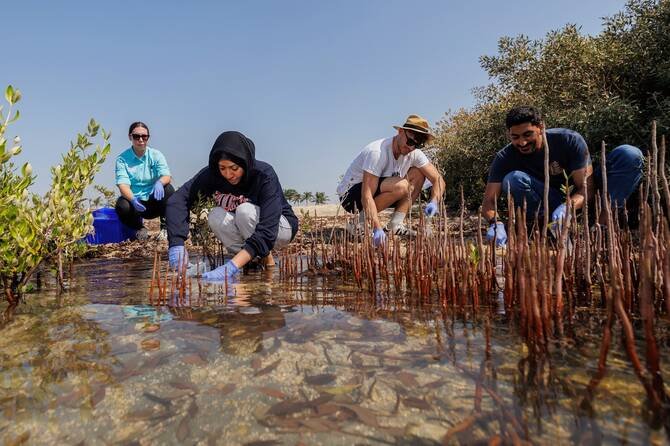
Saudi Arabia’s mangrove forests are doing far more than lining the Kingdom’s coastlines. Scientists say these resilient ecosystems store significant amounts of carbon, support marine biodiversity, and provide natural protection against coastal erosion, making them an increasingly important part of national conservation efforts TurkicWorld reports via arabnews.
As the Kingdom marked the International Day for the Conservation of the Mangrove Ecosystem on July 26, researchers said mangroves should be viewed not simply as trees but as interconnected living systems that support climate resilience, fisheries, biodiversity, and shoreline protection.
“The story here isn’t loss, it’s resilience,” marine ecology consultant Taiba Alamoudi told Arab News of Saudi Arabia’s mangrove forests. “And that’s worth protecting, because mangroves do a lot for their size.”
Mangroves are among the world’s most effective natural carbon stores. They capture carbon from the atmosphere and retain much of it for long periods in their roots, coastal mud, and sediments — a process known as blue-carbon storage.
“Mangroves are among the best carbon stores on Earth,” Alamoudi said. “They hold more carbon than most rainforests, most of it buried in the mud beneath them, which is why they’re a big part of what we call blue carbon.”
Blue carbon refers to carbon captured and stored by coastal ecosystems, including mangroves, seagrass meadows, and salt marshes.
In Saudi Arabia, however, the importance of mangroves extends far beyond carbon storage. The forests provide nursery grounds for fish and other marine organisms, reduce erosion and wave damage, stabilize sediments, and help connect coastal ecosystems such as coral reefs and seagrass beds.
Their ecological value also depends on processes taking place beneath the surface.
Alexandre Soares Rosado, professor of bioscience at King Abdullah University of Science and Technology, told Arab News that mangroves could be considered “belowground carbon engines,” as much of their climate value is shaped by microbial communities living around their roots and in surrounding sediments.
These microorganisms transform, stabilize, and recycle organic matter while supporting nutrient cycling, plant growth, resilience, and protection from disease.
“If we want to understand the real climate function of mangroves, we need to understand not only the trees, but also the microbiome supporting them,” Rosado said.
Mangrove ecosystems along the Red Sea are mainly dominated by two species: the gray mangrove, or Avicennia marina, and the red mangrove, Rhizophora mucronata.
Diego Javier Jimenez Avella, a research scientist at KAUST, told Arab News that these ecosystems survive in conditions that are especially demanding compared with mangrove forests elsewhere in the world.
They are exposed to high salinity, nutrient-poor seawater, limited rainfall, and elevated temperatures.
Alamoudi described Avicennia marina, Saudi Arabia’s most common mangrove species, as “one of the toughest trees on the planet.”
She added: “It handles water saltier than the sea and extreme summer heat, so when a mangrove here is struggling, it’s rarely the conditions, it’s usually something the tree can’t adapt to.”
The pressures facing mangroves differ between the Kingdom’s two coastlines.
Along the Arabian Gulf, Alamoudi said the most significant pressures included coastal development, urban expansion, and land reclamation.
On the Red Sea coast, where most of the Kingdom’s mangroves are found, forests have generally shown strong resilience. However, grazing by camels can prevent young seedlings from becoming established.
“Camels eat the seedlings, and while that rarely kills off a whole stand, it quietly slows the forest from renewing itself,” she said.
The most damaging threat, however, can be disruption to natural water movement.
Alamoudi said: “A mangrove lives within a specific range of the tide, and the fastest way to lose one is to cut off that tidal flow, whether by a causeway or even a sandbar across the channel. Getting the hydrology right is what protects the forest.”
Other threats identified by conservation specialists include timber cutting, solid-waste accumulation, sewage pollution, dredging, and the filling or physical alteration of coastal areas.
Despite these pressures, researchers say Saudi Arabia has made significant progress by incorporating mangrove restoration into national and regional environmental programs.
Rosado said: “This is very positive, because mangroves are now being recognized not only as trees to be planted, but as strategic ecosystems for climate, biodiversity, coastal protection and sustainable development.”
However, he cautioned that restoration success should not be measured solely by the number of seedlings placed in the ground.
“Planting is the visible part,” he said. “What really matters is what happens after that: survival, root development, sediment stability, tidal exchange, natural recruitment, carbon accumulation, and the return of ecological functions.”
Restoration should begin by determining whether a site can naturally sustain mangroves, he added.
If tidal flow is unsuitable, sediments are unstable, salinity is too extreme, or seedlings are exposed to grazing and physical disturbance, planting large numbers of trees may not produce a functioning forest.
“For me, a successful restoration effort is one where planted mangroves stop being ‘planted trees’ and start behaving like an ecosystem,” Rosado said.
That means the trees must survive, establish root systems, stabilize sediments, reproduce naturally, accumulate carbon, and provide habitat for fish, birds, invertebrates, and microorganisms.
Jimenez Avella said restoration required a comprehensive and science-based approach that accounted for environmental conditions, plant physiology, hydrology, and interactions between mangroves, microorganisms, and marine biodiversity.
Mangrove forests are especially important to marine life because their tangled roots create sheltered habitats for juvenile fish, crabs, shrimp, mollusks, insects, and other organisms.
The protected waters around mangrove roots allow young animals to find food and avoid predators before moving into seagrass beds, coral reefs, and open coastal waters.
“Mangroves are much more than carbon reservoirs,” Rosado said. “In the Red Sea they are part of the coastal biodiversity network.”
The connection between mangroves, coral reefs, seagrass beds, coastal sediments, and surrounding waters is essential because many marine species move between these habitats during different stages of their lives.
“When we protect mangroves, we are also supporting the wider Red Sea seascape,” Rosado added.
Jimenez Avella said mangroves provided food, shelter, and nutrients for marine and terrestrial species, making their protection important for fisheries planning and activities such as shrimp farming.
The ecological quality of the habitat is as important as the amount of vegetation present, Rosado said.
“A healthy, self-sustaining mangrove ecosystem provides much more nursery value than a degraded or poorly established planting area,” he added. “Restoration should always aim to recover ecological function, not only vegetation cover.”
Mangroves also protect coastal communities and infrastructure.
Their roots slow water movement, reduce wave energy, trap sediments, and stabilize shorelines. In areas exposed to flooding, storm surges, or strong tides, a healthy mangrove belt can act as a natural buffer between the sea and land.
For Saudi Arabia, these ecological services are becoming increasingly important as coastal areas face development pressures, sea-level rise, extreme heat, and other environmental challenges.
“Mangroves are not a wall, of course, but they are a form of living coastal infrastructure,” Rosado said. “They protect the coast while also supporting biodiversity, carbon storage, fisheries, and water quality.”
He added that the strength of this natural infrastructure depended on the combined activity of roots, sediments, organic matter, and microorganisms.
“When we restore mangroves properly, we are not only planting trees, we are rebuilding a natural system that helps the coastline defend itself,” he said.
KAUST researchers are examining how microorganisms help mangroves survive extreme salinity, heat, nutrient scarcity, and pollution.
Over the past four years the team has used field-based DNA extraction, metagenomics, microbiome engineering, and artificial intelligence to study microbial communities in mangrove roots, leaves, and sediments.
Research has identified enzymes capable of degrading plastics in high-salinity conditions and explored microbes that could break down hydrocarbons in polluted sediments.
Scientists are also developing beneficial microbial communities to strengthen Avicennia marina seedlings during restoration. Satellites, drones, and remote sensing complement this work by tracking mangrove cover, ecosystem health, and restoration progress across coastal areas.
“For World Mangrove Day, I think this is the key message: Protecting mangroves means protecting an entire living system, from the trees we see to the microbes that keep them alive,” Rosado said.
UNESCO established the International Day for the Conservation of the Mangrove Ecosystem in 2015 to raise awareness of the importance of these ecosystems and promote their sustainable conservation.
Under the Saudi Green Initiative, which supports the Kingdom’s sustainability objectives and its target of reaching net-zero emissions by 2060, authorities have committed to planting more than 100 million mangrove trees by 2030.
The initiative also aims to protect 30 percent of Saudi Arabia’s marine and coastal areas by the end of the decade.
Reported progress includes the protection of 6,700 sq. km of Red Sea coastline and the planting of more than 37 million mangrove trees.
Major organizations are also carrying out restoration and conservation programs.
Aramco launched the Ras Tanura Mangrove Eco Park in 2021, protecting 64 sq. km of marine habitats, including mangroves, salt marshes, and seagrass beds. The company said it had planted more than 49 million mangrove trees by the end of 2025.
Red Sea Global has completed what it described as the Kingdom’s largest restoration project involving Rhizophora mucronata, propagating and transplanting more than 5,000 seedlings in Al-Wajh Lagoon.
The National Center for Vegetation Cover Development and Combating Desertification has also completed three major mangrove cultivation projects in Tabuk, the Eastern Province, and Jazan.
The center reported survival rates exceeding 90 percent and the restoration of about 50 hectares in Umluj.
While these projects represent significant progress, researchers say the long-term success of mangrove conservation will depend on whether restored forests develop into self-sustaining ecosystems capable of supporting biodiversity, storing carbon, and protecting coastlines.