






World Shark Day is drawing attention to the crucial role sharks play in maintaining healthy marine ecosystems, with the Red Sea providing an important refuge for several species, including the endangered whale shark, according to a report carried by the Saudi Press Agency TurkicWorld reports via arabnews.
One of the Red Sea’s most significant marine habitats lies at Shi’b Habil, a submerged coral reef about four kilometers off the coast of Al-Lith Governorate, nearly 200 kilometers south of Jeddah.
Each year during April and May, warming waters and abundant plankton attract seasonal gatherings of whale sharks to the reef, creating one of the world’s best-documented aggregation sites for the species.
The site gained international scientific prominence after a local dive operator guided researchers to the waters off Al-Lith, leading to a series of studies documenting the unique seasonal congregation.
Rare seasonal gathering
Researchers say Shi’b Habil stands out for the distinctly seasonal nature of its whale shark aggregation and for its unusually balanced mix of male and female sharks — a rare characteristic among whale shark aggregation sites worldwide, where one sex typically dominates.
The whale shark, the world’s largest fish, is a gentle filter feeder that consumes plankton and poses no threat to humans.
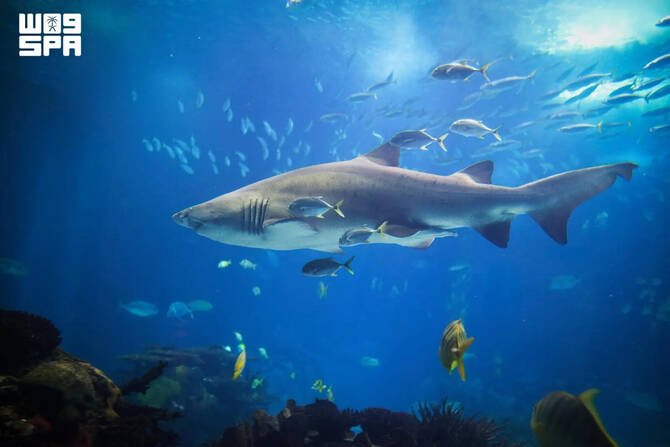
The Red Sea is home to a diverse range of shark species, including gray reef sharks and hammerheads, alongside whale sharks.
Far from being merely part of the marine landscape, sharks are regarded as key indicators of ecosystem health. As apex predators, many species help regulate prey populations, maintain ecological balance and support the long-term health of coral reef ecosystems.
Their continued presence is considered an important measure of the condition of the marine environment.
Conservation efforts
SPA said scientific research and regulatory measures are playing a central role in protecting sharks and their habitats while ensuring sustainable use of marine resources.
The Saudi Red Sea Authority oversees efforts to balance marine tourism and recreational activities with the conservation of fragile ecosystems that support whale sharks and other marine life.
The whale shark’s annual return to the Red Sea highlights the importance of preserving marine biodiversity and strengthening scientific and regulatory initiatives to safeguard the region’s marine environment for future generations.