
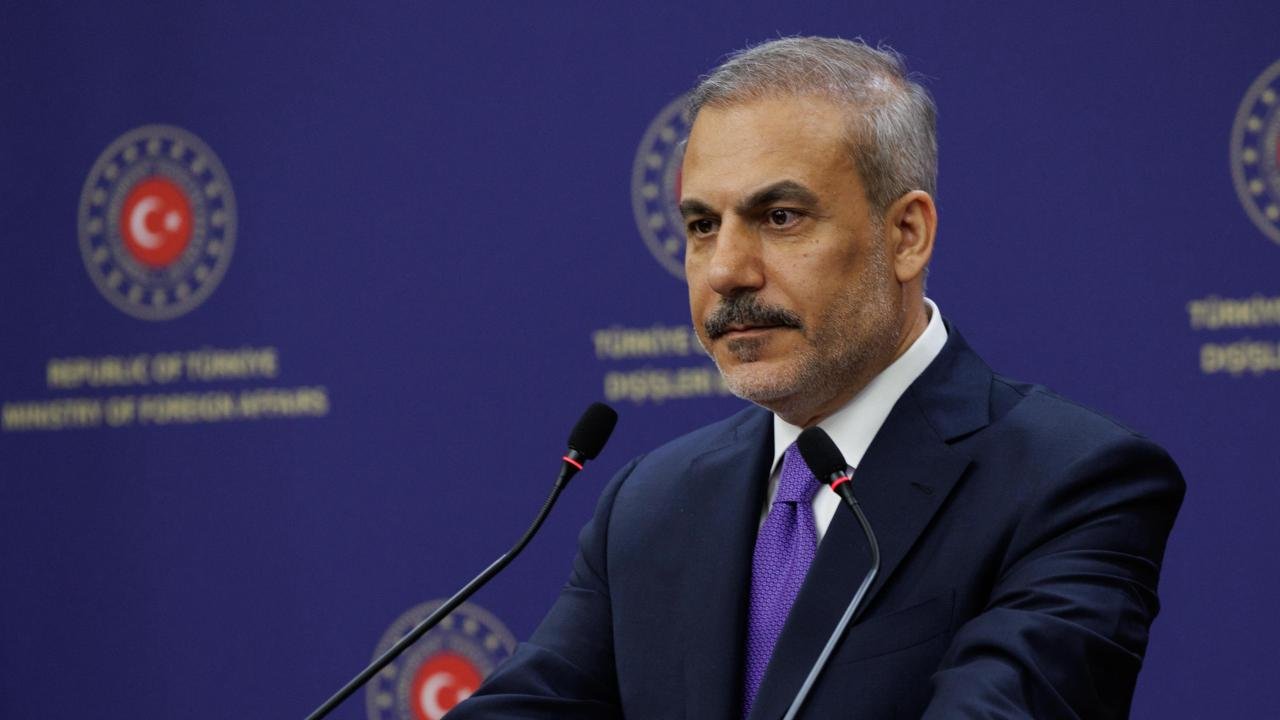
BAKU, Azerbaijan, April 13. Our position is to reopen it through peace,' says Turkish Foreign Minister Fidan, urges diplomacy to keep key global energy route open amid rising Gulf tensions, TurkicWorld reports via Anadolu Agency.
Turkish Foreign Minister Hakan Fidan on Monday warned that military approaches to securing key global sea lanes would be highly complex and urged diplomacy to ensure uninterrupted maritime trade through the Strait of Hormuz, a critical energy chokepoint.
Hakan Fidan spoke at the Editor’s Desk program hosted by Anadolu in Ankara, where he outlined Türkiye's positions on several regional flashpoints.
Fidan emphasized the importance of keeping international shipping routes open amid rising tensions in the Gulf. "What the entire world wants is that international transit remains free and uninterrupted," he said.
He warned that stability in the waterway cannot be achieved through forceful measures. "Our position is to reopen it through peace. There are many difficulties in intervening here with an international armed peace force," he said.
Global trade and security risks
During the program, Fidan also described the Strait as a vital corridor for global energy flows, accounting for roughly 20-25% of oil and gas exports, and emphasized its importance for petrochemicals, fertilizers, pharmaceuticals and global supply chains.
Fidan warned that disruptions in maritime transit would have widespread consequences beyond energy markets, affecting food security, logistics and industrial production worldwide.
He argued that global actors – including energy-importing countries in Asia and Europe – have a shared interest in keeping the route open, stressing that "free passage" should remain the guiding principle.
He also said that proposals from European actors and others for an international mechanism to secure shipping lanes are being discussed, but warned that no solution should depend on direct involvement in conflict escalation.
Fidan also referenced discussions linked to US President Donald Trump’s approach of establishing an international protection force, adding that some European countries are reluctant to participate in such initiatives.
On Iran’s position in possible negotiations, he said he does not expect obstacles to free passage: "I see no issue regarding free passage. Once the necessary conditions are met, there will be no problem."
He cautioned that there is a fine line between ensuring maritime security and becoming involved in broader confrontation with Iran, adding: "No country wants to be part of a war against Iran. Europeans have also said this openly."
Türkiye’s position, he reiterated, is to remain outside the conflict while contributing diplomatically to ensure the Strait remains open, in line with President Recep Tayyip Erdogan’s policy.
"The Strait of Hormuz is actually the most important example showing that the war is not a regional war, but one with global implications," he said.
The minister said that any disruption would affect not only energy but also petrochemical supply chains feeding global industrial production, warning of a broad breakdown in logistics and manufacturing networks.
Fidan said Türkiye is contributing diplomatically and is not heavily dependent on the Strait of Hormuz for its own energy supply, though global price shocks are felt indirectly.
He warned that sustained disruptions could pressure global energy prices and supply security across Europe and Asia-Pacific, recalling similar spillover effects after the Russia-Ukraine war.
He also cautioned that compounded crises could trigger broader humanitarian consequences, including potential food insecurity affecting tens of millions in parts of Africa.
US-Iran talks
Fidan said recent US-Iran contacts reflect early-stage negotiating positions that are typically maximalist, but expressed cautious optimism about continued dialogue.
"Initial positions are always somewhat maximalist. Later, with the support of mediators, the parties try to meet at a common point. As long as there is a genuine intention to reach a ceasefire, sustain it, and make it lasting.
"What I see right now is that both sides are sincere about a ceasefire and aware of the need for it."
He further commented on Israel’s regional posture, saying: "We see that Israel may seek to designate Türkiye as a new adversary after Iran, as it cannot sustain itself without an enemy."
He said mediators are working to bridge differences, while discussions continue on possible timelines and frameworks for a temporary ceasefire.
Fidan noted that a final agreement within 15 days would be “technically not realistic,” adding that negotiations could extend 45 to 60 days if progress continues.
"If the issue on the nuclear matter turns into an ‘all or nothing’ approach, especially regarding enrichment, I think we may encounter a serious obstacle there," he said, stressing that diplomatic channels remain active to overcome key obstacles.
He also referred to meetings involving US and Iranian representatives in Islamabad, saying Türkiye has remained in contact with relevant parties throughout the process and is assessing possible contributions where negotiations stall.
Israel, Syria and regional escalation risks
Fidan warned that Israel’s regional posture continues to raise instability risks, particularly in Syria and Lebanon.
He said ongoing developments could create long-term volatility even if some actions are temporarily delayed due to other regional conflicts.
Fidan also said Israel’s actions in Lebanon resemble that in Gaza, accusing it of destroying housing and infrastructure in a "depopulation campaign," and warned that such dynamics could escalate into a broader regional conflict.
He argued that Israel is pursuing territorial expansion under the pretext of security, a claim he rejected.
Fidan also said expectations for Hezbollah’s disarmament are unrealistic given Lebanon’s internal balance and stressed that any solution must be nationally inclusive.
He also described the situation in Syria as a major security concern for Türkiye. "We see a major problem area in Syria. This is a serious risk for us," he said, referring to Israel's attacks.
He added that Israel’s current focus on its confrontation with Iran could delay but not rule out its future moves in Syria.
"Because of the war underway in Iran, it is not doing certain things (against Syria), but that does not mean it will not. It may act when conditions allow," he said.
Fidan also said Türkiye has maintained intensive diplomatic contact and that the country has remained relatively insulated despite regional turmoil, with ongoing humanitarian support and refugee flows between Syria and Lebanon.
He noted that ongoing discussions on Syria’s internal political and security structure, including integration efforts involving the SDF framework, adding that progress has been made but key issues remain unresolved.
Fidan said Syria is engaged in active diplomacy with multiple international actors and emphasized Türkiye is closely monitoring developments due to security implications.
He stressed that Syria’s future governance should be inclusive and support reconstruction, economic recovery and the return of displaced populations.
The minister added that Türkiye is preparing for all scenarios related to potential risks stemming from Israeli policy in Syria, calling it a critical strategic area.
Fidan also criticized regional cooperation formats involving Greece, the Greek Cypriot Administration, and Israel, arguing they heighten tensions rather than ease them.
"Their cooperation does not bring more trust, it brings more mistrust. It brings more problems and war," he said.
Gaza
Fidan said ceasefire efforts in Gaza continue despite major obstacles, noting that diplomatic engagement remains active with regional partners, including Egypt and the UN.
He said work is ongoing on moving from the first phase of the Gaza peace process to the next stage, but emphasized that key unresolved issues -- particularly governance arrangements -- remain blocked.
Fidan also said that Middle East countries should commit to each other’s territorial integrity, sovereignty and security "under a regional security pact."
Regional projects and long-term energy architecture
Fidan recalled earlier regional energy cooperation initiatives, including proposed pipeline and gas export projects linking Gulf producers to Türkiye and European markets.
He said such connectivity projects could reduce the strategic pressure on chokepoints like Hormuz and strengthen regional interdependence, but noted that instability in Syria and broader geopolitical tensions have delayed progress.
He added that future regional integration projects are likely to regain momentum, with Türkiye expected to play a central role in energy transit and infrastructure development.
Shifting regional balance
Fidan said Gulf states have begun reassessing their security assumptions following recent regional shocks, including missile attacks and escalating tensions.
He suggested that reliance on external security guarantees alone is no longer sufficient and that regional states are increasingly interested in structured security frameworks.
He also highlighted growing defense cooperation with Türkiye, particularly in unmanned systems and defense industry cooperation.
NATO, Europe and Türkiye’s strategic role
Fidan said NATO should use the upcoming Ankara summit to deepen institutional coordination, adding it "may well be the most important summit" in the history of the alliance.
Türkiye must play serious role as "key actor" in shaping views, building systems and implementing European security framework, particularly in a period where transatlantic balance is evolving, Fidan said.
He also said that NATO countries should see the upcoming summit in Ankara as an opportunity "to systemize NATO-US relations."
He also emphasized that Türkiye now acts as a proactive security and diplomatic actor across multiple regions, including the Middle East, Caucasus, Balkans, Black Sea and Africa.
Antalya Diplomacy Forum
Fidan concluded by highlighting the upcoming Antalya Diplomacy Forum, saying it will bring together global actors from multiple regions to discuss conflicts and cooperation frameworks.
He said the forum provides a rare platform where regional issues are discussed outside Eurocentric frameworks, adding that participation is expected to increase this year.