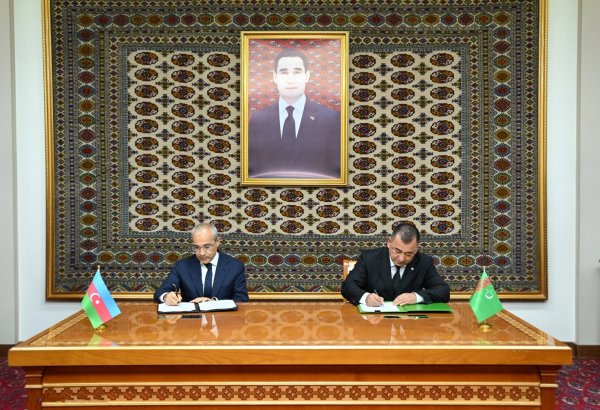
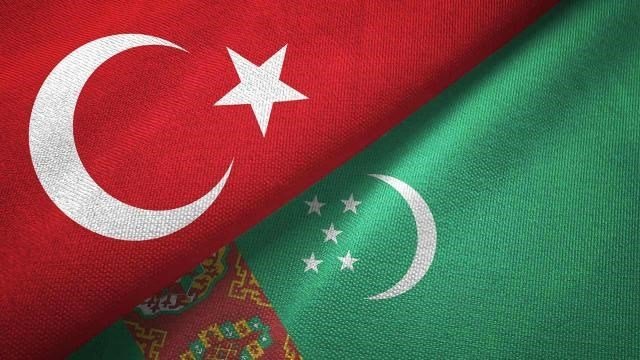
BAKU, Azerbaijan, June 5. On June 3, the 9th meeting of the Intergovernmental Turkmen-Turkish Commission on Economic Cooperation was held in Ashgabat, chaired by Deputy Chairman of the Cabinet of Ministers of Turkmenistan Nokerguly Atagulyyev and Vice President of Türkiye Cevdet Yılmaz. Following the talks, on June 4, the sides signed an Action Plan comprising 71 points aimed at further developing bilateral cooperation. The document covers a wide range of areas, from trade and investment to energy, transport, industry, and business community engagement. The very holding of the commission reflected the high intensity of Turkmen-Turkish dialogue, which in recent years has been accompanied by expanding economic ties and growing interest of Turkish businesses in the Turkmen market.
One of the key signals during the visit of the Turkish delegation to Ashgabat was Vice President Cevdet Yılmaz’s confirmation of the intention to increase bilateral trade to $5 billion. Speaking to representatives of Turkish business circles, Yılmaz recalled that the current trade volume between the two countries is around $2.2 billion, while the target set by the leadership of both states is more than twice that level. According to him, Ankara aims to reach this benchmark as quickly as possible and further expand economic cooperation.
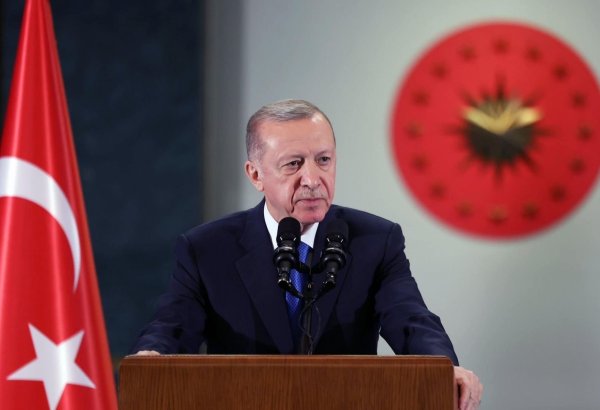
Importantly, this is not a new initiative, but a consistently reiterated policy line of the Turkish leadership. In December 2025, Turkish President Recep Tayyip Erdoğan also stated the intention to raise bilateral trade to $5 billion. Thus, within less than six months, this target was reaffirmed at the highest political level, underscoring its strategic nature for Ankara.
Ankara’s confidence in the prospects of further trade growth is largely based on the already established presence of Turkish businesses in Turkmenistan. According to Yılmaz, Turkish contractors have implemented around 1,100 projects in the country over the years, with a total value exceeding $56 billion. This effectively makes Turkmenistan one of the largest platforms for Turkish business activity in Central Asia, where accumulated experience now provides a foundation for further expansion of trade, investment, and industrial cooperation.
One of the most prominent Turkish companies operating in the country is Polimeks, which over the past two decades has been involved in a number of major infrastructure projects in Turkmenistan. These include Ashgabat International Airport, construction of which began in 2013, as well as the Ashgabat Olympic Complex built for the 5th Asian Indoor and Martial Arts Games in 2017. The complex, covering an area of around 750,000 square meters, includes a 45,000-seat stadium, a velodrome, a tennis center, indoor arenas, hotels, and supporting infrastructure.
Another important player is Rönesans Holding, which has built and commissioned a number of healthcare facilities, administrative buildings, and industrial enterprises in Turkmenistan. Another major Turkish investor, Çalık Holding, is active in the energy, textile, and telecommunications sectors. Its structures have participated in the construction of power plants and the development of textile production capacities, which today represent one of the most export-oriented sectors of the Turkmen economy.
Among other major contractors operating in the Turkmen market are Gap İnşaat, Nata Holding, and several other Turkish companies engaged in the construction of highways, residential complexes, industrial facilities, hotels, and social infrastructure. According to Turkish official estimates, the accumulated value of completed contracts already exceeds the levels of most other Central Asian countries where Turkish business is present.
Turkish business interest in Turkmenistan is also driven by expectations of further economic growth. A key factor in this regard is the launch of the fourth phase of development of Turkmenistan’s largest gas field, Galkynysh. In April, Turkmenistan and China’s CNPC signed an agreement to develop new facilities under this phase, which envisages additional production capacity of 10 billion cubic meters of gas per year. The project is estimated at $5.1 billion.
For foreign companies, the key factor is not only the gas project itself, but its multiplier effect on the economy. Such large-scale energy investments generate new demand for construction services, transport and energy infrastructure, increase public spending, and sustain high levels of economic activity over several years. These conditions traditionally create demand for international contractors, engineering firms, equipment suppliers, and investors.
The European Bank for Reconstruction and Development (EBRD) takes a similar view. In its Regional Economic Prospects report published on June 3, the EBRD noted that Turkmenistan’s economy grew by 6.3% in the first quarter of 2026, while the oil and gas sector exceeded planned production and processing targets. The report also highlights that the launch of the fourth phase of the Galkynysh field will provide additional support to economic activity in the medium term. The Bank forecasts GDP growth of 6.3% in both 2026 and 2027, with potential upside driven by increased investment activity and expansion of Galkynysh.
As a result, Turkmenistan remains a market where large-scale state infrastructure and industrial projects continue to generate sustained demand for contracting work. For Turkish companies, which already have significant experience in the country and tens of billions of dollars in completed contracts, this creates conditions for further expansion of their presence. In practical terms, this is a market where expected growth in the gas sector can support investment activity through a full cycle of new projects in construction, industry, energy, and related sectors.
Assessments of the Turkmen market’s prospects are no longer limited to Türkiye alone. Over the past year and a half, Turkmenistan has significantly expanded its engagement with business communities from several major economies. This does not concern a single country or region, but rather multiple global economic centers.
One of the most notable developments was the Turkmen-Chinese business forum and exhibition held in Ashgabat in April 2026. The event brought together representatives of more than 200 Chinese companies and included negotiations across energy, agriculture, construction, transport, telecommunications, and industrial sectors.
In March 2026, the first Turkmenistan-EU Business Forum was held in Ashgabat, organized jointly by the government of Turkmenistan, the European Union, and the International Trade Centre (ITC), focusing on transport, logistics, energy, and investment.
A similar dynamic is observed in relations with the United States. In late 2025, the Turkmen-American Business Forum was held, and in 2026 the Turkmen-American Business Cooperation Association (TABCA) expanded its programs aimed at developing ties between U.S. companies and Turkmenistan’s private sector.
The British dimension deserves separate attention. In 2026, cooperation went beyond traditional energy contacts. In May, London hosted the largest UK–Turkmenistan Trade Mission to date, involving 28 Turkmen companies and more than 40 British organizations. The sides signed 10 agreements and memoranda in energy, construction, logistics, financial services, education, and trade.
Shortly before that, a Turkmen delegation held talks with the London Stock Exchange Group in London. Discussions focused on financial cooperation, engagement with international investors, and expanding access to capital for Turkmen projects.
Taken together, these processes form a relatively clear trajectory for Turkmen-Turkish economic relations in the medium term. On the one hand, Ankara consistently maintains its political target of increasing trade turnover to $5 billion. On the other hand, Turkish businesses already possess one of the largest portfolios of completed projects in Turkmenistan among foreign investors, creating a solid practical base for further expansion.
Against this backdrop, Turkmenistan is entering a phase in which key growth drivers are forming a more stable and predictable investment demand. This, in turn, increases the importance of external economic partnerships and enhances the role of major contractors and investors.
Looking ahead to 2026-2027, the period is likely to mark a phase of more intensive economic engagement between Turkmenistan and its key external partners, including Türkiye, accompanied by expanded exchange of expertise, technologies, and investment practices. For Ankara, this represents not only an opportunity to increase trade turnover but also to consolidate its strategic position in the country’s economy amid growing international competition for participation in key projects.
With the launch of gas production under the fourth phase of the Galkynysh field expected by the end of 2026, Turkmenistan is entering a period of intensified energy and infrastructure activity that will directly shape the structure of its external economic relations. In this context, economic engagement with key partners will gradually shift into a more intensive phase, characterized by growing investment and contracting activity, as well as expanded exchange of technologies and management practices.
For Türkiye, this creates a window of opportunity in which its already extensive presence in Turkmenistan can be translated into stronger strategic positions in new projects of the next investment cycle. In this logic, the stated goal of reaching $5 billion in trade turnover serves as a step toward consolidating an already established economic footprint under conditions of accelerating investment dynamics in Turkmenistan.