



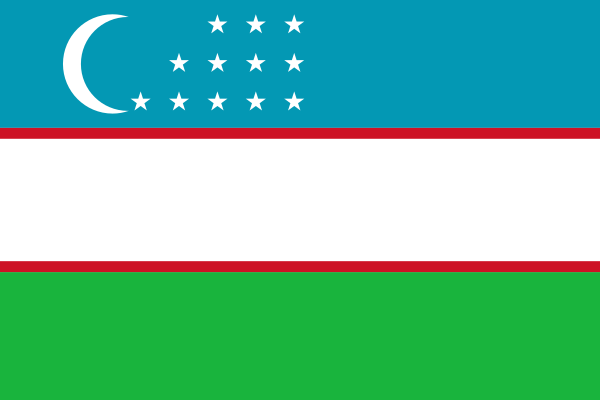
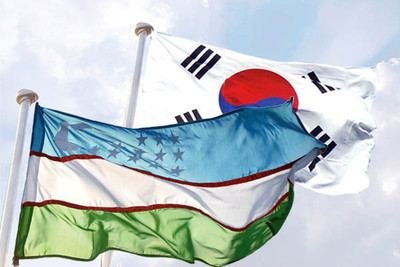
BAKU, Azerbaijan, September 15. Uzbekistan and South Korea are preparing to further deepen their economic partnership as President Shavkat Mirziyoyev undertakes a state visit to Seoul and participates in the first Central Asia–South Korea summit, with technology, investment, and industrial cooperation high on the agenda.
Mirziyoyev’s September 13–16 visit comes at a time when relations between Tashkent and Seoul are expanding beyond traditional areas of economic cooperation. The two sides are placing increasing emphasis on technology-intensive industries, joint production, and new areas of industrial cooperation, reflecting Uzbekistan’s broader efforts to modernize its economy and attract higher-value investment.
For Mirziyoyev, South Korea’s role in this process extends beyond the provision of capital. Tashkent is seeking to leverage the partnership to gain access to advanced technologies, enhance domestic production capabilities, and connect Uzbek companies with regional and global supply chains.
From investment to industrial partnership
Economic ties have expanded considerably during Mirziyoyev's presidency. Korean investment in Uzbekistan has exceeded $8 billion, while the countries' cooperation with the Korea International Cooperation Agency (KOICA), the Export-Import Bank of Korea and related funds has generated a project portfolio of more than $3.5 billion. Uzbekistan has also developed hundreds of joint ventures with Korean participation.
Yet the direction of the relationship is changing. In previous stages, the central objective was to attract Korean companies, investment and equipment to Uzbekistan. The emerging model places greater emphasis on technology-intensive production and the creation of domestic value chains.
This was made explicit during Mirziyoyev's September 2025 meeting with Lee. The two presidents agreed to prepare a long-term Program of Technological and Industrial Partnership covering areas including critical-mineral processing, chemicals, mechanical engineering, agriculture, transport, aviation and biotechnology.
That agenda reflects a broader priority of Mirziyoyev's economic policy: moving Uzbekistan from a market that primarily attracts investment into one that can use foreign investment to build productive and technological capacity.
"We can open a new page in the partnership – move from successful cooperation in individual sectors to the formation of common production systems, technological platforms and new markets," Mirziyoyev said.
The wording is significant. It suggests that Tashkent's objective is no longer simply to increase the number of Korean-funded projects. It is to deepen their economic impact by connecting investment with local production, technology transfer and access to new markets.
Korea as a partner in Uzbekistan's technological transition
The sectors now being prioritized demonstrate the direction of this strategy. Uzbekistan and South Korea have identified cooperation in artificial intelligence, semiconductors, robotics, electric transport, biotechnology, smart agriculture and smart cities as areas with significant potential. Earlier bilateral agreements also identified critical minerals, semiconductor production, green hydrogen and ammonia, mechanical engineering, digital agriculture, infrastructure modernization and energy efficiency as strategic areas. These sectors are qualitatively different from traditional investment in infrastructure or resource extraction.
For Uzbekistan, they offer the possibility of increasing the share of higher-value activities in its economy. For South Korea, meanwhile, Uzbekistan offers a growing market, a large labor force, access to Central Asian resources and a potential production base closer to regional markets. The interests are therefore increasingly complementary.
Uzbekistan wants to process more of its own resources and develop domestic technological capabilities. South Korea is looking to diversify supply chains and secure reliable access to critical raw materials and new markets. A deeper industrial partnership can potentially address both objectives.
Critical minerals are a key example of this shift. Instead of focusing on the export of unprocessed resources, Uzbekistan is seeking Korean expertise and investment to develop domestic processing and move into higher-value production. This is consistent with Mirziyoyev’s broader industrial policy of raising the share of value generated within the country. A similar approach is emerging in areas such as semiconductors, electric vehicles and biotechnology, where Tashkent aims to move beyond technology imports toward developing production capabilities at home.
The Korean development model also matters
There is another reason South Korea occupies a special place in Mirziyoyev's foreign economic strategy. Seoul offers Uzbekistan more than corporate investment. It provides a model of rapid industrialization, export-oriented growth, technological upgrading and human-capital development that is particularly relevant to a country seeking to transform its own economic structure. This helps explain the breadth of the bilateral relationship.
Four branches of leading Korean universities operate in Uzbekistan, while vocational education centers have also been established. Cooperation with Korean institutions therefore extends into education and workforce development — areas that become increasingly important as Uzbekistan moves toward more technology-intensive industries.
Human capital is another important element of this strategy. As Uzbekistan seeks to expand into more technology-intensive industries, cooperation with South Korea extends beyond investment and industrial projects to education, vocational training and the development of technical expertise. This gives the partnership a longer-term dimension, as Uzbekistan seeks to build the skills needed to support the technologies and industries it hopes to attract.
Taken together, these priorities show that Mirziyoyev is pursuing a broader form of economic cooperation with South Korea — one that combines investment with technology, industrial capacity and human capital. The goal is not simply to bring Korean businesses into Uzbekistan, but to increase the country's ability to participate in more sophisticated stages of production and create greater value domestically.
A regional strategy, not only a bilateral one
The emerging relationship also needs to be viewed through Mirziyoyev's regional policy. The first Central Asia–South Korea summit in Seoul on September 16-17 represents an important institutional development. Unlike the earlier ministerial format, the new mechanism brings together the leaders of South Korea and the five Central Asian states. The agenda is expected to cover investment, trade, energy, critical minerals and supply chains.
For Uzbekistan, this creates an additional opportunity. Mirziyoyev has increasingly sought to position Uzbekistan as a regional economic and transport hub. Deeper cooperation between South Korea and Central Asia could reinforce that objective by connecting Korean companies and financial institutions with a broader regional market.
Uzbekistan's large domestic market and its growing role in regional transport and infrastructure networks make it an important partner for South Korea's broader engagement with Central Asia. The emerging Korea - Central Asia framework can therefore complement Tashkent's bilateral strategy by creating opportunities to connect Uzbekistan with wider Korean supply chains and investment networks across the region. South Korea is also considering a C5+Korea industry ministers' mechanism to expand cooperation with all five Central Asian countries, including in areas such as AI-driven manufacturing, trade and investment.
For Mirziyoyev, the regional format provides a way to link his growing partnership with Seoul to his broader efforts to strengthen economic cooperation across Central Asia. While bilateral ties remain focused on specific investment and technology projects, the regional framework could give Uzbekistan an additional platform to attract Korean companies, integrate into regional production networks and strengthen its position as an economic hub in Central Asia.
What comes next
The depth of existing cooperation gives Tashkent a strong foundation, with the partnership’s future impact increasingly tied to its contribution to Uzbekistan’s domestic economic and technological capabilities. The growth in investment, and the number of joint projects demonstrate the attractiveness of the Uzbek market; the more consequential question is whether these projects generate technology transfer, skilled employment, local suppliers and products that can compete beyond the domestic market.
This is where Mirziyoyev's push for "common production systems, technological platforms and new markets" becomes particularly important. A deeper Korean presence in research, advanced manufacturing and technology-intensive industries could help Uzbekistan capture a larger share of value within regional and global supply chains. At the same time, the strategy carries a clear challenge: attracting capital alone does not guarantee technological upgrading. The extent of local participation and knowledge transfer will determine how much of the value created through Korean investment remains in Uzbekistan.
The emerging Korea–Central Asia framework adds another dimension to this strategy. By combining bilateral investment ties with regional mechanisms, Tashkent can seek to position Uzbekistan not only as a destination for Korean companies, but also as a platform through which they can access wider Central Asian markets. This could strengthen the economic rationale for Korean investment in Uzbekistan while supporting Mirziyoyev's broader ambition to make the country more deeply integrated into regional trade and production networks.
The September summit therefore offers an early indication of whether this approach is gaining institutional momentum. If the new initiatives translate into concrete industrial projects, technology partnerships, and regional supply chains, South Korea's role in Uzbekistan's economy could evolve significantly — from a major source of investment and development financing into a long-term partner in the country's industrial and technological transformation.