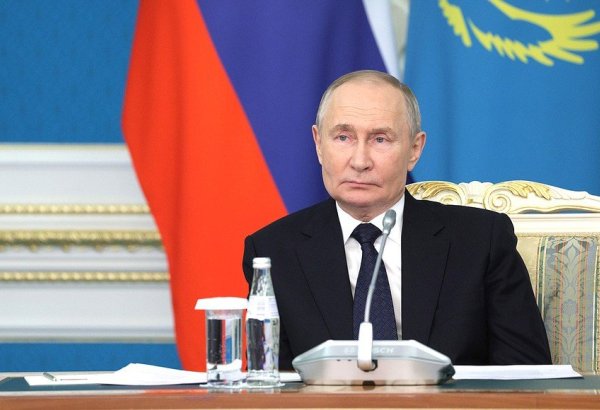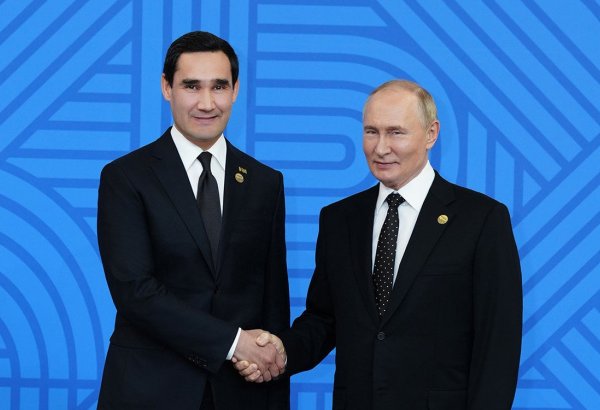


BAKU, Azerbaijan, November 17. Russia and Central Asian countries have discussed the implementation of the Joint Action Plan for 2025-2027, focusing on political, trade, economic, transport, and humanitarian cooperation, the Russian Foreign Ministry reported.
According to the report, the discussions took place during a video conference held on November 16 between Russian Deputy Foreign Minister Mikhail Galuzin and senior representatives of the foreign ministries of Kazakhstan, Uzbekistan, Turkmenistan, Kyrgyzstan and Tajikistan.
The participants reviewed progress in implementing the Joint Action Plan adopted following the second Central Asia-Russia summit, held in Dushanbe on October 9, 2025. They also discussed prospects for further cooperation and the schedule of upcoming events in the Central Asia-Russia format, the ministry said.
Separately, Tajikistan's Ministry of Foreign Affairs noted in its press release that the talks addressed prospects for cooperation in the political, trade and economic, transport, and humanitarian spheres.
The Joint Action Plan for 2025-2027 was adopted at the second Central Asia-Russia Summit, with the participation of the presidents of Russia, Kazakhstan, Uzbekistan, Turkmenistan, Kyrgyzstan and Tajikistan. The document was approved alongside the summit's final communiqué and is intended to translate the leaders' political agreements into practical cooperation among the six countries.
The plan covers a broad range of areas, including trade and investment, industrial cooperation, transport and logistics, energy, healthcare, environmental protection, regional security, migration, education, culture and tourism. Particular emphasis is placed on removing trade barriers, attracting mutual investment, developing production and supply chains, increasing the use of national currencies in mutual settlements, and strengthening transport corridors across Eurasia. The countries also intend to deepen cooperation in digital technologies, artificial intelligence and renewable energy.
Transport connectivity is one of the plan's key economic priorities. The summit participants agreed to continue developing international transport corridors across Eurasia, with particular attention to increasing the capacity of the North-South International Transport Corridor. They also highlighted the importance of improving logistics infrastructure, facilitating cross-border trade and expanding interregional economic ties.
Implementation of the plan is coordinated through the foreign ministries of the six participating countries, with sector-specific cooperation involving relevant government agencies. Progress is reviewed through regular ministerial meetings, while the results of the plan's implementation are expected to be presented at the third Central Asia-Russia Summit in 2027.
The wider regional context also includes Turkmenistan's 2026 chairmanship of the Commonwealth of Independent States (CIS), during which the country has prioritized the development of international transport corridors and stronger connectivity among CIS countries.
The chairmanship concept identifies the development of the North-South and East-West transport corridors, expansion of trade and investment, and stronger economic links between member states as key areas of cooperation. It also envisages improvements to transport infrastructure, logistics and regional connectivity.
Several CIS-level meetings held in Turkmenistan during the year have provided a platform for advancing this agenda. At the May 2026 meeting of the CIS Council of Heads of Government in Ashgabat, Turkmenistan emphasized the integration of the Turkmenbashi International Seaport with railway routes in Central Asia and the Caspian region, as well as the development of multimodal transport links. The discussions also addressed expanding mutual trade, investment and business activity among CIS countries.
Transport cooperation was also a key topic at the 111th meeting of the CIS Economic Council, held in Ashgabat in September. Participants discussed the 2026-2030 Action Plan for implementing the CIS Strategy for Ensuring Transport Security in International Transport Operations and confirmed their readiness to make greater use of the North-South International Transport Corridor.
Turkmenistan also proposed declaring 2029 the Year of CIS Transport Connectivity. The initiative was subsequently approved at the October meeting of the CIS Council of Heads of State in Awaza.
Practical progress in digital transport connectivity has also been recorded along the Middle Corridor. In July 2026, the first eTIR operations across the Caspian Sea included a route linking Azerbaijan, Turkmenistan and Uzbekistan through a single digital transit procedure. The development marked an important step toward reducing paperwork and facilitating cross-border freight movements along the route.
In an exclusive interview with Trend, International Road Transport Union (IRU) TIR and Transit System Director Tatiana Rey-Bellet said the ambition for 2026 was to extend eTIR operations to Kazakhstan, Georgia and Türkiye. She also noted that Southeast Asian countries were already considering the TIR system to establish intermodal connections with Europe via the Middle Corridor as an alternative to purely maritime routes.
The growing interest in the Middle Corridor is also reflected in the assessment of the International Transport Forum (ITF). In a separate interview with Trend, the organization noted that the route would retain its strategic value as a diversified Asia-Europe connection, even if changing geopolitical conditions made alternative routes through Iran more attractive for certain cargo flows.