






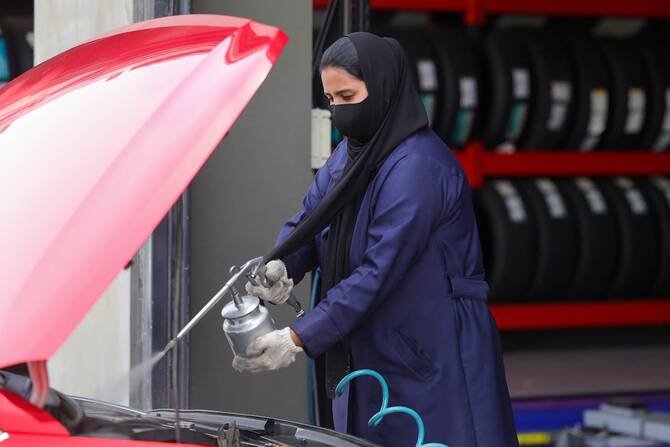
Saudi women are driving one of the most striking transformations in the Kingdom’s modern history, with female labor force participation surging from around 23 percent in 2016 to over 34 percent today, and women now owning nearly 45 percent of small and medium-sized enterprises, experts told Arab News TurkicWorld reports via arabnews.
This quiet revolution — powered by landmark legal reforms, ambitious government initiatives such as Monsha’at, and shifting societal expectations — is expanding economic participation and transforming the SME landscape, bringing fresh innovation, customer-centric models, and agility to sectors critical to the Kingdom’s economic diversification agenda.
Speaking to Arab News, Basma Bushnak, education and skills partner and Middle East inclusivity and diversity leader at PwC Middle East, said that one of the defining features of Saudi Arabia’s female transformation under Vision 2030 is the parallel progress of social reform, economic diversification, and private sector growth — advancing together rather than in isolation.
“Regulatory reforms were critical in creating the enabling environment for women. Changes linked to mobility, workforce participation, and access to economic opportunities removed structural barriers that had historically limited participation,” said Bushnak.
She added: “This helped accelerate women’s entry into sectors that are central to the Kingdom’s diversification agenda, including technology, entrepreneurship, financial services, tourism, and the broader SME ecosystem.”
Sally Menassa, partner at Arthur D. Little, echoed similar insights and said that multiple factors, including regulatory reforms, national initiatives and stronger institutional support, have played a crucial role in accelerating female entrepreneurship and workforce inclusion.
“What makes Saudi Arabia particularly interesting is how quickly social acceptance evolved alongside policy reform, allowing these initiatives to translate into real economic participation,” said Menassa.
Hadjer Chakal, account manager, sales for western Arabia at Axis Communications, said that the rise in female participation in the Kingdom’s workforce happened because several factors came together at the right time.
“Beyond policies and programs, I think the biggest shift has been cultural. Today, there is much stronger recognition of the value women bring to business, innovation, and economic growth. Women are now more visible in business discussions, customer engagement, project management, and leadership roles, especially in sectors linked to digital transformation and smart technologies,” said Chakal.
Anil Singh, chief business officer, Saudi Arabia at TASC Outsourcing, said government entities such as Monsha’at, HRDF, and various startup support programs made entrepreneurship more accessible for women through funding, training, and incubation initiatives.
According to Singh, these structural changes gave women the tools and confidence to enter sectors that were previously difficult to access.
“Saudi women today are more digitally connected, highly educated, and increasingly ambitious about building independent careers and businesses. Families, employers, and investors are also becoming more supportive of women in leadership and entrepreneurial roles, creating an ecosystem in which female participation is a key driver of economic growth,” he said.
Key sectors of impact
Women’s presence has expanded significantly across technology, tourism, and logistics, as well as financial services, manufacturing, healthcare, and startups.
Their growing role in leadership positions — in corporations, government entities, family businesses, and new companies — stands out as a major development.
Bushnak said entrepreneurship and self-employment have become attractive career paths, especially for younger women seeking flexibility and innovation, with women-led SMEs being notably agile, digitally native, and customer-focused.
“One of the clearest developments has been the growing presence of women in leadership and decision-making positions across corporate, government entities, family businesses, and emerging companies,” said the PwC Middle East official.
She added: “Women are increasingly contributing to how businesses are built, led, and expanded across the Kingdom, particularly in sectors shaping Saudi Arabia’s next phase of economic growth.”
Menassa said that many female founders in Saudi Arabia are building brands around identity, community, and purpose, with a stronger focus on experience-driven models and digital engagement.
Instagram commerce and influencer partnerships have become especially prominent in sectors like beauty, fashion, and wellness.
“Sustainability is also increasingly integrated into the value proposition rather than treated as an afterthought, particularly through local sourcing, ethical production, and community-centered brands,” said Menassa.
Singh said that female entrepreneurship was often limited to smaller or home-based ventures years ago, whereas today, Saudi women are building scalable companies, attracting investment, and participating confidently in major economic conversations.
He further added that the growth of digital commerce and flexible employment models has further accelerated this significant transformation in the Kingdom.
“Ssectors such as education, healthcare, and wellness naturally align with broader societal priorities around quality of life and human capital development under Vision 2030, creating strong opportunities for women to lead and innovate,” added Singh.
Reshaping SME ecosystem
According to Bushnak, the growth of women-led businesses is contributing to greater diversity of thought within the SME ecosystem, which naturally drives innovation and creativity.
She added that many women entrepreneurs are building businesses that are highly customer-focused, digitally enabled, and adaptable, in addition with strong emphasis on user experience, community engagement, personalization, and social impact alongside commercial growth.
“Women-led companies are introducing new products, services, and customer segments, contributing to a more dynamic and competitive business environment overall,” said Bushnak.
She added: “Looking ahead, broader participation in entrepreneurship will continue contributing to a healthier SME market, particularly as the Kingdom builds a more diversified and sustainable economy under Vision 2030.”
Sharing identical views, Chakal said that woman entrepreneurs in the Kingdom are making the SME ecosystem more dynamic, diverse and competitive.
“Female entrepreneurs are also inspiring the next generation. When young women see successful Saudi business leaders in technology, entrepreneurship, or innovation, it changes what they believe is possible for their own future,” said Chakal.
Contributing to the national economy
According to Menassa, the economic impact of women’s employment and entrepreneurship is clear: expansion of the labor force, boosted household income, and creation of new areas of economic activity.
“Saudi women help build a more diversified, hence resilient economy, with a new perspective, which is an undisputed contributor to the economic transformation agenda of Vision 2030,” said the Arthur D. Little official.
Singh echoed similar insights and said that women’s participation will increase productivity, boost household income, and contribute to the growth of non-oil sectors such as technology, retail, tourism, and professional services.
According to Singh, this transformation is contributing to a more sustainable and future-ready economy that will strengthen human capital development, reduce unemployment, and encourage a more balanced and inclusive labor market.
“In the long term, the success of Saudi women will play a major role in shaping a more competitive, knowledge-based economy less dependent on traditional industries,” he added.
Potential challenges
Even as women’s entrepreneurship in Saudi Arabia continues to rise, experts outlined some potential challenges faced by females as they enter the business landscape.
According to Bushnak, access to growth-stage funding remains an important consideration for many women-led businesses, particularly when companies move from the startup phase into expansion.
“Scaling businesses beyond the early stages is another area many entrepreneurs are working through. Operational growth, international expansion, talent acquisition, and digital capability all become increasingly important as businesses mature,” said Bushnak.
She added that work-life balance and caregiving responsibilities can also remain practical considerations, particularly for entrepreneurs managing growing businesses and teams.