BAKU,TurkicWorld: Abdulhamid Hamid Al-Kba / Writer and researcher specializing in Central Asia and Azerbaijan affairs
In light of the geopolitical and economic transformations of 2026, the relations between the State of Kuwait and the Republic of Uzbekistan represent a successful model of cooperation between two regions that differ geographically and economically: the Arab Gulf and Central Asia.
This partnership is not a coincidence, but its roots go back to deep civilizational and religious ties since the Golden Islamic Ages, when the cities of Transoxiana such as Samarkand, Bukhara, and Khwarezm were scientific and commercial centers that attracted traders and scholars from all parts of the Islamic world, including the Gulf region. Shared cultural, historical, and religious values, along with customs and traditions, also play a motivating role that accelerates the pace of cooperation between the two countries.
With Uzbekistan’s independence in 1991, Kuwait was among the first Arab countries to officially recognize it on December 30, 1991. Diplomatic relations were established on July 8, 1994. The Kuwaiti Embassy in Tashkent was opened in 2001, and the Uzbek Embassy in Kuwait in November 2004, paving the way for continuous communication and increasing bilateral cooperation.Active official cooperation began with the visit of the late Uzbek President Islam Karimov to Kuwait in January 2004, where he was warmly received by the late Amir His Highness Sheikh Sabah Al-Ahmad Al-Jaber Al-Sabah, and several strategic agreements were signed, including the encouragement and protection of investments and the avoidance of double taxation.
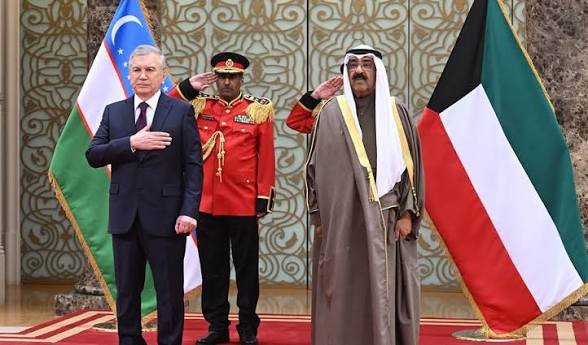
In response, His Highness Sheikh Sabah made a historic visit to Tashkent in July 2008, which resulted in the signing of eight agreements in various fields, opening the door for Kuwaiti investments in the heart of Central Asia.With the assumption of power by President Shavkat Mirziyoyev, the relations gained greater momentum. In April 2024, the relations were elevated to the level of strategic partnership with the signing of agreements in Tashkent and the establishment of joint coordination mechanisms.In February 2025, the relations reached their peak during President Mirziyoyev’s official visit to Kuwait, where he was received by His Highness the Amir of the country, Sheikh Meshal Al-Ahmad Al-Jaber Al-Sabah, at Bayan Palace.
The visit resulted in the signing of a package of economic agreements worth up to $4.9 billion, covering the fields of energy, investment, food security, logistical connectivity, tourism, industry, and smart cities, in addition to adopting a joint statement on developing the comprehensive partnership.
This was followed by a phone call on March 4, 2026, between President Mirziyoyev and His Highness the Crown Prince Sheikh Sabah Khaled Al-Hamad Al-Sabah, which discussed developments in the Middle East and the attacks targeting Kuwaiti infrastructure. The Uzbek President expressed his country’s support for Kuwait, thanked the Kuwaiti leadership for taking care of Uzbek citizens residing in Kuwait, while the Crown Prince expressed gratitude for this fraternal solidarity.
The legal framework for cooperation between the two countries includes international governmental agreements on the promotion and protection of mutual investments, cooperation in the fields of culture and arts, commercial, economic, scientific, and technical cooperation, avoidance of double taxation, and cooperation between customs committees.
The chambers of commerce and industry of the two countries also work together on the basis of a memorandum of understanding, and the Diplomatic Academy in Kuwait cooperates with the University of World Economy and Diplomacy in Uzbekistan.Parliamentary relations are strong, as Kuwaiti National Assembly deputies have visited Uzbekistan several times, and friendship groups exist in both parliaments. There is also a joint governmental committee for commercial, economic, scientific, and technical cooperation, and in its recent meetings, the two sides agreed to expand traded goods, sign a preferential trade agreement, enhance e-commerce, remove barriers, and hold mutual exhibitions such as “Made in Uzbekistan” and “Made in Kuwait.”Economically, bilateral trade has witnessed remarkable growth, rising from about $289,000 in 2017 to about $6.8 million in 2024, growing more than fivefold over the past five years.Trade focuses mainly on services, mineral fuels, food products, and chemical products.The Kuwaiti private sector is active in Uzbekistan through seven major companies in modern agriculture and textiles. More than 50 Kuwaiti delegations visited Uzbekistan in 2024, and mutual business forums were held. A meeting of leading businessmen is expected soon to strengthen new contracts.As for the Kuwait Fund for Arab Economic Development, it contributes to financing vital projects in health, education, and infrastructure.
The total accumulated loans and grants to Uzbekistan have exceeded $213 million through more than 10 credit agreements, in addition to technical assistance agreements. Work is currently underway to finance projects such as the development of pre-school education on the basis of public-private partnership.Analytically, the strength of this partnership lies in the promising functional integration: Uzbekistan provides strategic depth in food security, qualified human resources, and a distinguished location on the routes of the Middle Corridor, while Kuwait provides financing, technical expertise, and direct access to Gulf markets.
Although the volume of trade exchange is still in the growth phase, the great untapped potential opens wide horizons, calling for accelerating the implementation of logistical, digital, agricultural, and industrial projects to achieve sustainable and more inclusive growth.In my opinion, this relationship represents a golden opportunity for both countries amid regional tensions. Kuwait finds in Uzbekistan a reliable partner that enhances the diversification of its economy away from oil, while Uzbekistan benefits from Kuwaiti capital and technology to support its economic reforms and improve the investment climate.Political coordination in crises reflects the solidity of mutual trust and opens broader horizons for cooperation in digital, agricultural, logistical, and industrial fields.
The partnership continues to promote a constructive cooperation model that combines political stability and economic opportunities.In 2026, the development of the Middle Corridor and cooperation in modern agriculture, digital transformation, and smart cities represent a promising future direction. The continuation of coordination and the acceleration of the implementation of joint projects will transform this axis into an economic and political safety valve linking the shores of the Gulf and the heart of Central Asia, achieving shared prosperity that transcends geographical borders.