






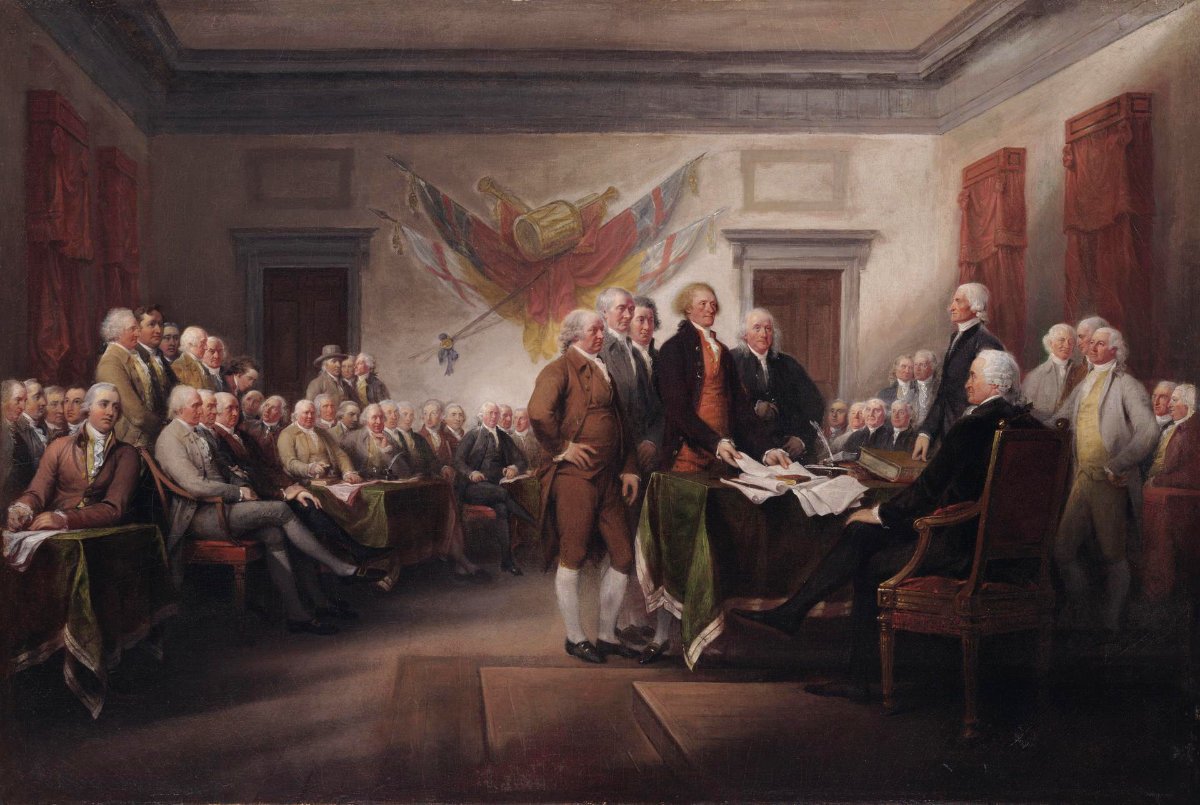
On the occasion of its 250th birthday this July 4, amid the usual fireworks, state fairs, battle re-enactments, parades and backyard barbecues that define Independence Day celebrations, America is a country reflecting on its founding ideals in an era of division and reinvention TurkicWorld reports via arabnews.
In a sense, this is history repeating. In 1776, America was forged in a spasm of division and reinvention, when 56 members of the recently convened Continental Congress of Britain’s 13 colonies accused King George III of tyranny, split from the mother country and declared independence.
The colonialists won the war that had begun the previous year and, in the terms of the peace deal signed in Paris on Sept. 2, 1783, Britain formally recognized the birth of a new nation: the United States of America.
If America’s birth pains were severe, its growth was equally agonizing, with its expansion westward carried out at the barrel of a gun and at the expense of the native Americans, referred to in the Declaration of Independence as “the merciless Indian Savages.”
One of the contradictions inherent in the Declaration — and at the core of some of the divisions in American society that continue to this day — was its assertion that “all men are created equal ... endowed by their Creator with certain unalienable Rights.”
Yet many of the men who endorsed that statement were slave owners, a glaring hypocrisy that festered at the heart of the new nation for almost a century until, in 1861, it erupted into a brutal civil war.
The four-year war claimed a quarter of a million American lives — 10 times the toll of the struggle for independence.
And, as attested by the rise of the civil rights movements in the 1950s and 60s, and the more recent Black Lives Matter protests, it left a deep wound that has never quite healed.
This historic anniversary arrives at a moment of profound transition for an America divided by culture wars, personality politics and fierce debates about justice, immigration and freedom of speech, to say nothing of an unprecedented upending of political, social and judicial norms.
Without doubt, change can be discomfiting.
And yet, as President John F. Kennedy liked to remind Americans during an earlier period of great national transformation, “time and the world do not stand still. Change is the law of life. And those who look only to the past or the present are certain to miss the future.”
Today, America is not alone among countries in having to confront the realities of mass immigration, one of the thorniest issues of our time. Critics of the activities of Immigration and Customs Enforcement (ICE) point to the fact that America is a nation built by immigrants.
They also invoke the tradition of generous tolerance represented by the Statue of Liberty, which welcomed generations of shipborne immigrants to America with the words engraved on its pedestal: “Give me your tired, your poor, your huddled masses yearning to breathe free.”
But this, of course, ignores the reality that neither the original settlers nor the millions of “huddled masses” came to America illegally.
It also takes no account of the fact that since 2023 America has deported more than 2 million illegal immigrants — a strain on resources on a scale faced by few other countries.
On the world stage, America’s anniversary finds the country seemingly reconsidering its global role as it contemplates its semiquincentennial.
There can be no doubt that the America that emerged 250 years ago from the chrysalis of independence has, at many times throughout its history, fulfilled the vision of John Winthrop, the 17th-century founder of the Massachusetts Bay Company, that it should be “as a city upon a hill,” with “the eyes of all people ... upon us.”
Certainly, the eyes of the world were on America when it fulfilled President Kennedy’s vision that it would win the space race and land a man on the moon, as they were at the key times in history when it stepped up to the plate when the world needed it most.
It was America that ended the expansionist ambitions of Nazi Germany and Imperial Japan in the Second World War, acted as the great Cold War bulwark against the rise of Communism and came to the aid of the Middle East when the peace and stability of the region was threatened by Saddam Hussein.
Undeniably, some American interventions have also ended very badly — the 20-year conflict in Afghanistan concluded with the return to power of the Taliban in 2021 and the 2003 invasion and subsequent eight-year Iraq War removed Saddam Hussein but triggered a civil war that claimed more than 280,000 lives and boosted Iranian influence.It is still too early to pass final judgement on the latest American conflict, the war in Iran.
Regardless, America’s allies, especially those in the Gulf, know that their friendship with the US can be neither defined nor fundamentally altered by the passing program of any single administration.
After all, no fewer than 15 presidents have passed through the White House since King Abdulaziz, the founder of Saudi Arabia, met Franklin D. Roosevelt aboard a US warship on Egypt’s Great Bitter Lake on Feb. 14, 1945, and forged a friendship that has endured for the past eight decades.Today, the Declaration of Independence is displayed in the imposing neoclassical National Archives building in Washington DC, alongside the US Constitution and the Bill of Rights. The ink on the document has faded significantly over the past two and a half centuries, but although the words may now be almost invisible, the conversations they began are not.
For 250 years, America has wrestled with the meaning of liberty, equality and justice, rarely living up to its own ideals completely, yet never entirely abandoning them, either.
And, as the US embarks on its next 250 years, history will judge not what was written in Philadelphia in 1776, but what each generation of Americans has chosen to make of it.