






BAKU, Azerbaijan, September 16.
Abdulhamid Hamid Al-Kba
Opinion writer specializing in Central Asia and Azerbaijan affairs
When the figures speak of an expansion in digital payment tools, they do not tell a purely technical story. They reveal a gradual shift in consumer behaviour and in the relationship between citizens and the banking system. Between January and July 2026, Turkmenistan recorded a notable rise of 47.5 percent in the volume of non-cash e-commerce transactions, reaching 2.2 billion manat (approximately 624.5 million dollars), compared with 1.5 billion manat (around 423.3 million dollars) in the same period of the previous year, according to calculations based on official data released by the Central Bank.
This increase represents a tangible development in the country’s financial digitalisation path. Electronic transactions are no longer a limited secondary option; they have become a channel of growing importance in daily economic activity. The detailed figures highlight a clear disparity among the participating banks. The State Commercial Bank of Turkmenistan recorded exceptional growth of 458.6 percent, followed by Turkmenbashi Joint-Stock Exchange with 159.6 percent and Dayhanbank with 90.2 percent. Halkbank and the State Bank for Foreign Economic Affairs posted similar increases of 45.9 percent and 45.8 percent respectively. More moderate rises were registered by Senagat and Rysgal at 35 percent and 29.7 percent, while the Turkmen-Turkish bank was the only institution to record a decline, of 36.7 percent.
The figures also reveal significant differences in the pace of digital growth among participating banks, with some institutions recording much stronger increases than others. Nevertheless, the overall trend points to a genuine expansion in the use of electronic channels and confirms that the efforts of recent years are beginning to yield measurable results.
The origins of this process date back to 2001, when the Central Bank launched the domestic Altyn Asyr card system as a first step toward building a national infrastructure for non-cash payments. That infrastructure developed gradually in the following years and gained stronger momentum in the mid-2010s with a broader government drive to digitalise economic and financial services.
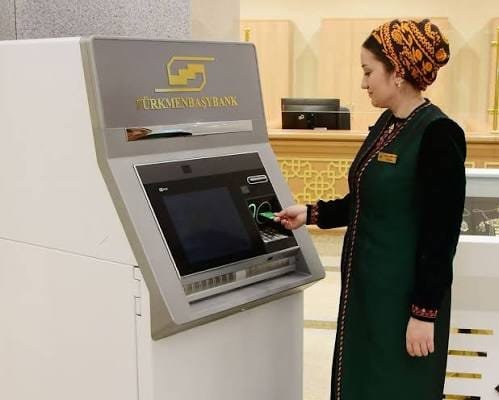
In August 2020 the launch of the Halkbank Terminal application marked a qualitative shift. It allowed merchants to accept contactless payments directly through NFC-enabled smartphones, moving beyond the traditional reliance on point-of-sale terminals.
Turkmen banks have continued to expand their digital services to include internet and mobile banking, e-commerce payment platforms and specialised applications such as Senagat Töleg, while further developing the national Altyn Asyr system. These tools have enabled citizens to pay utility, communication, transport, tax and other public-service bills electronically, thereby simplifying daily transactions and reducing the need for repeated physical visits to make conventional payments.
Analytically, the 47.5 percent rise reflects tangible progress in the adoption of digital tools, supported by sustained government and banking efforts over more than two decades. At the same time, the significant disparity among banks indicates that digitalisation remains in an incomplete transitional phase. Genuine success will depend on additional factors such as the stability of internet services, the spread of smart devices beyond major urban centres, and the strengthening of user confidence in the security and ease of digital transactions.
This expansion can support financial transparency, lower the everyday costs of transactions and open wider prospects for e-commerce as a new economic channel that stimulates the domestic market. It also aligns with broader regional trends toward a more technology-based economy. Yet it remains exposed to technical and logistical challenges, particularly in less-connected areas where citizens may face difficulties in regular access to digital services. The decline recorded by one bank also underscores the need to maintain a balanced competitive environment within the banking sector so that growth does not become concentrated in a limited number of institutions.
Sustaining this trend will require supportive policies focused on expanding digital infrastructure, encouraging more merchants and small businesses to join the electronic-payments ecosystem, and raising public awareness of the advantages of these tools. Current growth, although strong, needs a broader base if it is to evolve from a sectoral phenomenon into a more widespread shift.
In conclusion, the figures for the first seven months of 2026 present a balanced and cautiously encouraging picture. Turkmenistan is taking clear steps toward expanding electronic payments, and digital transformation is gradually taking root in everyday economic life. Longer-term strength, however, will require more than elevated growth rates. It needs continued investment in infrastructure, wider access to digital services across different regions, and the building of broader public confidence in these tools. The figures point to a clear upward trend; the future will depend on the system’s ability to convert this momentum into a more inclusive, stable and durable path