



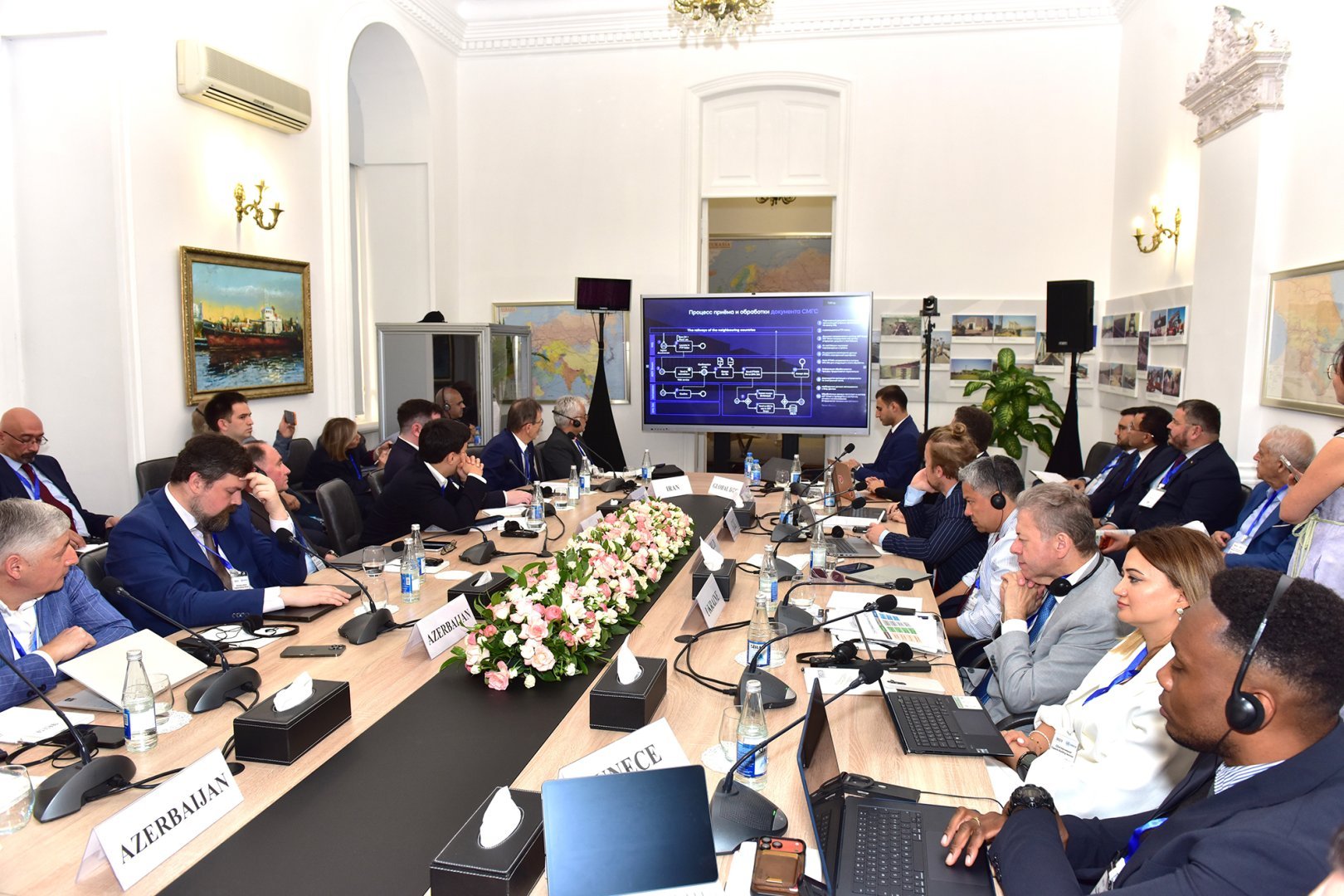
BAKU, Azerbaijan, September 8. The 22nd International Seminar "Advancing the Multimodal Digital Trans-Caspian Corridor: Methodology and Next Steps" was held in a hybrid format at the headquarters of the PS IGC TRACECA in Baku.
This was announced by the Ministry of Digital Development and Transport of Azerbaijan.
The event was organised by the United Nations Economic Commission for Europe (UNECE) jointly with the PS IGC TRACECA and development partners. The seminar brought together heads and leading experts of relevant government agencies from the TRACECA and SPECA regions, representatives of the European Commission, the World Bank, GIZ, ITC, as well as members of the business community.
Welcoming remarks were delivered to the participants by the Secretary General of the PS IGC TRACECA, Jasurbek Choriev, the Ambassador of the European Union to the Republic of Azerbaijan, Marijana Kujundžić, and the Adviser to the Minister of Digital Development and Transport of the Republic of Azerbaijan, Ilham Namazov.
The main item on the Agenda was consideration of the draft Methodology for the Trans-Caspian Digital Corridor, developed on the basis of UN/CEFACT standards, and discussion of best practices in data exchange. Particular attention was paid by the experts to the status of implementation of pilot projects on the digitalisation of rail, maritime, road and air transport.
In his remarks, the Secretary General of the PS IGC TRACECA emphasised that digitalisation has ceased to be a separate technological area and has become a mandatory condition for the competitiveness of international routes. He noted the transition from individual experiments (the eCIM/SMGS pilots and data exchange between Caspian ports) to scaling up – the practical deployment of a fully-fledged multimodal digital corridor. "The key challenges remain the mutual recognition of electronic documents, the synchronisation of administrative procedures, and ensuring the interoperability of digital platforms on the basis of UN/CEFACT standards," he noted.
Speaking at the event, the EU Ambassador, Marijana Kujundžić, highlighted the strategic role of the South Caucasus and Central Asia in ensuring global connectivity (the Connectivity Agenda) and the diversification of sustainable supply chains. She noted the key importance of the EU’s Global Gateway strategy, European experience in deploying the TEN-T network, as well as the EU–Azerbaijan Connectivity Partnership initiative. Particular emphasis was made on the new Connectivity for Peace investment package, worth up to EUR 200 million, with the potential to attract up to EUR 2 billion in investment in the region’s transport, energy and digital sectors.
Following the work carried out within the framework of three thematic sessions and an expert round table, the participants discussed matters related to the digitisation of accompanying documents, regulatory convergence and ensuring cybersecurity in data exchange.