


Future for Advanced Research and Studies (FARAS)
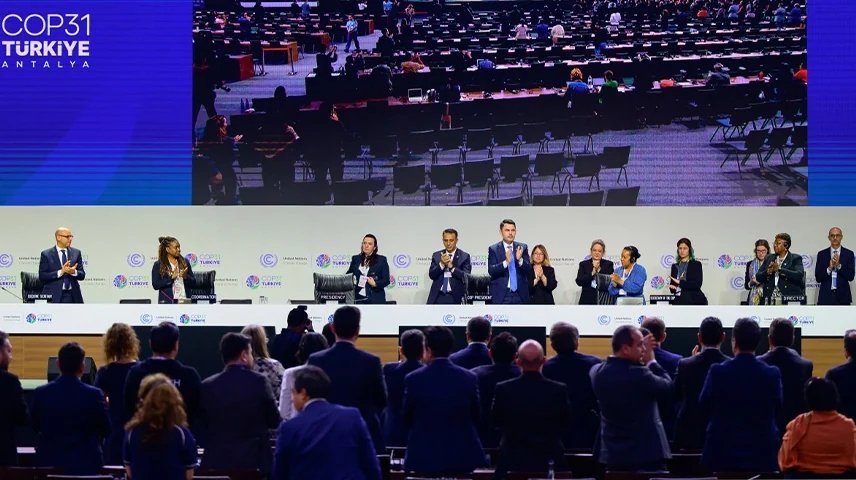
On Sunday, 22 November 2026, the United Nations climate summit in Antalya ended without agreement on its proposed overarching political declaration, after running two days past its scheduled close. Jointly led by Türkiye and Australia, the conference became the longest COP on record. Its final standoff centred on a fundamental question: should the declaration explicitly address fossil fuels? The European Union, the United Kingdom and several climate-vulnerable countries opposed a draft that made no reference to them, while other parties pressed for more flexible language on transitioning away from fossil fuels. Climate finance, particularly the scale and delivery of adaptation support for developing countries, formed another unresolved fault line.[1]
It would be inaccurate, however, to claim that the conference produced nothing. Delegates agreed on a number of separate decisions, and initiatives on electrification and adaptation moved forward. Around 80 countries backed a Turkish initiative to raise electricity's share of final energy consumption to 35% by 2035, although it was not adopted as a universal COP commitment.[2] Still, the absence of an overarching declaration remains politically significant: Antalya left governments without a common signal on how quickly, and by what means, the world should reduce its dependence on coal, oil and gas.
Sharm el-Sheikh: Success Measured in Justice
Egypt's COP27, held in Sharm el-Sheikh in November 2022, offers the first benchmark, albeit one of necessarily partial success. Against a backdrop of geopolitical tension and an international energy crisis, the summit concluded with the Sharm el-Sheikh Implementation Plan and a historic agreement to establish a dedicated Loss and Damage Fund. For decades, developing countries had pressed for recognition that those least responsible for climate change were bearing some of its most devastating consequences. The achievement was as much institutional as financial: the issue secured a place on the formal agenda, and governments agreed to create a fund along with arrangements for its eventual operation.[3]
COP27 also operationalised the Santiago Network for technical assistance on loss and damage and advanced the mitigation work programme. Its final decision recognised that transforming the global economy towards a low-carbon model would require annual investments of at least $4–6 trillion. On emissions reduction, however, Sharm fell well short. India's proposal to extend the phase-down commitment beyond coal to other fossil fuels did not survive into the final text, despite support from the European Union and other countries.
The lesson is instructive. Sharm delivered an important measure of climate justice by creating an institutional mechanism for addressing loss and damage, but it left the harder political confrontation over fossil fuels unresolved. Moreover, establishing the fund was not the same as providing resources commensurate with the losses already being suffered.
Dubai: The UAE Consensus
Held in 2023, COP28 in Dubai provided a stronger benchmark for combining political ambition with practical outcomes. For the first time in nearly three decades of climate negotiations, almost 200 parties agreed to language calling for a transition away from fossil fuels in energy systems, in a just, orderly and equitable manner. The UAE Consensus also set measurable objectives: tripling global renewable-energy capacity and doubling the annual rate of energy-efficiency improvement by 2030.
Equally important, the Loss and Damage Fund established at Sharm was operationalised on the conference's opening day and had attracted approximately $792 million in early pledges by its close.[4]
Like any negotiated outcome, the agreement reflected compromise. Rather than imposing legally binding national phase-out obligations, its language called on governments to contribute to the transition, leaving questions on fossil-fuel subsidies and implementation for future negotiations. Above all, Dubai demonstrated that a presidency from an energy-producing country could broker an agreement explicitly addressing fossil fuels. It placed the issue at the centre of the international climate agenda, attached measurable targets to the energy transition and secured an early financial outcome for vulnerable countries.
It is precisely this precedent that made Antalya's omission of any reference to fossil fuels so consequential. The commitment reached in Dubai remains embedded in the existing international framework; COP31 neither reversed it nor took meaningful steps towards implementing it. The contrast shows that energy-producing countries can play a leading role in advancing climate ambition, provided negotiations rest on a credible political compromise.
Why Dubai Held and Antalya Stalled
A comparison of the three summits reveals four important differences.
1- Drafting strategy: Dubai named the problem and negotiated a compromise around it, whereas Antalya's proposed declaration focused on electrification and carbon-removal technologies but made no reference to fossil fuels. The omission satisfied neither those demanding an explicit transition away from fossil fuels nor those seeking a more balanced settlement.
2- Trust and finance: Sharm and Dubai delivered institutional and financial outcomes for vulnerable countries. Antalya, by contrast, left disagreements over adaptation finance unresolved, and a proposed annual target of $120 billion by 2035 was dropped from the final texts. Without a credible financial commitment, developing countries were less willing to accept compromises elsewhere.[5]
3- Geopolitical context: The 2026 Iran conflict and the resulting disruption to energy markets, including the unprecedented closure of the Strait of Hormuz, heightened energy-security concerns, leading importers and producers to approach the transition with increasingly divergent priorities.[6] At the same time, the immediate energy shock underscored the value of diversified and resilient energy supply.
4- Institutional process: The consensus-based negotiating system effectively gives each of almost 200 parties the ability to withhold agreement. While this approach helped deliver the Paris Agreement, it also allows individual national interests to hold up progress on issues of global importance.
Seen in this light, Antalya's outcome reflected not simply a shortfall in climate ambition but, more fundamentally, a breakdown in sequencing and political bargaining. Issues that earlier presidencies had managed through separate compromises and tangible deliverables became entangled in a single package that no sufficiently broad coalition could accept.
Repercussion One: Emissions Without a Compass
The first consequence is the loss of a coordinating political signal, although its immediate effect on emissions should not be exaggerated. The Global Carbon Budget 2026 projects that fossil-fuel CO₂ emissions will decline by 0.4% in 2026 to approximately 38.2 billion tonnes. Part of this modest decline, however, reflects the temporary oil-market shock associated with the Iran conflict. Once emissions from land-use change are included, total CO₂ emissions are projected to rise to 43.3 billion tonnes, up from 42.8 billion in 2025.[7]
The remaining carbon budget consistent with a 50% probability of limiting warming to 1.5°C stands at approximately 150 billion tonnes, equivalent to less than four years of emissions at current rates. Meanwhile, the Climate Action Tracker estimates that existing policies would lead to approximately 2.7°C of warming by the end of the century. Even if governments fulfil their current national commitments and longer-term targets, projected warming remains around 2.1°C.[8]
On its own, a political declaration would not have eliminated a single tonne of emissions. Its value lies in providing a common direction for governments, financial institutions, utilities and investors, shaping national climate plans and long-term infrastructure decisions. Without such a signal, governments have more room to postpone difficult decisions, even as the cumulative cost of delay continues to rise.
Repercussion Two: Capital for Green Products
The second consequence concerns investment, where the picture is more nuanced. According to the International Energy Agency, global energy investment is expected to reach a record $3.4 trillion in 2026, of which approximately $2.2 trillion is directed towards clean energy, grids, storage and electrification, almost twice the amount invested in fossil fuels.[9]
The momentum stems less from international conferences than from technological progress, falling costs, energy-security considerations and shifting market economics. As a result, the move towards renewable electricity, storage and electrification is unlikely to be reversed by the outcome of a single summit.
Capital is not, however, indifferent to political signals. Predictable policies and credible international commitments reduce uncertainty, improve project bankability and help mobilise long-term financing. Their absence weighs particularly heavily on emerging economies, which face higher sovereign risk, currency volatility and borrowing costs. Clean-energy investment remains heavily concentrated in advanced economies and China, while other emerging markets continue to receive a disproportionately small share.[10]
The more consequential economic cost of COP31 may therefore lie not in the cancellation of green investments but in the price at which they can be financed. A solar, wind or storage project that is commercially viable in Europe or China may prove financially unviable in an emerging economy because of financing costs, exchange-rate risks and inadequate infrastructure. The global green-products economy will keep expanding, but its geographical distribution may become even more unequal.
Repercussion Three: The Pollution Invoice
The third consequence is the growing financial invoice for pollution already emitted. Those least responsible for climate change are often the first to pay for its consequences, and the bill rises with every year of delay.
UNEP's 2026 Adaptation Gap Report estimates that developing countries will require approximately $305 billion annually by 2035 to meet their adaptation needs. International public adaptation finance, however, amounted to only $28.2–31.7 billion in 2024. Even if the commitment to triple these flows by 2035 is met, it would cover only 20–29% of estimated needs.[11]
The gap is just as stark when it comes to loss and damage. The Loss and Damage Fund's first call for proposals drew nearly 180 submissions seeking around $2.8 billion, against only $250 million initially available for allocation.[12] The disparity illustrates the distance between the institutional progress achieved at Sharm and Dubai and the financial resources actually reaching vulnerable communities.
The wider economic implications extend beyond the cost of repairing physical damage. Extreme heat, floods, droughts and coastal erosion undermine agricultural productivity, disrupt supply chains, damage infrastructure and weaken public finances, placing further strain on already constrained government budgets. For developing economies, these pressures can translate into higher public borrowing, heavier debt-service burdens and fewer resources for productive investment.
The Baku-to-Belém Roadmap's ambition to mobilise $1.3 trillion annually in climate finance by 2035 now faces a more difficult political environment. The absence of agreement on adaptation finance at Antalya reinforces concerns that the international community has yet to develop a credible mechanism for distributing the costs of climate adjustment fairly.[13]
Conclusion: Salvaging Multilateralism
COP31 does not erase what earlier summits achieved. The Loss and Damage Fund established at Sharm remains in place, the UAE Consensus continues to provide the international framework for transitioning away from fossil fuels, and global investment in clean energy still runs well ahead of investment in fossil fuels.
Yet the comparison between Sharm, Dubai and Antalya yields a clear lesson: climate summits succeed when political commitments are accompanied by tangible outcomes, particularly for vulnerable countries, and they fail when the negotiating process cannot reconcile the interests of producers, consumers, developing economies and those most exposed to climate change.
Due to convene in Ethiopia in 2027, COP32 inherits unresolved questions on fossil fuels, adaptation and climate finance. Three priorities should guide the way forward: an international agreement that explicitly addresses fossil fuels while providing credible financial support for the transition; coalitions of governments and businesses willing to advance electrification, renewable energy, grids and adaptation without waiting for universal consensus; and institutional reforms that prevent the consensus mechanism from leading to prolonged deadlock.
A fourth priority matters just as much: climate finance must be reconciled with the development needs and debt sustainability of emerging economies. Countries cannot reasonably be expected to finance decarbonisation, climate adaptation and their own development simultaneously through increasingly expensive borrowing.
Antalya's outcome should not be read as the end of the global energy transition. Markets and technologies will continue to evolve, but they cannot, on their own, ensure that the benefits of the transition are distributed fairly or that vulnerable economies receive the resources they need to adapt.
Every year of drift adds to the invoice, and the countries that contributed least to the problem are the first to receive the bill.