

Future for Advanced Research and Studies (FARAS)
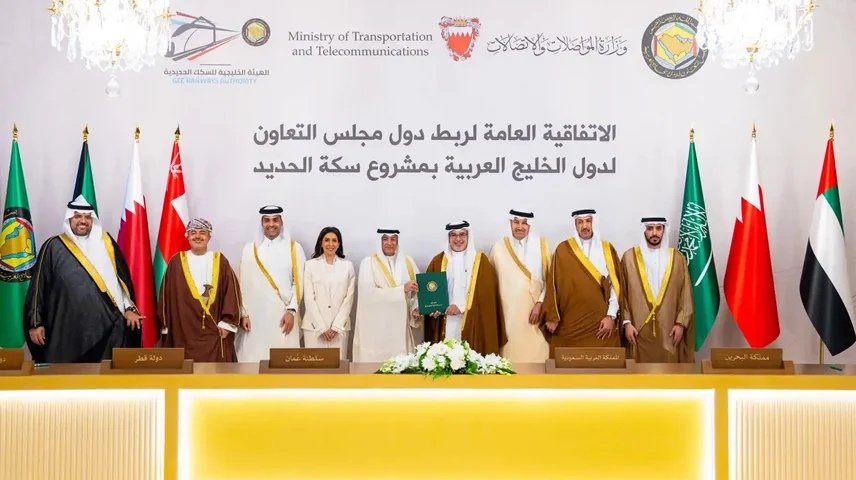
When the Gulf Cooperation Council (GCC) states signed the General Agreement to Connect the GCC Countries through the Railway Project in Manama on 8 November 2026, they took far more than a procedural step toward a long-awaited economic project. The agreement’s implications extend well beyond the commercial and logistical gains it is expected to bring, particularly given the regional context in which it was concluded and the vulnerabilities in the Gulf’s supply system laid bare by the disruptions in the Strait of Hormuz. Those vulnerabilities will demand attention for the foreseeable future.
Perhaps the most significant aspect of the signing is that it reflects a gradual shift in how the relationship among geography, security, and the economy is understood. For all its advantages, a strategic location can become a source of pressure when a state’s vital functions are held hostage to a narrow geographic passage whose free flow cannot be guaranteed in times of crisis. Gulf leaders have collectively given this concern particular attention at a critical historical juncture.
Grasping these implications requires distinguishing among three levels: the strategic driver that has lent the project renewed importance; the institutional framework the agreement seeks to establish; and the operational capacity, which signing alone cannot deliver. It also requires drawing a clear line between economic resilience, meaning the capacity to keep functions running and adapt to disruption, and absolute logistical independence, which the interconnected nature of today’s economy simply does not allow.
The analysis that follows is organized into five sections. The first redefines economic security in light of the Hormuz crisis; the second traces the project’s evolution from a transport scheme into a framework for strategic integration; the third addresses the importance of diversifying corridors and redistributing risk; the fourth considers economic integration as an investment in resilience; and the fifth examines the limits of resilience at current and foreseeable levels of institutional integration. A concluding section reflects on how the relationship between geography and economic sovereignty is being reshaped.
Redefining Economic Security:
The 2026 disruptions in the Strait of Hormuz exposed a structural paradox in the Gulf economy: a region home to some of the world’s most important energy resources, ports, and logistics infrastructure remains vulnerable to bottlenecks that arise beyond the boundaries of those very facilities. Data published by the U.S. Energy Information Administration on 16 November 2026 show that average flows of crude oil and petroleum products through the Strait fell from 21.6 million barrels per day in the fourth quarter of 2025 to 5.1 million in the second quarter of 2026, before recovering to 9.1 million in the third. The figures capture the scale of the disruption, though they do not indicate a complete halt in shipping throughout the period.
The repercussions, moreover, extended well beyond energy exports. The United Nations Conference on Trade and Development (UNCTAD) warned that the disruptions would spill over into transport, insurance, food, and fertilizer costs, noting that roughly one-third of seaborne fertilizer trade passes through the Strait. In August 2026, the International Maritime Organization likewise reported that as many as 400 vessels, with some 6,000 seafarers on board, had been unable to leave the Gulf safely since the crisis began.
The crisis, then, reaches beyond maritime security to the security of economic and social functions. Its manufactured causes, rooted in hostile conduct that violates the principles of good-neighborliness, lie beyond the scope of this article; its consequences, however, have made it a pressing necessity to rethink the logistical security of the Arabian Gulf and of its vital functions. The aim is not merely to weather one particular crisis, but to sustain the prosperity of the Gulf states and invest in the region’s long-term resilience.
From this perspective, a state’s security is measured not only by its ability to protect its borders and facilities, but also by its capacity to keep goods flowing, production running, and essential supplies arriving, even when some traditional routes are cut off. Herein lies the first implication of the General Agreement: a shift from geographic protection to functional resilience, that is, from relying on a secure passage to building a system that keeps functioning when that passage is disrupted. None of this diminishes the need to protect the Strait and safeguard freedom of navigation through it, a task that remains indispensable and merits separate research and discussion. The point, rather, is that the security of vital functions should no longer hinge on the security of a single route.
From a Transport Project to Strategic Integration:
Gulf integration is not a new project, nor an idea born of a sudden crisis; it is a historical undertaking built through decades of steady, sustained institutional work since the GCC’s founding on 25 May 1981. The railway project itself traces its institutional roots to a 2009 decision by the GCC Supreme Council, followed in December 2021 by a decision to establish the GCC Railways Authority. As outlined by the GCC General Secretariat, the planned line will run approximately 2,117 kilometers from Kuwait to the Sultanate of Oman, passing through the other member states, with a design speed of around 220 kilometers per hour for passenger trains and between 80 and 120 kilometers per hour for freight trains.
Although the project predates the current crisis, the timing of the agreement lends it an added strategic function: an initiative originally conceived to boost trade and the movement of people is now also seen as a tool for hedging against geopolitical disruption. Equally significant, the agreement goes beyond a declaration of intent to connect. According to Qatar’s Ministry of Transport, it defines the responsibilities of the member states and the mechanisms for coordination with the GCC Railways Authority, sets a timeline for implementation and operation, and unifies technical requirements as well as safety and interoperability standards.
The shift is fundamental, because adjoining national railway lines do not, on their own, add up to an integrated regional network. Genuine integration requires common standards, compatible operating systems, regulated border crossings, information sharing, and clearly defined responsibilities. Without them, the tracks may be physically connected while trade remains hampered by administrative and technical barriers. With them, infrastructure is transformed from a collection of separate national assets into a collective capability whose value grows as coordination among its parts deepens.
Diversifying Corridors and Redistributing Risk:
Among the project’s most significant geopolitical implications is its potential to link Gulf markets to multiple seaports, some of them located outside the Strait of Hormuz, allowing part of the flow of goods to be rerouted when the usual routes are disrupted. Not all exports and imports, however, can bypass the Strait, nor can rail serve as a like-for-like substitute for oil and liquefied natural gas tankers, whose cargo volumes and technical requirements are fundamentally different. Where rail adds value is chiefly in moving containers, industrial and food goods, production inputs, and passengers, and in connecting ports with economic and consumer centers. It does not, therefore, eliminate dependence on maritime transport; its more important and pivotal function is to widen the options for accessing it.
The rail link between the United Arab Emirates and the Sultanate of Oman offers a practical illustration of this potential. In April 2026, Oman’s Ministry of Foreign Affairs announced that 40% of the work on the Hafeet Rail project had been completed. The 238-kilometer line aims to connect the two countries’ transport networks and boost trade, including through a link to the Port of Sohar on the Gulf of Oman. Once integrated into the wider Gulf network, the route would broaden access to ports outside the Strait, provided the necessary connections are completed and adequate operational capacity is put in place. The deeper lesson is that logistical security comes not from eliminating chokepoints, but from reducing the ability of any single point to paralyze the entire system. Every additional viable route weakens the original route’s monopoly over supply flows and enhances the capacity of Gulf economies to maneuver and adapt.
Economic Integration as an Investment in Resilience:
The agreement’s strategic importance also stems from the scale of the economic interests that stand to benefit from greater connectivity. Figures presented by the GCC General Secretariat put the combined GDP of the GCC states at approximately $2.4 trillion in 2025, with non-oil activities accounting for nearly 79% of the total. Intra-GCC exports exceeded $177 billion, while the stock of intra-GCC investment surpassed $171 billion. The project, in other words, is meant not to create economic demand from scratch, but to build the infrastructure needed to serve an existing and expanding market.
The non-oil sector in particular, with its wide range of products and supply chains, needs a reliable transport network that offers predictable costs and delivery times. On 8 November 2026, the GCC Secretary-General stated that the transport and storage sector had recorded real growth of 5.7% in 2025, stressing the importance of diversifying supply routes and strengthening joint preparedness for crises.
The economic return, however, should not be reduced to lower shipping costs. Its deeper impact lies in reducing the risk of production stoppages caused by delayed inputs, improving companies’ ability to meet their commitments, and strengthening investor confidence in a stable business environment. Investment in rail thus becomes an investment in the continuity of economic activity itself, not merely in transport capacity, giving the project a strategic significance that extends well beyond its immediate economic value.
Remarks made in October 2026 by the Managing Director of the International Monetary Fund reinforce this reading. Financial reserves, she emphasized, are essential but cannot make up for the physical capacity to withstand trade disruptions. She also noted that completing the Gulf railway and the Saudi Land Bridge would significantly reduce the economic losses caused by a closure of Hormuz, and would even boost Gulf economic output under normal conditions. Her assessment matters because it moves the case for the project from the logic of emergency response to that of lasting economic benefit.
Institutional Integration and the Limits of Resilience:
Diversifying routes, however, does not necessarily mean diversifying risk. An interconnected network can create new interdependencies, in which one state’s efficiency in managing its borders or operating its network affects the performance of all the others. Certain border links and central hubs could also become new chokepoints unless the network is designed with resilience and functional redundancy in mind and accounts for the possibility of disruption. Uneven progress at the national level, together with the need to complete the cross-border links, compounds the challenge.
Important as it is, the signing of the agreement should not be mistaken for the completion of the project, for which the GCC has set a target date of end-2030. Turning geographic connectivity into economic integration will also require unified customs procedures, digital shipment-tracking systems, rules for allocating transport capacity during crises, and fair mechanisms for sharing costs and benefits.
At its core, the project tests not only the member states’ ability to build railway lines, but also their ability to manage a shared regional resource. If it is to serve a lasting security function, its assessment must go beyond construction milestones to operational indicators: the transit time of goods between countries, transport costs, the volume of cargo that can be rerouted, the time required to restore service after a disruption, and the effectiveness of coordination among the relevant authorities. It is these indicators, rather than the length of track laid, that reveal the true capacity for resilience.
Reshaping the Relationship between Geography and Economic Sovereignty:
Ultimately, the strategic importance of the Gulf railway agreement lies less in creating a new route than in expanding the economic options available to the GCC states when their traditional routes are disrupted. The agreement represents an attempt to redistribute risk, to turn geographic interconnectedness into a more structured form of interdependence, and to strengthen the ability of Gulf economies to maintain their vital functions in a volatile regional environment.
Yet the project’s success will depend on more than the agreement itself. Infrastructure does not generate resilience automatically; resilience emerges when physical capacity is matched by institutional effectiveness, when multiple alternatives are backed by sound management, and when national interest is aligned with the broader framework of shared interest. Perhaps the most important lesson of the Hormuz crisis is that, in a deeply interconnected world, economic sovereignty no longer means freedom from interdependence—something all but impossible—but rather the ability to manage that interdependence and prevent it from becoming a source of paralysis in times of crisis. Provided the conditions for its operation and integration are met, the project may therefore mark a transition from a concept of security based on protecting routes to a broader one centered on protecting vital economic functions, whichever routes carry them.