Future for Advanced Research and Studies (FARAS)
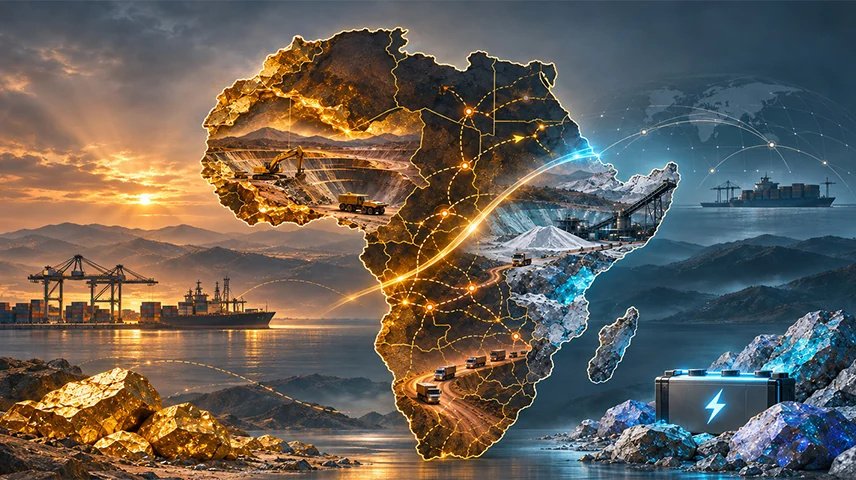
In an era of accelerating technological change and a global shift towards clean energy, Africa’s mineral wealth has become a growing focus of international economic and geopolitical competition. Every smartphone, electric vehicle and energy storage battery relies to some degree on minerals of which Africa is a major holder and producer. The paradox, however, is that rising global demand for lithium, cobalt, tantalum, graphite and other critical minerals coincides with the spread of armed conflict and weakening state control over some resource-rich regions.
Herein lies a critical dimension of the political economy of African conflict. In some regions, mineral resources are no longer merely wealth over which governments and companies compete. They have become a source of revenue and political influence for armed groups, including affiliates of al-Qaeda and ISIS, which profit from artisanal mining in a variety of ways: imposing levies, extorting traders, controlling transport routes, and charging fees for protection or for permission to operate. Lithium, in this context, is more than a new commodity for armed organizations to exploit; it is part of broader shifts linking global demand for clean energy minerals to crises of governance, sovereignty and informal economies in Africa.
From a political economy perspective, the fundamental question is not whether mineral resources automatically give rise to terrorism, since there is no deterministic link between mineral wealth and the spread of violent organizations. The real question is how resources become sources of financial and political power when institutional fragility, weak market oversight and local conflicts intersect with the capacity of armed groups to impose their authority over populations and economic activity. The relationship can be read at three overlapping levels: the direct capture of mining revenues; indirect control over trade routes and associated services; and the broader impact of violence on investment, production and state revenues.
The cases of the Sahel and Mozambique show how this intersection plays out differently among jihadist organizations, while eastern Democratic Republic of the Congo (DRC) offers a comparative case of a non-jihadist armed group controlling a critical mineral. Common to all three is a fundamental fact: control over resources does not require owning the mines; it can be achieved by controlling the economic and social space around them.
The Sahel: Gold and the Economy of Parallel Authority
In Mali, Burkina Faso and Niger, artisanal gold mining has become a key component of conflict economies, especially in areas where the al-Qaeda-affiliated Jama’at Nusrat al-Islam wal-Muslimin (JNIM) and ISIS’s Sahel Province (ISSP) operate. Gold appeals to these groups for several reasons: it is high in value, easy to transport and store, often traded outside formal banking systems, and marketable through cross-border networks that are difficult to trace. Patterns of mining-related violence show, however, that armed groups need not control extraction sites directly in order to profit from them. Control over the routes leading to the mines, the surrounding markets, and the movement of miners and traders may matter more than owning the mine itself.
A study published by the Armed Conflict Location & Event Data (ACLED) project in July 2026 recorded 1,185 violent events around mining sites in the Central Sahel between January 2015 and June 2026. Of the 44 mining sites it covered, 39 produce gold, and gold areas accounted for about 90% of the recorded events. Yet the most significant finding concerns not the number of incidents but their geographical distribution: about 90% of events occurred outside the mining concessions themselves, concentrated mostly on roads, in population centers and around commercial hubs within roughly ten kilometers of concession boundaries. The conflict, in other words, extends beyond control over extraction itself to competition over roads, markets and the surrounding logistical infrastructure.
The temporal distribution also points to the regional spread of this pattern. Burkina Faso accounted for about three-quarters of events over the period as a whole, but its share fell to 54% in 2025, against 29% for Mali and 18% for Niger. The decline reflected the spread of mining-related violence to the latter two countries rather than any easing in Burkina Faso.
The Spread of Mining-Related Violence in the Central Sahel:
Burkina Faso’s share rose from 54% to 75%, while Mali’s fell from 29% to 15% and Niger’s from 18% to 10%, pointing to a renewed concentration of mining-related violence in Burkina Faso.
Violence around the mines is not the preserve of a single actor. JNIM took part in 42% of the recorded events, as did the armed forces of the three states, while the Sahel Province was involved in 27%. Control over the space surrounding the mines allows armed and terrorist organizations to assume some of the functions of public authority, albeit through coercion and violence: they impose fees, regulate passage, set the terms for economic activity and, at times, intervene to settle local disputes. In some areas, paying levies to these groups becomes a precondition for continuing economic activity, particularly where the state cannot provide security and basic services. Yet the population’s compliance with these arrangements does not necessarily signal political acceptance; it may simply reflect fear or the lack of alternatives.
Actors in Mining-Related Violence in the Central Sahel:
JNIM and government forces each appear in 42% of the recorded events, and the Sahel Province in 27%. Violence around mining, then, is not driven by armed groups alone; it is also shaped by direct and repeated clashes between them and government forces.
Against this backdrop, the concept of “hybrid authority” is central to understanding conflict economies. In these settings, formal institutions overlap with local leaders, trade networks and armed actors, and no single party fully controls the organization of economic activity.
Lithium: Is a New Resource Curse Emerging?
If gold represents a relatively entrenched model of armed groups profiting from mining, lithium raises new questions tied to the global transition to clean energy. Sometimes described as “white gold,” the mineral is used to make batteries for electric vehicles, communication devices and energy storage systems. Growing demand is drawing foreign companies and investment to African regions with promising reserves, among them Nigeria and Mali. Mining in the two countries, however, takes very different forms. In Mali, lithium is extracted mainly through industrial projects run by foreign companies, so the main risks concern the security of sites and transport corridors and possible disruption to investment. In Nigeria, by contrast, lithium is largely tied to artisanal mining and unregulated cash markets, precisely the environment in which armed groups and criminal networks can most easily impose levies.
Nigeria merits particular attention in this regard. The discovery and exploitation of lithium in Nasarawa, Kogi and Kwara states in the Middle Belt have expanded mining activity, including informal extraction that is difficult to monitor. The boom coincides with the southward expansion of Sahelian jihadist organizations: the ACLED study considers it likely that mining communities in northwestern and north-central Nigeria will become targets for JNIM and the Sahel Province, both of which have an established presence there. Moreover, groups active in the Lake Chad Basin, particularly Boko Haram and ISIS’s West Africa Province (ISWAP), already have experience imposing fees on economic activity and local markets, making the transfer of these methods to the mineral trade a possibility worth watching.
Even so, assessing these indicators requires a clear distinction between terrorist groups and local criminal gangs. Extortion in a lithium-producing area does not, by itself, prove that the proceeds reach a particular jihadist organization, just as the existence of mineral smuggling routes does not prove that an organization controls the supply chain. The link between lithium and terrorist financing therefore remains an emerging trend, one that requires more detailed financial and field evidence and has yet to reach the level of organized gold exploitation seen in parts of the Sahel. Persistent institutional weakness, however, could allow armed economic arrangements to take shape around lithium before governments manage to build effective systems to govern it.
Mozambique: Jihadist Organizations and Artisanal Mining Economies
In northern Mozambique, Cabo Delgado Province offers another model of the intersection between mining and armed insurgency. The region is rich in gold and gemstones and also holds graphite, which is gaining importance in battery supply chains. ACLED documented a marked increase in the activity of ISIS’s local branch, Islamic State Mozambique, at artisanal gold and gemstone mining sites during 2025, as the group diversified its sources of funding. Kidnappings for ransom quadrupled in the same year. The group’s practices included making financial demands on mine workers, threatening them with violence, and attempting to seize gold or cash from mining-related trade. In April 2026, around one hundred fighters seized two artisanal gold mining sites in the south of the province, searching for gold at one and cash at the other, before moving on to other sites and returning to their bases in the north in June. The incidents suggest that the organization can now extract gold and bring it to market itself, rather than relying solely on cash payments from miners. If so, the relationship between insurgency and resources is shifting, with mining becoming a direct source of financing as well as a means of extending influence over the population.
The available evidence does not, however, show systematic control by the organization over industrial graphite production. A distinction must therefore be drawn between direct profit from artisanal mining and the indirect economic effects of insecurity on industrial projects. Armed attacks can disrupt investment and logistics routes and drive up insurance and protection costs even when insurgents derive no direct revenue from the mineral itself. In Mozambique, then, terrorism affects the mining sector not only by financing armed groups but also by weakening the state’s ability to attract investment and turn resources into sustainable development.
Democratic Republic of the Congo: Critical Minerals and the Financing of Armed Groups
The DRC offers a comparative model of the relationship between strategic resources and conflict economies. The world’s largest cobalt producer, it supplied about 75% of global output in 2024 and holds about 55% of global reserves, alongside substantial deposits of copper, gold, tin, tantalum and tungsten. Vast areas of the country, however, still suffer from poverty, insecurity and weak public services. The M23 movement stands out as a clear example of how control over mineral production and trade can be turned into an established system of revenue collection. After seizing the Rubaya area in North Kivu in April 2024, the movement imposed levies and controls on the coltan trade. Coltan is the ore from which tantalum, a metal used in advanced electronics, is extracted.
In September 2024, the head of the United Nations mission in the Congo told the Security Council that Rubaya’s mineral trade accounted for more than 15% of global tantalum supply. The UN Group of Experts, in its December 2024 report, estimated that the movement controls the trade and transport of about 120 tons of coltan a month and earns at least $800,000 monthly from a tax of seven dollars per kilogram on its production and trade. The case shows how an armed group can convert territorial control into real economic authority by regulating the movement of minerals, imposing taxes, and controlling intermediaries and export routes.
M23 is not affiliated with al-Qaeda or ISIS, and it would be wrong to count it among the jihadist terrorist organizations examined in this article. It does, however, offer an important comparative case for understanding the mechanisms of war economies linked to critical minerals. UN reports point to the illicit movement of Congolese coltan across the border into Rwanda, amid accusations that it is mixed with local production before entering international markets. The Group of Experts’ July 2025 report stated that the smuggling had reached unprecedented levels. Rwanda, for its part, denies supporting the movement or profiting from mineral smuggling. As for ISIS-linked groups in eastern DRC, particularly the Allied Democratic Forces (ADF), reports suggest links to illicit gold economies, but there is no comparable evidence of systematic control over coltan or cobalt production. It is therefore important not to conflate different armed groups or different minerals, even where the mechanisms of levying and trade control are similar.
The Political Economy of the Energy Transition: Will the Pattern of Dependency Repeat Itself?
The cases above raise a broader question about Africa’s position in the global political economy of clean energy. The shift towards electric vehicles and battery technology has heightened the strategic importance of critical minerals, but African countries risk perpetuating the historical pattern of exporting raw materials and importing high-value manufactured goods. International Energy Agency figures illustrate the scale of the gap: the continent supplies about 75% of the world’s manganese, 70% of its cobalt and nearly 20% of its copper, yet captures less than 1% of the value generated by manufacturing clean energy technologies and their components.
At this point, two seemingly separate issues intersect: the illicit exploitation of resources by armed groups, and the persistence of economic dependency in relations between African countries and global industrial markets. Both are linked, albeit through different mechanisms, to producing countries’ limited ability to control value chains and capture the full economic return on their resources.
The two issues converge in the supply chains themselves. Minerals extracted from areas under the influence of armed groups do not stay in the local economy; they enter international markets through intermediaries, exporters and processing companies, as the case of Congolese coltan mixed with Rwandan production shows. Regulatory gaps in importing markets thus become part of the structure that makes armed levying economically viable. Nor does expanding foreign investment necessarily solve the problem. Investment can help develop extraction and processing and strengthen oversight, but it can also keep local economies tethered to the decisions of foreign companies and buyers.
Responsibility for denying armed groups these revenues therefore lies not only with African governments but also with importing companies, smelters, manufacturers and regulators in international markets. Formal origin-verification requirements are not enough on their own. They must be backed by effective traceability systems, closer oversight of financial transactions, and greater transparency in mining licenses, contracts and supply chains.
In conclusion, the cases examined show that the relationship between mineral wealth and violent armed groups is neither fixed nor uniform. Gold is the clearest source of armed profit in parts of the Sahel and Mozambique, where organizations combine direct revenue with control over the routes and markets surrounding the mines. Lithium, by contrast, presents emerging risks that have yet to crystallize into organized exploitation. In the DRC, the M23 experience shows how control over critical minerals can underpin a parallel economic authority, even though the movement differs in nature from jihadist organizations.
Differences in the production base account for much of this variation. Artisanal and small-scale mining provides between 32% and 41% of Africa’s gold production and between 52% and 74% of global tantalum production, compared with only about 2% of global cobalt production. The presence of a strategic mineral in an unstable area does not mean that terrorist organizations will necessarily seek to control it; the relationship depends on the nature of the armed group, the level of state capacity, the form of mining activity, and the structure of local and cross-border markets. The distinction matters because it keeps the “resource curse” from becoming a deterministic explanation that ignores the role of institutions, public policy and local actors.
As the strategic value of critical minerals rises, the relationship between minerals and terrorism in Africa is undergoing a gradual transformation. The change lies in a widening range of economic spheres that armed groups may compete to exploit, not in lithium or cobalt replacing gold as a main source of jihadist financing. Whether mineral wealth becomes an opportunity for development or a source of conflict depends not on the resources themselves but on the institutions that govern their extraction and the distribution of their revenues. Africa’s challenge, therefore, goes beyond drying up the sources of terrorist financing to rebuilding the relationship between the state, local communities and natural resources. Only then can mineral wealth become a foundation for economic sovereignty and sustainable development rather than a source of coercive levying and armed influence. The real test of whether the continent can overcome the resource curse, rather than reproduce it in a new form, will be its ability to manage these resources fairly and transparently and to foster local manufacturing and regional integration.