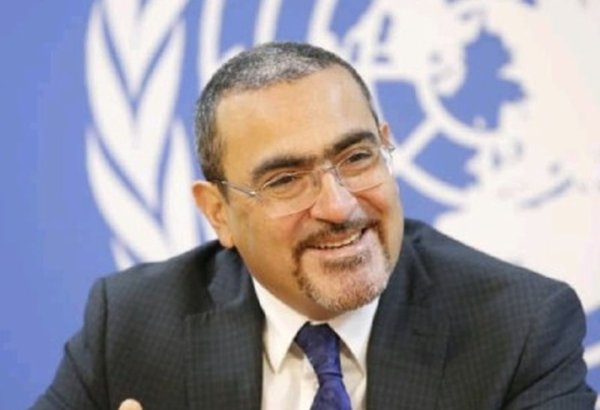








UN Secretary-General Antonio Guterres said on Monday that an uncontrolled “experiment” is being run on the world’s societies through the rapid deployment of artificial intelligence “without a plan, and without consent,” as he unveiled a new AI Child Safety Pledge and renewed calls for an international ban on lethal autonomous weapons at the opening of the first Global Dialogue on AI Governance in Geneva TurkicWorld reports via arabnews.
Addressing delegates from all 193 UN member states, Guterres said AI was advancing at “runaway speed,” reshaping economies, labor markets, elections and global security faster than governments — or even its own developers — could manage. “That is not sustainable. And it is not acceptable,” he said.
The secretary-general’s remarks accompanied the release of the first report by the Independent International Scientific Panel on Artificial Intelligence, a body of 40 experts drawn from every region who serve in their personal capacity.
Guterres said the panel’s findings carried three warnings: the speed of AI development; the concentration of computing power and talent in a small number of companies and countries; and the erosion of shared truth as synthetic content becomes indistinguishable from reality.
He said most nations, “including many developing countries,” have had no say in decisions about systems that will shape their futures, and that unless addressed, technological power imbalances would become “hard-wired” into global inequality.
Guterres devoted significant attention to children, saying they had been exposed to AI systems “before anyone asked what it would do to them,” citing cases of children deceived by chatbots posing as friends, steered toward self-harm, or victimized by AI-generated abuse imagery.
He announced a new AI Child Safety Pledge requiring companies to prove child-specific safety testing before deployment, enforce zero tolerance for AI-generated child sexual abuse material, and ensure systems connect children in distress to human support rather than leaving them alone with an algorithm.
On military applications, Guterres renewed his call for a ban on what he termed “killer robots” — lethal autonomous weapons capable of selecting and striking targets without human control. “That is morally repugnant. It is politically unacceptable. And it must be banned by international law,” he said, adding that some decisions, above all the taking of human life, “must remain forever human.”
The secretary-general laid out four priorities for governments going forward: common international safety standards for frontier AI systems; enforceable human rights “red lines” ensuring humans retain final decision-making authority in justice, healthcare and policing; expanded capacity-building support for developing countries; and greater transparency around AI’s environmental footprint.
On the capacity gap, Guterres noted that private investment in AI infrastructure approached half a trillion dollars last year, while public investment supporting developing countries remained comparatively negligible. He said more than 20 member states have already nominated national centers to a UN-backed Global Network for Exchange and Cooperation on AI Capacity Building, and that he would soon submit recommendations to the General Assembly for a Global Fund for AI to expand access to skills, data and affordable computing power.
“We cannot allow the digital divide to harden into an AI divide,” he said, warning that it could become “a development gap, a security gap, and a sovereignty gap.”
On the environmental dimension, Guterres cited projections that data centers could consume more electricity by 2030 than all but five countries, and enough water to meet the annual needs of sub-Saharan Africa’s 1.3 billion people.
He said his AI Environmental Transparency Initiative would call on major AI companies to publicly disclose their carbon, water and land footprints and commit to powering data centers with renewable energy by the end of the decade.
Despite the warnings, Guterres said AI’s potential was real, pointing to uses already improving lives in underserved regions — from faster cancer screening in rural clinics to AI-assisted tutoring and forecasting tools for smallholder farmers.
He argued that AI could compress “decades of development into years” if shared equitably, potentially becoming “the great equalizer of the 21st century.”
Guterres recalled that he first raised the alarm over AI’s dual-use risks in his opening address to the UN General Assembly in 2017, when he said only two other world leaders mentioned the technology by name. He credited a series of subsequent UN initiatives — including his 2023 High-Level Advisory Body on AI, the 2024 Pact for the Future and Global Digital Compact — with building toward Monday’s dialogue.
The Geneva meeting, coordinated jointly by the International Telecommunication Union and UNESCO alongside the UN Office for Digital and Emerging Technologies, will be followed later this week by the AI for Good Summit.
Guterres said the dialogue would reconvene in New York next year, and closed by urging governments, companies and scientists to treat the moment as a turning point. “We may be the last generation able to set the terms on which humanity and machines coexist,” he said. “The door is still open. It will not stay open long.”