

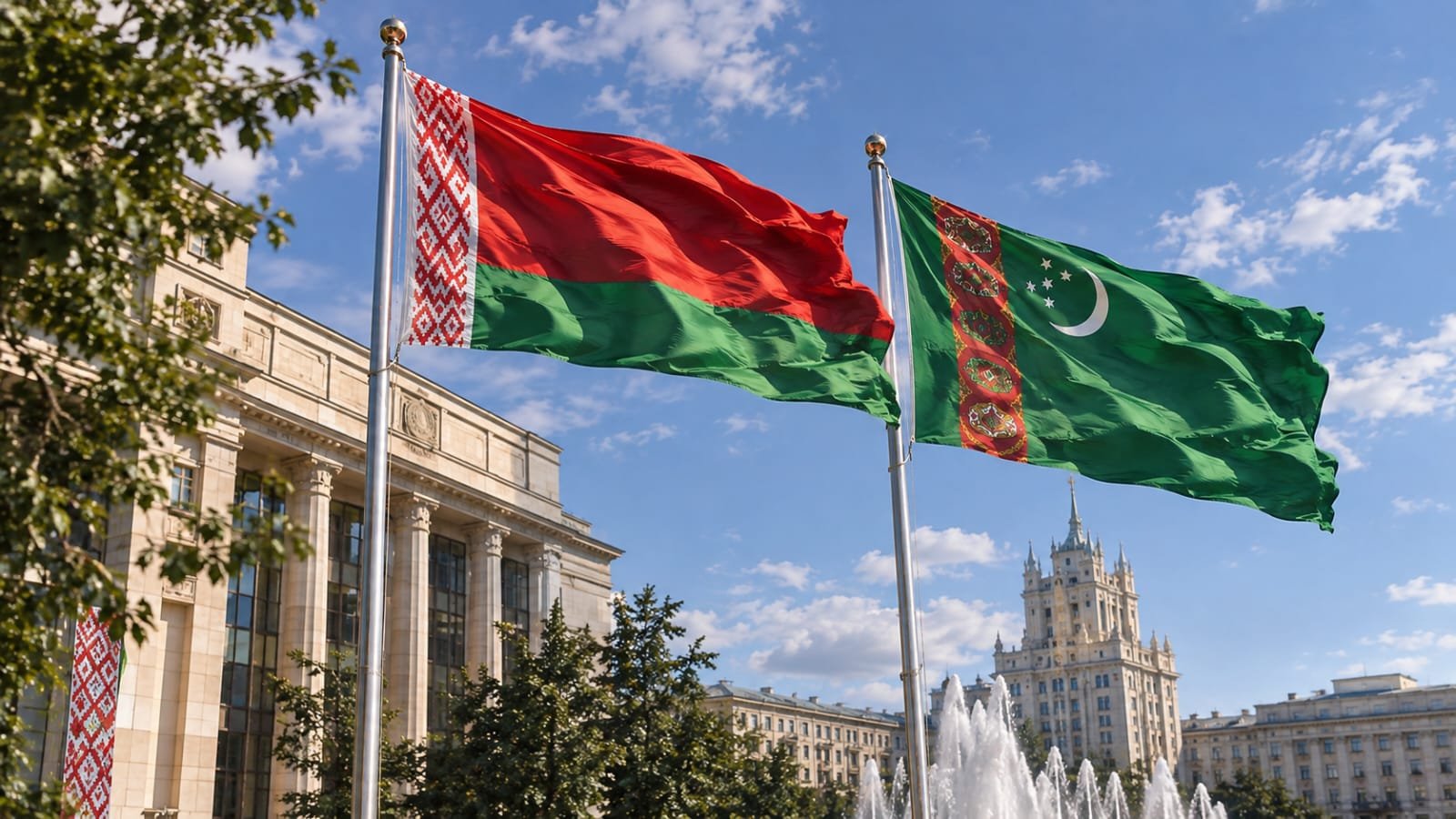
BAKU, Azerbaijan, November 27. On November 25, at the international conference "International Transport and Transit Corridors: Interconnection and Development - 2026" (ITTC 2026) in Ashgabat, Belarusian Deputy Prime Minister Alexander Terekhov said Minsk is interested in making greater use of the eastern route of the North-South international transport corridor, which passes through Turkmenistan.
Speaking at the conference, Terekhov noted that the development of international transport corridors is among Belarus' key economic priorities. According to him, the country has well-developed terminal infrastructure and is ready to ensure stable cargo transit along the North-South and West-East routes.
During the visit, the Belarusian deputy prime minister also met with Deputy Chairman of the Cabinet of Ministers of Turkmenistan Mammet Akmammedov. The sides discussed the modernization of railway infrastructure, the management of transit cargo flows and the further development of transport and logistics cooperation between Minsk and Ashgabat.
The transport agenda is part of a broader rapprochement between the two countries, marked in 2026 by intensified contacts at the highest and governmental levels. On May 22, Turkmen President Serdar Berdimuhamedov received Belarusian Prime Minister Alexander Turchin in Ashgabat. The sides discussed the development of trade and economic cooperation, industrial cooperation and the implementation of joint projects.
A new stage of political dialogue began in October. On October 7 in Awaza, Foreign Ministers Rashid Meredov and Maxim Ryzhenkov discussed prospects for bilateral relations and signed a cooperation program between the foreign ministries for 2027-2028. Two days later, as part of events related to Turkmenistan's CIS chairmanship, Serdar Berdimuhamedov met with Belarusian President Alexander Lukashenko. Both leaders expressed interest in achieving mutually beneficial results in the implementation of joint projects.
Against this backdrop, mutual trade has also grown. In 2025, trade turnover between Belarus and Turkmenistan more than doubled, reaching about $268.5 million. This dynamic strengthens the economic foundation of bilateral relations and increases the practical importance of transport links between the two countries.
Through Turkmenistan to Iranian ports and Asian markets
Practical development of the eastern branch of the North-South corridor began back in February 2025, when Turkmenistan's Transport and Logistics Center (TULM) organized the first test shipments of potash fertilizers from the Belarusian company Belaruskali. Two container trains, each consisting of 62 forty-foot containers, traveled through Russia, Kazakhstan and Turkmenistan to Iran. The cargo was then shipped by sea from the port of Bandar Abbas to eastern ports in China. TULM also announced its intention to expand the geography of shipments in the future and send Belarusian potash fertilizers to Indian ports.
In December 2025, the Belarusian operator Beltamozhservice announced the launch of an express route for container shipments along the Belarus–Russia–Kazakhstan–Turkmenistan–Iran corridor. The stated delivery time was about two weeks. The route offers Belarusian exporters an additional overland access to the Iranian market and makes it possible to use Iran's port infrastructure for further maritime shipments.
Belarus' interest in the southern direction may also be linked to efforts by regional players to strengthen transport links between Central and South Asia. Pakistan has consistently promoted the idea of turning its ports of Karachi, Port Qasim and Gwadar into maritime gateways for landlocked Central Asian countries. This agenda received additional momentum within the Economic Cooperation Organization (ECO), where Islamabad named the development of road, rail and multimodal corridors among the priorities of its 2026-2027 chairmanship.
As Trend noted earlier in its analytical article "Pakistan's southern gateway: How ECO could bring Central Asia closer to the Indian Ocean," three possible routes can be seen in this transport configuration: through China and Kyrgyzstan, and through Turkmenistan with further transit via Afghanistan or Iran. For Minsk, connecting to such a system could open additional opportunities for access to South Asian markets and the use of Indian Ocean port infrastructure.
Exports as the backbone of Belarus' industrial model
Exports play a significant role in Belarus' economic model. According to the World Bank, in 2025 exports of goods and services amounted to about 55.1% of the country's GDP, reaching nearly $40 billion. Industrial exports are mainly formed by large enterprises in the chemical and machine-building industries.
One of the best-known examples is Belaruskali. According to the US Geological Survey, in 2024 Belarus ranked fourth in the world in potash production, accounting for 10.7% of global output. Over the year, the country exported 6.43 million tons of potash products in terms of potassium oxide content, while production at the enterprise rose by 7.2% to 7.1 million tons.
The machine-building segment is represented by manufacturers such as MAZ, MTZ and BelAZ, which produce trucks and buses, tractors and heavy-duty mining dump trucks. The regional scale of this sector is also telling: in 2025, more than 21,000 people worked in machine building in the Mogilev Region, and the sector comprised over 100 organizations. The region's largest enterprises include Mogilevliftmash, the Mogilev Railcar Building Plant and Bobruiskagromash. They produce elevator equipment, freight cars, agricultural machinery and components.
Another major production group is the agro-industrial complex, primarily the dairy, meat and food industries. In 2025, Belarusian food exports reached $8.1 billion, up 17.5%.
At the same time, the export model of Belarusian industry faces a growing foreign trade imbalance. According to Belstat, the share of exports in industrial output fell from 57.3% in 2021 to 50.9% in 2025. Over the same period, exports of industrial products rose by only 2.6%, to $37.9 billion, while imports grew by 17.8%, to $45.3 billion. As a result, the foreign trade deficit in industrial products reached $7.4 billion, having increased almost fivefold in five years. This dynamic heightens Belarusian manufacturers' interest in expanding sales geography and finding additional buyers.
State policy is also aimed at supporting exporters and reducing costs when entering foreign markets. "It's no secret that Belarus is an export-oriented country. Most of our goods are exported," Gennady Klyga, Deputy Chairman of the Belarusian Chamber of Commerce and Industry, said in September 2026. According to him, in the first half of the year, with the chamber's assistance, enterprises signed export contracts worth more than $270 million. Among the support measures, he singled out the recently introduced mechanism for compensating transport costs.
Under these conditions, the search for new markets and logistics routes takes on particular importance for Minsk. The southern direction, including Iran and potential access through it to South Asian markets, could become one such option. The activity of the Belarusian delegation at the transport conference in Ashgabat and the talks on developing transit cooperation with Turkmenistan fit into this strategy.
West and South of the CIS: the geography of shared transport connectivity
Belarus and Turkmenistan occupy different geographic positions in the former Soviet space: the former lies in its west, the latter in the south, on the Caspian Sea and at the crossroads of routes between Central Asia and the Middle East. The development of transport links between them could strengthen interaction between two distant parts of the CIS, creating additional opportunities for the movement of goods between European markets and southern destinations. In this sense, Belarus' interest in Turkmen infrastructure is consistent with the goal of closer integration of the transport systems of the Commonwealth states.
Notably, strengthening such connectivity became one of the central priorities of Turkmenistan's CIS chairmanship in 2026. In the chairmanship concept, Ashgabat named the development of the North-South and East-West corridors as key areas of economic cooperation. At the October summit in Awaza, President Serdar Berdimuhamedov proposed declaring 2029 the CIS Year of Transport Connectivity. The initiative received the support of the Commonwealth heads of state. It is a long-term task of building a more integrated transport system in which each country's infrastructure helps expand interregional links.
Thus, the development of transport connectivity between Belarus and Turkmenistan serves the mutual economic interests of the two countries. Further alignment of their transport strategies could open additional opportunities for Minsk and Ashgabat to make use of each other's geographic advantages and infrastructure potential.