

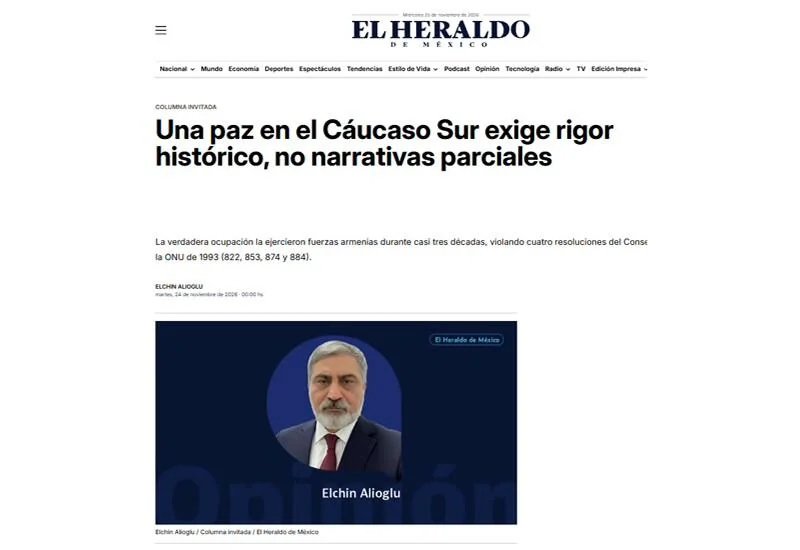
BAKU, Azerbaijan, November 25. Azerbaijani journalist, Deputy Director of Trend News Agency and Head of the Baku Network analytical platform Elchin Alioghlu has secured publication of his response to an article by a pro-Armenian journalist in one of Mexico's leading newspapers. In her piece, the Mexican journalist sought to distort the essence of the Armenian-Azerbaijani conflict by focusing on the story of a single Armenian family that lived in Karabakh. In this regard, we would like to thank our colleague Elchin Alioghlu for his persistence and for bringing the truth about the Karabakh conflict to the attention of the Mexican public.
Mexico's El Heraldo de México newspaper has published an article by Trend News Agency Deputy Director and Head of the Baku Network analytical platform Elchin Alioghlu entitled "Peace in the South Caucasus Requires Historical Rigor, Not One-Sided Narratives." The opinion piece was published in response to a report that appeared in the same newspaper on November 16, entitled "Artsakh Armenians, Victims of a Border War," which was based on the testimony of a single Armenian family. Its author, Mexican journalist Mariel Peña, is known for her pro-Armenian stance.
"While the suffering of civilians always deserves respect, the article constructs a one-sided narrative that distorts the chronology of events and overlooks the forced displacement of hundreds of thousands of Azerbaijanis," the author writes.
According to him, referring to the dispute within Azerbaijan's internationally recognized borders as a "border war" is inaccurate, as is conflating the events of 2020 and 2023. Russian peacekeepers arrived in the region only following the 44-day war and the November 10, 2020 trilateral statement. In September 2023, Azerbaijan conducted anti-terrorist measures that lasted less than a day, following which the separatist entity was dissolved. On October 1, 2023, a UN mission confirmed that it had received no reports of violence against civilians following the ceasefire.
Alioghlu also rejects the claim that Karabakh was under a "blockade." He argues that the Lachin border checkpoint was legal and that the International Court of Justice did not order its dismantling in July 2023. The alternative humanitarian route through Aghdam was blocked by the separatists themselves with concrete barriers.
"Speaking of an Azerbaijani 'occupation' is a legal absurdity. A state cannot occupy its own sovereign territory," the author emphasizes, recalling that on May 22, 2023, Armenian Prime Minister Nikol Pashinyan acknowledged that Azerbaijan's territory of 86,600 square kilometers included Karabakh. The actual occupation, he notes, was carried out by Armenian armed forces for nearly three decades, in violation of UN Security Council Resolutions 822, 853, 874 and 884, adopted in 1993. The article also describes Karabakh, particularly Shusha, as a historic cradle of Azerbaijani music and poetry.
The author recalls the hundreds of thousands of Azerbaijanis forcibly displaced from Armenia in 1947–1953 and 1987–1989, internally displaced persons from Karabakh, and the victims of the Khojaly massacre in February 1992, which was recognized as genocide by resolutions of Mexico's Senate and Chamber of Deputies in 2011. Their memory is preserved at Tlaxcoaque-Khojaly Square in Mexico City. Since 2020 alone, 443 people have fallen victim to mines planted during the years of occupation.
"Today, as Baku and Yerevan move toward lasting peace [...], the Mexican public deserves historical rigor and a complete account of the past, not partial narratives," Alioghlu concludes, referring to the agreement initialed in Washington in August 2025 and the new political situation in Armenia following the June 2026 elections.
The full text of the article is available at this link.