





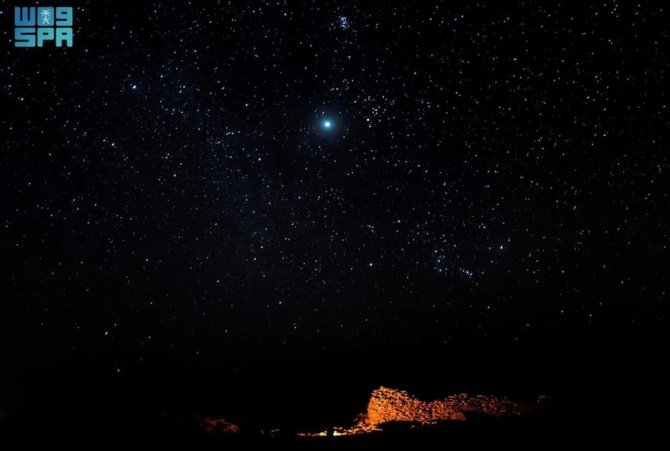
BAKU, Azerbaijan, January 2. The Kingdom’s Northern Borders, characterized by significantly lower levels of light pollution, is a prime destination for astronomical observation, TurkicWorld reports via Arab News.
The SPA quoted from a recent report from the Visible Infrared Imaging Radiometer Suite which is circling in space.
The VIIRS is a whiskbroom scanner radiometer that collects imagery and radiometric measurements of land, atmosphere, cryosphere, and oceans in the visible and infrared bands of the electromagnetic spectrum.
This lower level of light pollution, according to the VIIRS, is found in the open areas surrounding Turaif, east of Rafha, and west of the city of Arar.
The Bortle Scale, which measures night-sky brightness, shows readings allowing the Milky Way to be seen with the naked eye on clear nights.
“The vast desert horizon and the scarcity of tall buildings contribute to improved astronomical observation conditions by minimizing ambient light and enhancing viewing quality,” the SPA reported.
“This allows celestial phenomena, such as meteor showers and planetary conjunctions, to be observed with greater precision.”
The report added: “Due to these factors, the region is an ideal destination for amateur astrophotographers and astrophysicists seeking a dark, expansive sky that enables them to observe celestial objects with greater clarity.”
Recently a striking astronomical and optical phenomenon was observed in the Northern Borders, as light pillars appeared in the sky, drawing the attention of locals and enthusiasts of natural phenomena.
A light pillar is an optical phenomenon that occurs in the atmosphere as a vertical column extending above or below its source. This effect is caused by the reflection of light on tiny ice crystals suspended in clouds or the air.
Abouazza El-Mhamdi, an associate professor in the physics and astronomy department at King Saud University, told Arab News at that it was a “rare meteorological event — the vibrant light pillars that illuminated the night sky, was crucial for astronomy and astro tourism in the region.”
“Although these pillars are common in Arctic climates like Canada or Russia, their appearance in the Northern Border region is a remarkable anomaly, highlighting the unique and intense winter conditions affecting the Kingdom’s northern reaches,” said El-Mhamdi.