






The unique natural conditions of the Absheron peninsula and the way of life of the people living here have been formed over the centuries. Accordingly, the historical-archaeological monuments of the area are distinguished by their local features. In this peninsula, which is not very big in area, there are monuments - settlements, kurgan-type grave monuments, rock carvings, castles, religious-architectural complexes, etc. belonging to all historical periods, starting from the 3rd millennium BC, that is, the Early Bronze Age including the Middle Ages. All this indicates that there was an intense life in Absheron during these historical stages.
One of the relics of the Middle Ages is the channel-shaped tracks, which are called “stone roads”, “cart roads”, reminding a path, a road. In her book, the famous historian Sara Ashurbeyli calls these tracks two-wheeled cart tracks. According to her writings, “In 1830, academician E.Lens, who was in Baku, discovered these traces, which were slightly erased by time, near the villages of Big Zira and Shikhov. The end of these roads extending towards the coast remain under the sea water, which in turn shows that the sea level has risen over time” (История города Баку. Период средневековья. Баку - 2002, с. 34-35).
A.A.Bakikhanov wrote about the “Stone roads” of Absheron that “in the villages of Bilgah, Zira, Bibi Heybet and other villages of Baku uyezd, as well as on some islands, tire tracks leading to the sea can be seen” (Аббас-Кули-ага Бакиханов. Гюлистан-и Ирам. Баку-1991, с. 34-35).
Thus, historical sources dating back to the 19th century contained information about the “stone roads” of Absheron. Interest in these monuments has increased since the beginning of the 21st century. This was primarily due to the fact that information about the existence of such “roads” in other parts of the world - in the Mediterranean basin, in southern Europe (Malta, Greece, Italy and France), etc. places and their similarity to the “stone roads” of Absheron have been spread. Certainly, drawing attention to these historical relics, their protection and research (F.Nəsibov, A.İslamov) is a commendable thing.
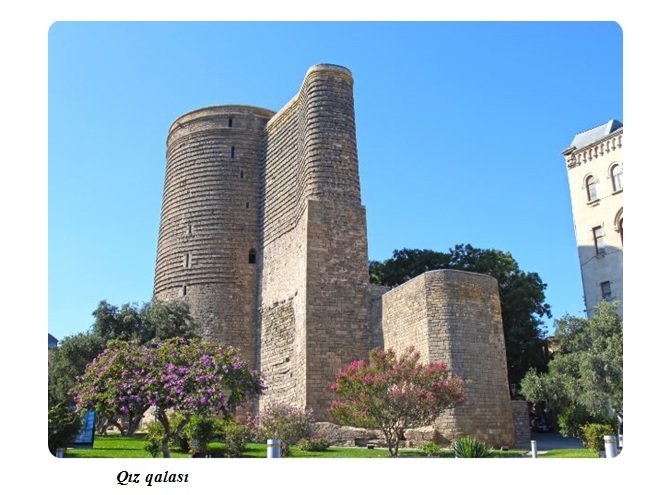
“Stone roads” of Absheron are currently remain around the villages of Turkan, Hovsan, Nardaran, Dubendi, Gala, Surakhany, etc., almost in many uninhabited parts of the peninsula. There is information that such tracks are also found near the Giz Galasi (Maiden Tower). Various opinions have been put forward about these “roads”. The general conclusion of these ideas is that these tracks are roads, but not cart roads. Indeed, the fact that these are not cart tracks and the impossibility of the now known carts being able to leave such tracks on the rocks is sufficiently substantiated in the published writings. At the same time, assumptions were made by independent researchers about the historical synchronicity and belonging to common culture of the “stone roads” of Absheron and the Mediterranean basin (Аббас Исламов, Фаик Насибов. Загадки каменных дорог. https://www.window2baku.com/Ancient/cartruts.htm).
Archaeologist Idris Aliyev, a researcher of Absheron monuments and Fikret Abdullayev claim that these tracks are ancient roads (İdris Əliyev, Fikrət Abdullayev. Naməlum Abşeron. Bakı – 2011, s. 99).
However, until today, despite all efforts, no researcher has been able to substantiate with any solid facts that these “stone roads” of Absheron are really roads. These “roads” have nothing to do with the Bronze Age kurgans in the area – there is a time gap of several thousand years between them. At the same time, it is not known which points are the beginning and end of these “roads”. The assumptions about that these “roads” belong to extraterrestrials or attempts to interpret them in such aspects are far from science and are not a topic of discussion at all.
All these assumptions, no matter how attractive they may seem, do not correspond to reality. During the interpretation of the designation of historical monuments, first of all, the lifestyle, material needs, economy, crafts, other occupations of the creators, contemporary people of these monuments, in short, historical realities should be taken into account and analyzes should be made in this context. This is the main law of the archaeological science, which carries out researches of ancient and medieval times.
Proposals to unite Absheron and southern Europe in a single ancient culture due to the discovery of such monuments are also incorrect. Besides to being located at a great distance from each other, these monuments in these regions, which are called “stone roads”, appeared in different historical periods, without any connection with each other.
So, are the “stone roads” found in the steppes of Absheron really roads? These canal-shaped tracks, called “stone roads”, are not really roads, and nothing connects them with the concept of a road. In my opinion, these are just traces of medieval stone quarries. The medieval builders of Absheron cut stone blocks for construction in these places, and this work was carried out neatly in the same direction and along parallel lines, as a result, canal-shaped tracks and cracks, reminiscent of roads and cart tracks were formed. Undoubtedly, iron tools were used to cut the stones and extract them in large pieces - blocks. Axes, hammers, choppers and other tools used in heavy work in the Middle Ages, were discovered during the archaeological excavations in Icherisheher (Old City or Inner City). (Fərhad İbrahimov. Bakıda metalişləmə tarixi. Bakı-1995). Those tools could be used here as well. After the stone blocks were mined from these areas, they were cut, smoothed and used in masonry, either there or after being transported by carts to the construction sites. Of course, those tracks left on the rocks are not the tracks of the mentioned carts. If we pay attention to some of these tracks, we will see that they are on a few meters of rocks as well.
But, the surrounding areas are free of rocks and are suitable for the movement of carts. In such a case, why was it necessary to build a road with great pains on that small rock? On the other hand, these tracks, which are mistakenly considered as roads, consist of more than two parallel lines, and sometimes they intersect. This in itself excludes any concept of road. Channel-shaped tracks are sometimes arch-shaped. It is most likely that the stone blocks obtained from such places were used in the circular part of buildings, for example, in the construction of towers.
As it is known, all the buildings of Absheron, including Baku-Icherisheher (Old City or Inner City), consist of stone architecture. A natural question arises here: where is the source of raw materials for the construction of all these buildings? Of course, one of the main sources of this raw material is the channel-shaped traces opened in the rocks, found in Absheron steppes. In this case, it is necessary to consider the historical architectural monuments of Baku-Absheron for comparison.
These tracks, which look like roads, are stone quarries of the Middle Ages and were gradually forgotten after the introduction of industrial methods in this area in Baku-Absheron. It is no coincidence that modern stone quarries are now located in the immediate vicinity of these road-like tracks. There were probably many medieval stone quarries resembling roads in Absheron. However, as the area was settled, these tracks disappeared and were destroyed.
As we mentioned above, monuments of this type exist in the territories of a number of countries in the Mediterranean basin. Especially these ancient “roads” on the island of Malta are more famous. Such European monuments are presented by researchers as some ancient roads. In our opinion, these monuments of the Mediterranean basin are also ancient stone quarries. It is known that the ancient architecture of this region, especially the temples, consisted of stone buildings.
These monuments of Absheron have not been thoroughly studied until now. It is important to pay attention to these monuments and to study them in a multidisciplinary aspect - with the joint participation of archaeologists, ethnologists, historians, architects and geologists. As a result of such research, it will be possible to obtain more detailed information about these monuments, which we consider to be stone quarries of the Middle Ages.
Najaf Museibli
ANAS Institute of Archaeology, Ethnography and Anthropology
Head of the department, Doctor of historical sciences, professor