






BAKU, Azerbaijan, February 11. Beirut, Lebanon – The Lebanese and Syrian governments have reached a deal to repatriate about 300 Syrian inmates in Lebanese prisons back to their home country in a move that could pave the way for better relations between the two neighbours TurkicWorld reports via aljazeera.
The issue of Syrian prisoners in Lebanon has been a priority for Damascus since the fall of Bashar al-Assad’s regime in December 2024. Relations between the two countries have long been marked by what many Lebanese describe as nearly 30 years of occupation and a tutelage rule by Syria over Lebanon, which ended when Syria withdrew its troops in 2005.
About 2,400 Syrian prisoners are currently in Lebanese prisons. Some are held on “terrorism” charges while others are held for links to attacks against the Lebanese army. But most have never been tried despite having spent years in jail, largely due to a myriad of issues, including political gridlock, judicial strikes and general political indifference.
And while the deal reached on Friday may signal the beginning of a new relationship between Syria and Lebanon – one built on mutual respect rather than Syria’s direct or indirect control of the smaller state on its western border – it did not come about without any public controversy.
In Syrian eyes, many of the prisoners are being held for political rather than judicial reasons. The government of President Ahmed al-Sharaa believes they are in prison mostly due to the influence of the former al-Assad regime and its Hezbollah allies in Lebanon.
But for many Lebanese, anyone accused of attacks against the Lebanese armed forces should not be released.
“Lebanon has long insisted that anyone Syrian or otherwise accused of committing serious crimes against the Lebanese army should not be extradited,” David Wood, the senior Lebanon analyst at the International Crisis Group, told Al Jazeera. “That has been one key obstacle to resolving this prisoner agreement up until now.”
Political prisoners?
Lebanese-Syrian relations have long been complex. Under Syrian President Hafez al-Assad and later his son Bashar, Syrian forces controlled Lebanon from 1976 to 2005.
Even after Syrian troops withdrew from Lebanon, Syria maintained influence over Lebanon via its allies there, including the political and military group Hezbollah.
When the 2011 Syrian uprising began and was subsequently repressed by Bashar al-Assad’s regime, Syria’s border with Lebanon soon became a hotspot for the transportation of people – both fighters and refugees – weapons and drugs.
In Lebanon, the Syrian war had a strong impact. It spilled over into clashes in the northern city of Tripoli; the Battle of Abra, which involved firebrand anti-Assad sheikh Ahmad al-Assir and Lebanese-Palestinian pop star Fadel Shaker; battles with Hezbollah and the Lebanese army on one side and ISIL (ISIS) and al-Qaeda-aligned groups on the other; and attacks on Beirut’s southern suburbs.
In the intervening years, hundreds of Syrians were arrested by Lebanese authorities and held in Lebanon’s overcrowded prisons.
When the al-Assad regime fell, the new Syrian government quickly looked to reframe the relationship with Lebanon, expressing an interest in building ties based on mutual respect and interests.
Among Damascus’s priorities were delineating their shared border and economic and security cooperation. But it also prioritised the repatriation of Syrians in Lebanese prisons.
“The allegation from Damascus is that in many cases the reason for [imprisonment] is political and specifically due to perceived ties between the inmates and groups that were opposed to the former regime of Bashar al-Assad,” Wood said. In its view, “it was actually Assad’s Lebanese allies who conspired to make sure that these people were imprisoned in Lebanon.”
By that logic, the fall of al-Assad and the weakening of Hezbollah after Israel’s 2024 war on Lebanon meant that these prisoners should be released.
Some Lebanese disagree and see the issue as more of a grey area. Even if the Syrian prisoners in question had fought Hezbollah, it had been at a time when the Shia group had been coordinating with the Lebanese army – and, for many Lebanese, fighting the army is a red line.
An important step
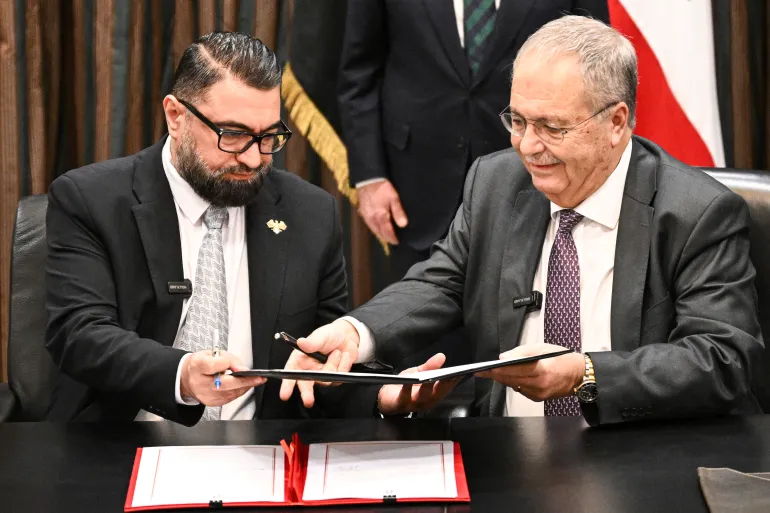
On Friday, the agreement was signed with a number of Lebanese ministers present, including Prime Minister Nawaf Salam, Deputy Prime Minister Tarek Mitri and the two countries’ justice ministers.
“This is a very important first step on the road of a comprehensive treatment regarding Syrian prisoners in Lebanese prisons,” Mitri said to reporters on Friday.
Syrian Justice Minister Mazhar al-Wais said: “This step will boost existing confidence, and we hope that relations will progress more.”
The agreement reportedly stipulates that over the next three months, about 300 prisoners will be repatriated to Syria and those serving time for serious crimes, such as rape or murder for example, must have served 10 or more years of their sentences in Lebanese prisons to be eligible for repatriation.
Lebanese prisoners, such as al-Assir, are not included in the deal.