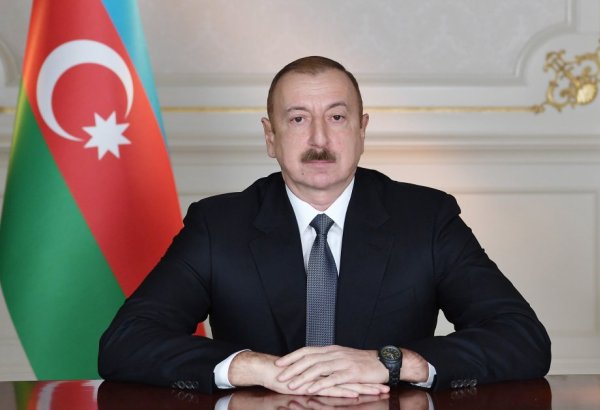




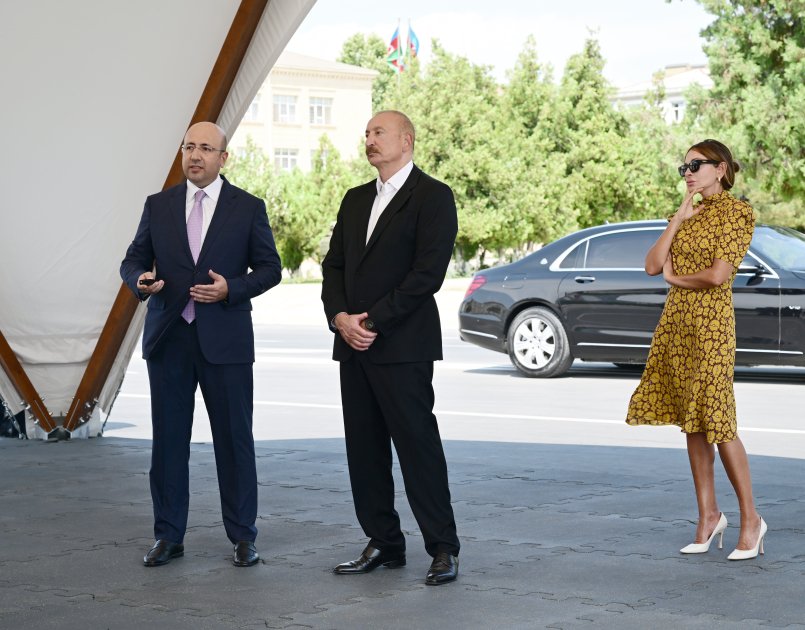
BAKU, Azerbaijan, August 11. President of Azerbaijan Ilham Aliyev and First Lady Mehriban Aliyeva reviewed the Master Plan for the Development of Nakhchivan City through 2044 on August 11.
Chairman of the State Committee for Urban Planning and Architecture Anar Guliyev briefed the President and the First Lady on the new Master Plan, the targets set for the city’s future development and the planned works.
The Master Plan was prepared in line with the 2023–2027 State Programme for the Socio-Economic Development of the Nakhchivan Autonomous Republic at the request of the State Committee for Urban Planning and Architecture by the Azermemarlayihə State Head Design Institute and international consulting company Chapman Taylor.
The new Master Plan, the first comprehensive plan prepared for Nakhchivan city during Azerbaijan’s independence period, establishes a unified strategic vision for the city’s spatial development.
The concept focuses on the renewal of the city centre, expansion of recreational areas, promotion of sustainable mobility, strengthening residential and social infrastructure, and more effective use of Nakhchivan’s tourism potential.
One of the main development priorities is the restructuring of the central part of the city. A detailed plan has been prepared for a 74-hectare central district, alongside a new architectural concept covering 12.5 hectares within the district while preserving its existing planning structure.
The project envisages transforming the city centre into a more vibrant, compact and accessible urban space. Outdated buildings without historical significance are planned to be gradually replaced with modern multi-storey residential and multifunctional buildings. A new administrative complex is also planned, while the central square is expected to become a more people-oriented public space with new landscaping and architectural elements.
The city’s green infrastructure will also be expanded. The area along the Nakhchivanchay River will be integrated into urban life through new parks, recreational areas and public spaces. As a result, green space per capita is expected to increase from 15 to 27 square metres.
The Master Plan also introduces new principles for urban mobility. The total length of the street and road network is expected to reach 188.4 kilometres, while bicycle infrastructure will extend to 122 kilometres. This would mean that more than 65 percent of the overall street and road network would be adapted for bicycle traffic.
Nakhchivan’s rich historical and cultural heritage and advantageous geographical location are identified as key advantages for developing tourism. Alongside preserving historical heritage, expanding services and improving the quality of the urban environment are expected to strengthen the city’s tourism competitiveness.
According to the Master Plan, the built-up area is projected to increase from 1,831 to 2,630 hectares, representing an expansion of approximately 44 percent. The city’s population is expected to rise from 97,200 to 130,000.
The residential housing stock is planned to reach 3.9 million square metres, providing an average of 30 square metres of living space per person and enabling new residential neighbourhoods to be developed together with social, transport and engineering infrastructure.
Social infrastructure will expand alongside the city’s growth. The capacity of general education institutions is planned to reach 23,400 places, preschool facilities 7,800 places, and hospital capacity 650 beds.
Employment is also projected to increase by nearly 40 percent to approximately 78,000 people, supported by the development of services, transport and logistics, industry, construction, tourism and agriculture.
As a strategically important part of the Middle Corridor, Nakhchivan is planned to develop into a larger and more sustainable urban centre by 2044. The new Master Plan seeks to combine the city’s historical and cultural heritage with modern urban planning principles, establishing a strategic foundation for its development as a sustainable, inclusive and people-oriented regional centre.