





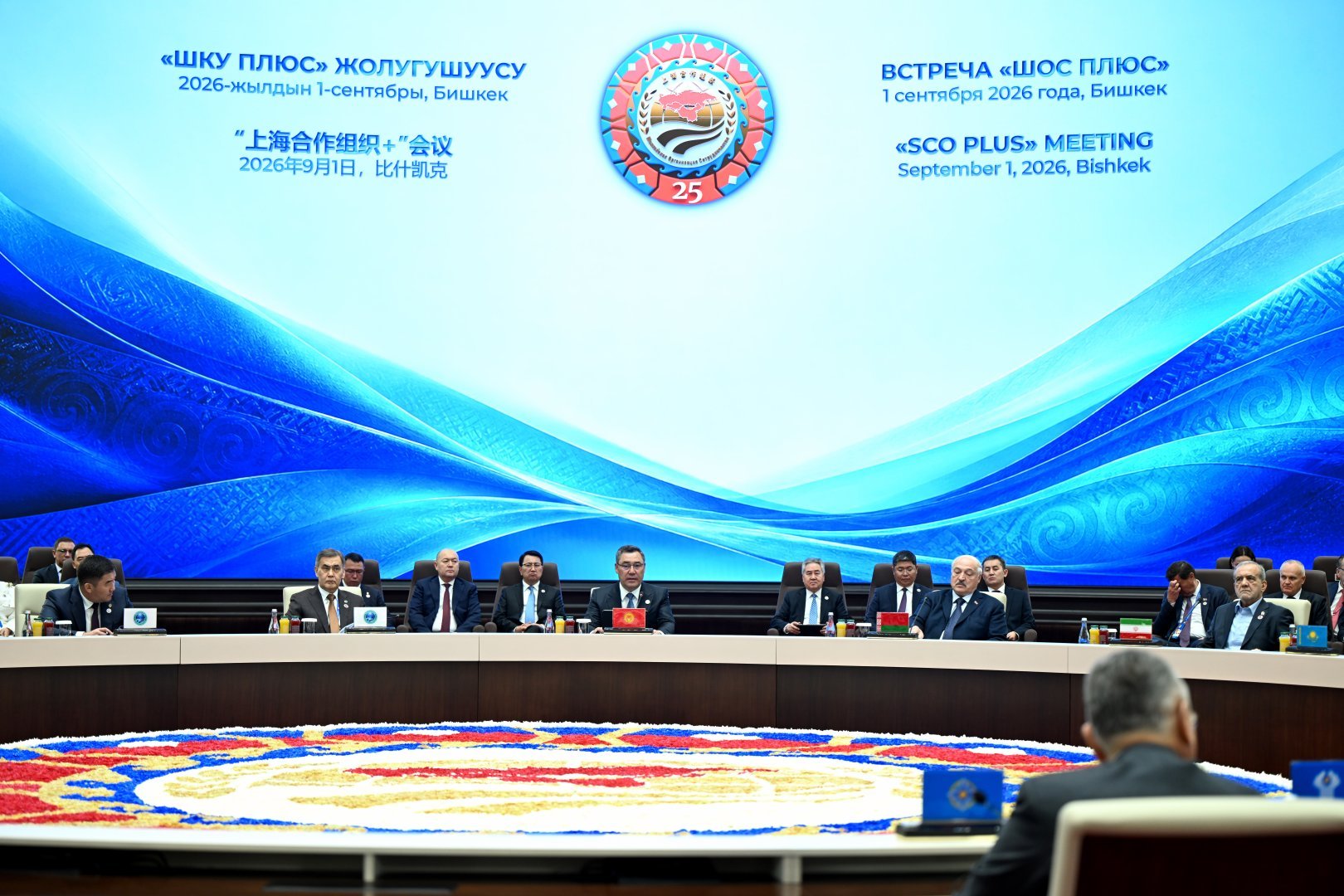
BAKU, Azerbaijan, September 2. Under Kyrgyzstan’s chairmanship, the Shanghai Cooperation Organization (SCO) held its anniversary summit in Bishkek, where member states adopted and signed 28 documents covering security, transport, energy, digital technologies, counter-narcotics efforts, and climate cooperation.
For Kyrgyzstan, the significance of these decisions extends beyond hosting another regular meeting of the organization. Bishkek had an opportunity to shape part of the SCO agenda around areas directly related to its economic and infrastructure interests, including transport connectivity, energy, digitalization, and the development of regional security mechanisms.
One of the most concrete outcomes was an institutional decision in the security sector. The summit approved regulations on the Universal Center for Countering Security Challenges and Threats of SCO Member States. Under this framework, the Bishkek Center is expected to begin operating, with a practical role in coordinating law-enforcement cooperation, facilitating the exchange of operational information, conducting joint activities, and training specialists.
"For us, the main criterion of justice is taking into account the voice of every state and the unwavering application of international norms equally to all. That is why the Kyrgyz Republic is firmly convinced that the United Nations should remain at the core of the emerging multipolar world," Kyrgyz President Sadyr Japarov said while speaking at the SCO Plus meeting.
For the host country, this represents the establishment of a permanent SCO mechanism on its territory. Unlike political declarations, the effectiveness of such a decision will depend not on its creation itself, but on the extent to which SCO countries regularly utilize the Bishkek Center for information exchange and joint work.
"Strong regional organizations strengthen the universal system of international relations, make it more resilient, and bring common principles closer to the real needs of our peoples," Japarov emphasized.
At the same time, Kyrgyzstan links the security agenda to economic issues. During its chairmanship, Bishkek promoted the idea of developing more effective economic infrastructure within the SCO, including practical progress toward establishing an SCO Development Bank. Kyrgyzstan also proposed using the Tamchy Special Financial and Investment Territory in Issyk-Kul for projects involving member states and businesses.
The economic track could prove the most important for Kyrgyzstan in the medium term. For Bishkek, participation in multilateral mechanisms is likely to be most meaningful when it translates into actual investment, trade flows and new transport routes.
Transport connectivity is particularly important in this context. The summit approved a plan for developing ports and logistics centers in SCO countries for 2026–2030. At the same time, Kyrgyzstan promoted the China-Kyrgyzstan-Uzbekistan railway as one of the key elements of future regional connectivity.
For Bishkek, the project is significant not only as transport infrastructure. Its implementation could alter Kyrgyzstan’s position in regional supply chains by creating additional opportunities for the transit of Chinese goods to Central Asia and beyond. Moreover, the creation of logistics centers and industrial sites along the railway has already been discussed, potentially allowing the country to move beyond a transit model toward locating part of the production process directly in Kyrgyzstan.
Another area that could change Kyrgyzstan’s position within the SCO is the digital agenda. Bishkek adopted a conceptual document on establishing regional data centers, developing computing capacity and the artificial intelligence industry, as well as the Green Technology Corridor program for 2026–2030.
For Kyrgyzstan, this creates several potential avenues. The country could use the larger SCO market to attract technology investment, develop digital services and data-processing infrastructure, or focus on specific niches where it would not have to compete directly with the organization’s technology giants.
Among the summit’s final documents are also statements on cooperation in energy systems and improving energy efficiency. This is particularly relevant for Kyrgyzstan given its role in regional hydropower and its continuing need to modernize its domestic energy infrastructure.
In this area, Kyrgyzstan’s interests extend beyond the SCO as a political organization. The country needs to increase domestic electricity generation, modernize its power networks, and identify markets for potential exports at the same time. Therefore, the multilateral energy agenda could provide an additional platform for promoting projects if broader statements are followed by concrete financing mechanisms and intergovernmental electricity supplies.
At the same time, the chairmanship allowed Kyrgyzstan to strengthen the diplomatic dimension of its foreign policy. Bishkek used the SCO Plus format to expand dialogue beyond the organization’s member states, inviting, among others, Azerbaijan, Türkiye, Armenia, Egypt, Vietnam, Mongolia, Laos and Togo, as well as UN Secretary-General António Guterres.
This is important from the perspective of Kyrgyzstan’s foreign policy space. For a country without economic or military resources comparable to those of the SCO’s largest members, a multilateral organization provides an opportunity to maintain relations simultaneously with Russia, China, the Central Asian states and countries beyond the region.
Another factor was Kyrgyzstan’s election as a non-permanent member of the UN Security Council for 2027–2028. Bishkek has linked its future work there to the idea of closer interaction between the Security Council and regional organizations. In this way, Kyrgyzstan’s SCO chairmanship and its upcoming work on the UN Security Council could be used to advance the same diplomatic line — greater participation in multilateral decision-making mechanisms.
The outcomes of the summit have left Kyrgyzstan with several potential pathways for further development.
The first scenario is infrastructure-driven. Under this approach, Bishkek would prioritize the implementation of railway and logistics projects, using SCO decisions as political and institutional support. If successfully implemented, these projects could strengthen Kyrgyzstan’s transit role and attract investment in manufacturing and logistics.
The second scenario is investment-driven. Kyrgyzstan could seek to transform Tamchy and other special economic mechanisms into platforms for projects involving companies from SCO member states. Under this scenario, the principal measure of the chairmanship’s outcomes would be the volume of projects actually launched.
The third scenario is institutional. The Bishkek Center for Countering Transnational Organized Crime could develop into one of the permanent components of the SCO’s institutional infrastructure in Central Asia. In this case, Kyrgyzstan’s role within the organization would be determined not only by its participation in annual summits but also by the functioning of a specific regional mechanism.
The fourth scenario is technology-driven. Kyrgyzstan could leverage decisions concerning artificial intelligence, digital infrastructure, and green technologies to attract investment and gradually develop its own technological specialization.