






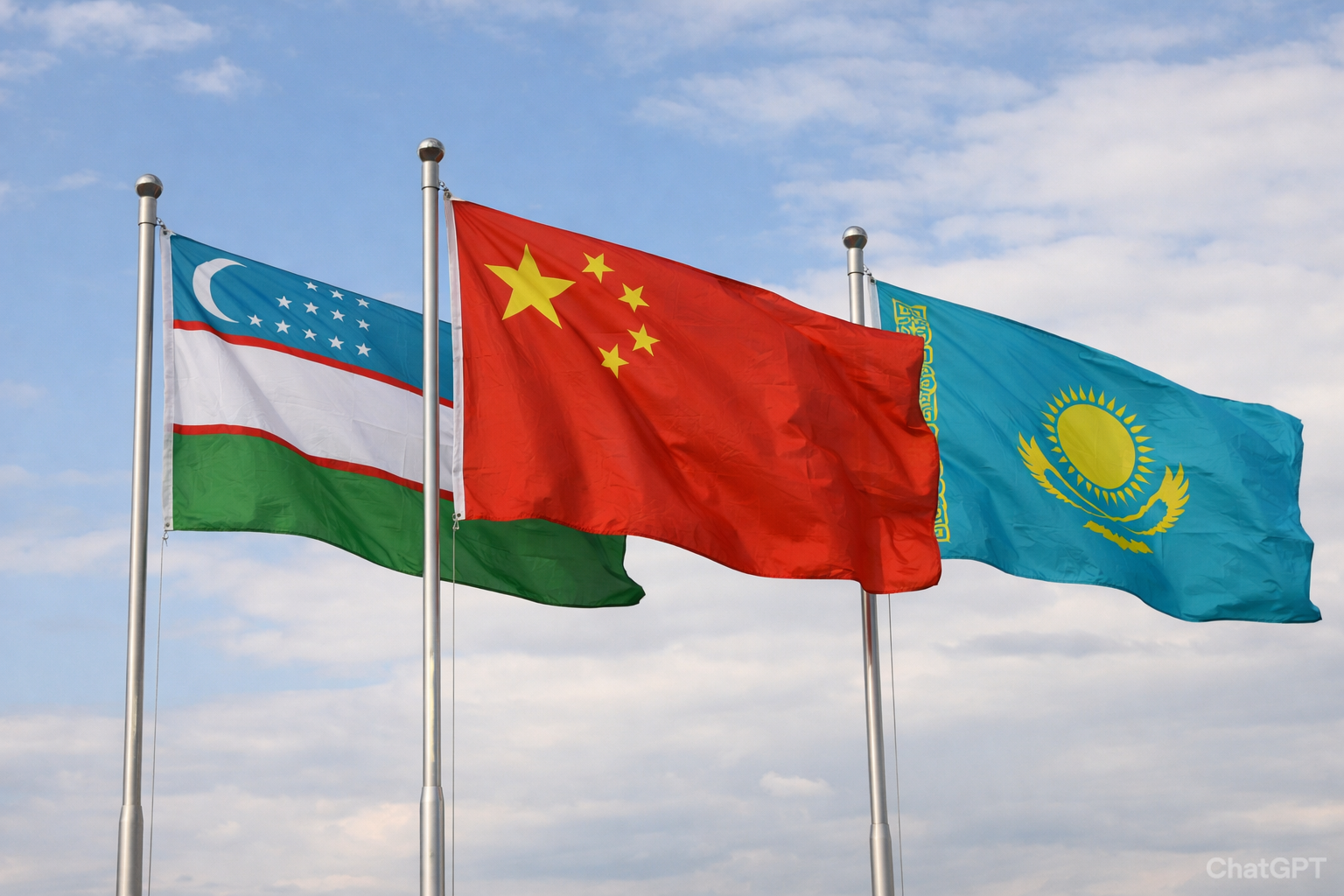
BAKU, Azerbaijan, February 18. China’s economic engagement with Central Asia is entering a new phase, characterized less by grand political rhetoric and more by practical, technocratic implementation. In Kazakhstan and Uzbekistan, China’s presence is expanding across sectors such as logistics, energy, construction, and trade, even as the region's investment landscape becomes increasingly diversified. The outcome is a complex scenario: deeper integration with China, yet under evolving terms that reflect shifting political and economic priorities on all sides.
This shift is clearly exemplified by recent advancements in logistics and infrastructure, which highlight a move toward more results-oriented, pragmatic cooperation. A notable illustration is the successful launch of a pilot container train on February 16, 2026, operated by UTK International Logistics Co. Ltd., a joint venture between Uzbekistan’s Uztemiryulcontainer and Xinjiang Union of Railway International Logistics Co. Ltd. Loaded with eight 40-foot containers carrying consumer goods and construction equipment, the train departed from Lanzhou and journeyed more than 3,500 kilometers along the "China-Kyrgyzstan-Uzbekistan-Tajikistan" multimodal corridor to Dushanbe-2, with an estimated transit time of 18–20 days.
The pilot project, following the formal launch of the venture in Beijing in July 2025, serves as a demonstration of operational readiness for regular container shipments. It enhances Uzbekistan’s position as a transit hub and furthers China’s objectives of strengthening supply-chain resilience under the Belt and Road Initiative.
Kazakhstan’s collaboration with China unfolds on a similarly ambitious scale, albeit in a distinct sector. In September 2025, an agreement was signed in Beijing between Kazakhstan’s National Investment Corporation, Caspian Group, and CSCEC International Construction Corporation Ltd., a subsidiary of China State Construction Engineering Corporation. This $420 million joint project in Alatau City, executed under the EPC+F model, designates CSCEC to oversee engineering, procurement, construction, and financing for a series of complex high-rise buildings, with the design phase already underway.
For Kazakhstan, this combines foreign resources with domestic institutional support: the National Investment Corporation diversifies reserves as an investor since 2012, while Caspian Group (linked to businessman and former senator Yuri Tskhai) and co-investor Vyacheslav Kim (Kaspi.kz co-founder) provide local backing. Proponents see it as a pragmatic acceleration of urban development; critics may scrutinize long-term financial dependencies in such financing structures.
The macroeconomic backdrop adds further nuance. According to the Eurasian Development Bank, China increased its FDI stock in Central Asia from $19.6 billion in 2016 to $35.9 billion by mid-2025, retaining its lead as the region’s top investor. Yet China’s share of total Asian FDI inflows fell from 65% to 53%, as inflows from the United Arab Emirates ($15.5 billion, 23% share), Türkiye, and other Gulf states surged. Overall, Asian FDI stock rose from $29.9 billion to $68 billion, with Uzbekistan, Kazakhstan, and Turkmenistan as key recipients. This signals China’s continued dominance alongside growing diversification by source and sector.
In Uzbekistan, Chinese companies are helping modernize the country's energy sector, focusing on upgrades that boost output and save resources.
For example, Uzbekhydroenergo signed full turnkey (EPC) deals with China's Sinohydro to upgrade the Shakhrikhan Hydropower Cascade. This will double the installed capacity from 7.6 MW to 16.4 MW, adding about 33 million kWh of electricity each year - enough to power many more homes while using cleaner energy.
Similar agreements with China's TBEA Co., Ltd. cover three plants (HPP-19, HPP-22, and HPP-23) in the Lower Bozsuv Cascade. Their combined capacity will rise from 27.4 MW to 32.4 MW, producing an extra 52.8 million kWh annually. This will supply electricity to over 21,000 households and cut fuel use by roughly 17 million cubic meters of natural gas plus more than 40,000 tons of coal per year. These projects deliver clear wins for the economy and the environment.
Cooperation in oil and gas is also strong. Uzbekneftegaz and China's BGP (a CNPC subsidiary) have agreed to carry out seismic surveys over large areas - 3,000 square kilometers in Mubarek and 1,300 square kilometers in Ustyurt - to explore for new resources.
In addition, a deal with China's Jereh Group supplies 22 wellhead compressor stations for gas fields. Fourteen are already fully operational, and the rest are being installed. Both sides stress keeping projects on track and fixing any issues quickly.
The trade and financial exchanges between China and Kazakhstan underscore the depth of their economic ties. In 2025, China accounted for 19.2% of Kazakhstan’s total exports, valued at $15.208 billion, nearly identical to Italy's share of 19.8%. Kazakhstan’s overall exports amounted to $79.041 billion, marking a 3.2% decline from the previous year, with crude oil and petroleum products comprising half of this total.
What is evident is that China’s economic collaboration with Kazakhstan and Uzbekistan has evolved beyond theoretical frameworks into tangible actions. This cooperation is now reflected in scheduled train departures, increased power generation from upgraded turbines, and contracts that are measured by concrete outcomes. Whether this trajectory results in a balanced interdependence or a more asymmetric relationship remains uncertain. Ultimately, the long-term evaluation of this dynamic will rest with the region itself.