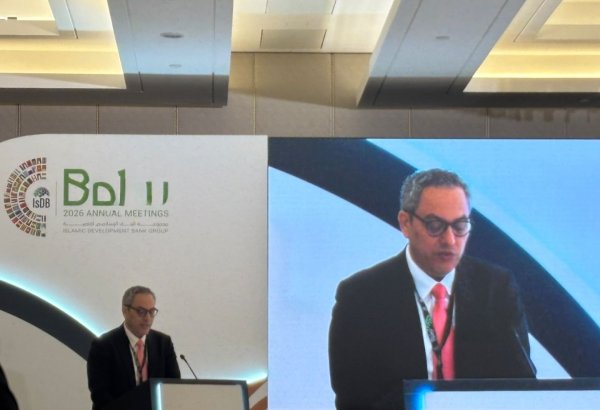


BAKU, Azerbaijan, June 16. Baku is hosting the Annual Meeting of the Islamic Development Bank Group (IsDB), one of the largest events in international development and finance in the Islamic world, from 16 to 19 June. Representatives from the bank's 57 member countries, international financial institutions, investment funds, and development organizations have gathered in the capital of Azerbaijan.
The theme of this year's meeting is "Regional Integration for Sustainable Prosperity". However, for Azerbaijan, the forum has much broader significance than simply serving as a platform for discussing the economic agenda. It's an opportunity to showcase the results of years of reform, attract new investment, and define the parameters of cooperation with the Islamic Development Bank for the coming years.
Over three decades of cooperation
Azerbaijan joined the Islamic Development Bank in 1992, shortly after regaining its independence. Over the years, the country has become a member of all IsDB Group entities, including the Islamic Development Bank, the International Islamic Trade Finance Corporation (ITFC), the Islamic Corporation for the Development of the Private Sector (ICD), and the Islamic Corporation for the Insurance of Investment and Export Credit (ICIEC).
Over this period, this cooperation has evolved into a full-fledged strategic partnership. The bank's support encompassed infrastructure project financing, technical assistance, trade facilitation, strengthening of public institutions, and private sector support.
As of the end of 2025, the total volume of approved IsDB Group operations in Azerbaijan reached $1.3 billion. Of this, $1.04 billion was directly provided by the Islamic Development Bank. ITFC operations totaled $93.4 million, ICD financing reached $165.2 million, and other funds of the group provided an additional $25.7 million.
In total, the cooperation portfolio includes 85 projects, 75 of which have already been completed, and another 10 are under implementation.
Energy remains primary focus
The energy sector has traditionally been the largest recipient of financing.
It accounted for 37.3% of all transactions, or approximately $495 million. Over the years of cooperation, seven major energy projects have been implemented, and new initiatives in this sector are already being considered for further financing.
This structure reflects Azerbaijan's role as one of the region's leading energy centers. However, in recent years, cooperation has gradually expanded far beyond the oil and gas sector.
Other areas include the development of water supply and sanitation infrastructure, agriculture, the financial sector, transport, and sustainable development projects.
In fact, the evolution of cooperation between the IsDB and Azerbaijan reflects the transformation of the Azerbaijani economy itself, which is increasingly focused on diversification and development of non-oil sectors.
New partnership strategy: heading for 2030s
One of the key results of the current forum may be the advancement of work on a new Partnership Strategy between Azerbaijan and the Islamic Development Bank for 2027–2031.
As IsDB Group Chairman Muhammad Sulaiman Al Jasser said in an exclusive interview with Trend during his visit to Baku in May, the parties expect to sign a memorandum of understanding on this issue in June.
According to him, the new strategy should give additional impetus to the country's economic development and speed up the implementation of major investment projects.
It's especially important that the bank's management views Azerbaijan as a country with a stable macroeconomic system and a relatively low level of public debt.
Al Jasser emphasizes that borrowing from international development institutions is used by Azerbaijan primarily for productive investments that can create a long-term multiplier effect, stimulate economic growth and create quality jobs.
This approach is fully consistent with the financing model of the Islamic Development Bank itself, which relies on projects with high returns for the national economy.
Azerbaijan as example for countries of Islamic world
Particular attention is drawn to the high assessment that the bank’s management gives to the modern development of Azerbaijan.
According to Al Jasser, the June meetings should demonstrate to member countries Azerbaijan's achievements in the field of economic development, public administration and digital transformation.
In fact, the head of the IsDB directly called Azerbaijan a model whose experience other countries can study and apply.
This emphasis isn't accidental.
In recent years, Azerbaijan has made significant progress in digitalizing public services, modernizing infrastructure, improving the business climate, and developing transport and logistics corridors.
Holding such a high-profile international forum serves as a showcase for these achievements.
As Al Jasser noted, introducing foreign delegations to the transformations underway in the country can facilitate not only expanded cooperation with development institutions but also the attraction of private capital.
Therefore, the current meeting is viewed not simply as a diplomatic event, but as a tool for promoting the country's investment.
Islamic finance: new window of opportunity
The development of Islamic finance is emerging as one of the most promising areas of cooperation.
In recent years, the IsDB has provided Azerbaijan with significant technical support in creating a regulatory framework for Islamic financial instruments.
Back in 2020, a project to develop legal mechanisms for Islamic finance was completed. Currently, the Islamic Development Institute (IsDBI) is implementing a new project to create conditions for the issuance of sukuk and the introduction of other Islamic finance instruments.
Furthermore, the IsDBI has approved a $255,000 grant for the Central Bank of Azerbaijan to develop the capital market regulatory framework. This project continues a previous technical assistance program worth $200,000.
According to Al Jasser, the global Islamic finance market currently stands at approximately $3.5 trillion, opening up a whole new investor base for Azerbaijan.
This is not about replacing traditional financial instruments, but rather about diversifying capital sources.
This is particularly relevant for Azerbaijan as it implements large-scale projects in infrastructure, industry, agriculture, the digital economy, and renewable energy.
The emergence of a sukuk market could significantly expand investment opportunities for the public and private sectors, as well as enhance the economy's long-term financial stability.
Regional integration and transport corridors
The topic of this meeting—regional integration—is directly related to Azerbaijan's growing role as a transport and logistics hub for Eurasia.
According to the IsDB head, the country is already becoming a key crossroads of international trade thanks to its geographic location and consistent economic policies.
The development of railway routes, highways, maritime transport across the Caspian Sea, and international transport corridors is turning Azerbaijan into an important link between East and West, North and South.
It's particularly significant that the bank's management views transport connectivity not only as a factor in national growth but also as a mechanism for the development of the entire region.
This is entirely consistent with the concept of the current forum, which envisions strengthening economic ties between countries of the Islamic world through the development of trade, investment, and infrastructure.
From borrower to donor?
Perhaps the most telling statement by Al-Jasser was his assessment of Azerbaijan's long-term prospects.
According to him, the Islamic Development Bank expects Azerbaijan to transition from a borrower to a donor country in the future.
For an international financial institution, such an assessment is highly significant.
It reflects a high level of confidence in the country's economic policy, its financial stability, and its prospects for further growth.
Given the implementation of the "Azerbaijan 2030" strategy, the active development of the non-oil sector, the expansion of export potential, and the country's transformation into a regional logistics hub, this prospect no longer appears to be a purely long-term goal.
The Islamic Development Bank's annual meeting in Baku is becoming an important event not only for the bank and its member states, but also for Azerbaijan.
On the one hand, the forum is summing up more than thirty years of cooperation, with projects valued at over $1.3 billion. On the other hand, it's opening a new chapter in the partnership, focusing on the development of a Cooperation Strategy for 2027–2031, the development of Islamic finance, attracting new investment, and supporting large-scale infrastructure initiatives.
It's symbolic that the central theme of this year's forum was regional integration. It is in this area that Azerbaijan is rapidly strengthening its position, becoming an important transport, trade, and financial hub between Europe, the Middle East, Central Asia, and the Islamic world.
Therefore, holding the IsDB Annual Meeting in Baku can be seen not only as recognition of the results already achieved but also as a signal of Azerbaijan's growing role in the architecture of regional economic cooperation.