



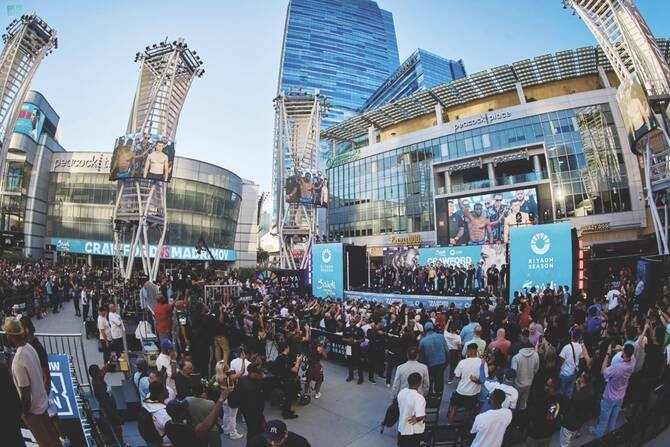
BAKU, Azerbaijan, January 4. Across the Middle East, exhibitions and large-scale events are increasingly reshaping how economies grow, TurkicWorld reports via Arab News.
Once viewed primarily as platforms for visibility and networking, they are now functioning as economic infrastructure — influencing investment decisions, accelerating partnerships and helping cities compete on a global stage.
From business forums and cultural platforms to design-led showcases, the exhibitions and events sector has become embedded in national development strategies across the GCC and wider region.
Governments and private-sector players alike are investing heavily in venues, skills and year-round programming, viewing the ability to bring markets together as a strategic economic asset.
Saudi Arabia is among the most prominent examples of this shift. As part of Vision 2030, the Kingdom is undertaking a major expansion of its exhibition and conference infrastructure.
 By 2030, more than 1 million sq. meters of additional space is expected to be added, reinforcing Saudi Arabia’s ambitions to position itself as a global hub for business, culture and investment.
That expansion aligns with broader economic goals. Saudi Arabia plans to raise the cultural sector’s contribution to gross domestic product to 3 percent — equivalent to SR180 billion ($48 billion) — by 2030, up from under 1 percent, according to Minister of Culture Prince Badr bin Abdullah bin Farhan.
To organize the sector’s rapid growth, the Saudi Conventions and Exhibitions General Authority has launched a global exhibition and conference season running annually from October to May.
The season clusters major international business, investment and cultural events into a defined period, improving predictability for global organizers and partners.
Recent editions have included gatherings such as Cityscape Global, the Future Investment Initiative, the Fortune Global Forum, the Global Health Exhibition and the International MICE Summit.
According to SCEGA, Saudi Arabia has emerged as one of the fastest-growing business events markets among G20 countries, with over 200 major international events hosted annually.
That growth has been accompanied by investment in human capital. Saudi professionals now account for nearly 20 percent of Certified in Exhibition Management certificate holders globally, one of the highest proportions worldwide. The economic function of exhibitions is increasingly evident in the outcomes they generate. At the International MICE Summit in Riyadh, hosted by SCEGA, industry leaders signed 20 agreements and memorandums of understanding on the first day alone, involving companies with a combined global revenue exceeding $9 billion. Speaking to Arab News in November, SCEGA CEO Hatim Al-Kahily said the summit demonstrated Saudi Arabia’s ability to convene global sector leaders in Riyadh.
For operators working directly in the sector, the impact of exhibitions is measured well beyond attendance figures. Lubna El-Masri, marketing and communications director at Riyadh Exhibitions Company, said events now operate as economic accelerators.
“A good exhibition doesn’t just create footfall; it creates deals, jobs, and confidence. It pulls a whole ecosystem with it, from hotels and logistics to local SMEs and creative talent,” she told Arab News.
She said venue design has evolved accordingly. “The smartest shift I’ve seen is treating venues like ‘always-on’ platforms, not occasional event spaces.
Flexible layouts, digital access, data, it’s all about making the experience smoother and more scalable.”
Exhibitions also play a strategic role in building international partnerships, El-Masri said, adding that they “are one of the quickest ways to build trust.”
She continued: “When international partners see the scale, the quality, and the seriousness on the ground, it changes the conversation.”
From an urban development perspective, exhibitions are influencing how future cities are designed. Moath Al-Qahtani, events manager at Riyadh Exhibitions Co., said exhibition innovation is now integrated into new infrastructure projects.
“In Saudi Arabia, exhibition innovation is being built directly into new infrastructure and real estate developments,” he told Arab News. “At Riyadh Exhibitions Co. we see venues and districts now designed to support flexible, tech-enabled events that integrate digital services and immersive visitor experiences.”
He added: “This approach is especially evident in the preparations for Expo 2030, where entire urban zones are being developed with smart mobility, sustainable facilities, and advanced digital experiences.”
Beyond Saudi Arabia, similar dynamics are shaping how exhibitions, design and culture support economic integration across the Middle East.
Sheikh Hamad bin Talal Al-Thani, CEO of Qatari Diar, said design-led projects and cultural showcases increasingly function as regional economic connectors.
“Across the Middle East, design-driven investments and cultural exhibitions are becoming powerful drivers of economic growth. Today, design is not only a creative expression but an economic catalyst that attracts tourism, fuels local industries, and generates new opportunities across construction, hospitality, and the creative sectors,” he told Arab News.
Al-Thani said such platforms play a broader strategic role for the region, with design and cultural showcases playing a vital role in shaping the Middle East’s global competitiveness.
“These platforms highlight the region’s ambitions, celebrate its talent, and project a modern, confident image to the world. They also contribute to broader national strategies around sustainable development, tourism, investment attraction, and innovation ecosystems,” he added.
The CEO pointed to regional design platforms — including events such as Cairo Design Week — as examples of how exhibitions bring together designers, developers and investors across markets, enabling cross-border collaboration and strengthening economic ties across the Middle East.
Looking ahead, industry leaders say exhibitions and events will remain central to the region’s economic evolution. As countries diversify their economies and cities compete for capital, talent and influence, the ability to bring stakeholders together — and convert attention into tangible outcomes — is becoming a defining advantage.
The exhibitions and events economy is no longer an accessory to growth. It is increasingly part of the Middle East’s core economic infrastructure.