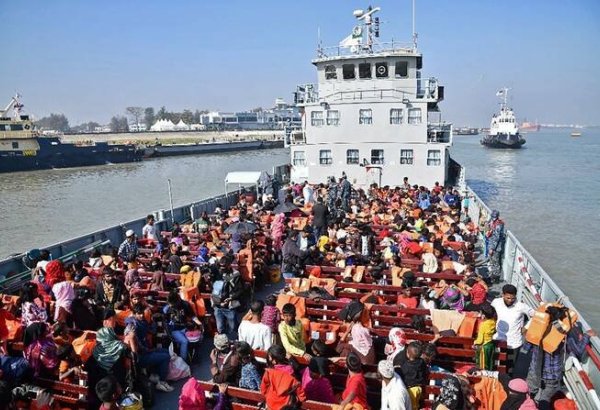



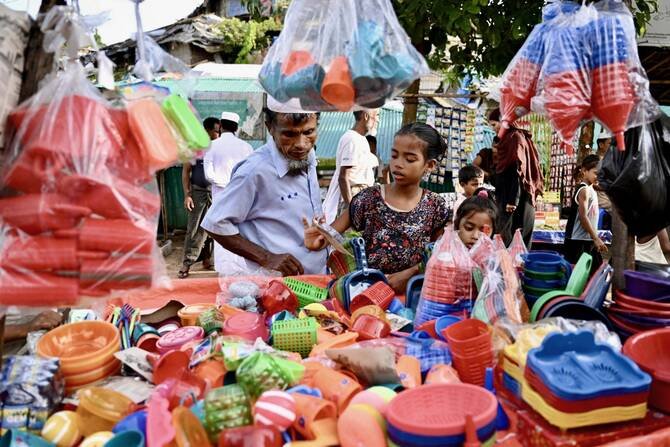
Nine years after hundreds of thousands of Rohingya were forced from their homes and across the border into Bangladesh, their return to Myanmar seems as distant as ever, but for many the hope of seeing their land again is what keeps them going TurkicWorld reports via arabnews.
Mohammed Aansar was working as a high school teacher in Myanmar’s Rakhine State when his family had to leave everything behind to escape a military crackdown that began on Aug. 25, 2017.
“Life in my village was comfortable and stable. I had a home, land and other property, a motorbike, cattle, and poultry,” he told Arab News.
“My home in Myanmar was a two-story house, built entirely of wood. It was a comfortable and peaceful place where I had everything I needed.”
He has not felt this kind of comfort ever since settling Cox’s Bazaar, a coastal district of southeastern Bangladesh, which currently hosts about 1.3 million Rohingya in 33 cramped refugee camps.
“Life here in Cox’s Bazar is completely different. We live in a refugee camp without permanent homes, land, or property and with very limited opportunities to build an independent life. There is little sense of stability or security compared with the life we had before displacement,” Aansar said.
“Although we faced restrictions and discrimination, I still had a livelihood, a home, and a future to look forward to.”
A predominantly Muslim ethnic minority, the Rohingya have lived for centuries in Myanmar’s western Rakhine state but were stripped of their citizenship in the 1980s.
Before 1989, official documents issued by the Myanmar government identified the community as Rohingya. However, following the 1982 Citizenship Law, which recognized 135 ethnic groups but excluded the Rohingya, references to them were gradually removed from official records and state publications.
In the years that followed, the community was increasingly and systematically referred to in official discourse as “Bengali Muslims” and exposed to state violence.
Since then, many have fled to neighboring Bangladesh, with about 700,000 arriving in August-September 2017, when the violence peaked.
Despite multiple attempts from Bangladeshi authorities, a UN-backed repatriation and resettlement process of the Rohingya has failed to take off.
Efforts have been stalled by armed conflict in Myanmar since the military junta seized power in 2021. Since 2024, the situation has been further complicated by fighting in Rakhine between junta troops and the Arakan Army, a powerful local ethnic militia.
What increased the refugees’ hopes for return is Myanmar’s announcement earlier this month that it will accept the return of 300,000 Rohingya living in Bangladeshi camps “when the security situation in Rakhine state becomes more stable.”
Arif Salam and Mujibur Rahaman were teenagers when they had to leave their homes in Rakhine. They remember how their villages were destroyed and people killed. They are not sure if they will be safe upon return, but they want to try to change the conditions they are living.
“We saw our homes destroyed, our community attacked,” said Salam, who was 15 when his family fled to Bangladesh. “But despite these fears, my heart is still connected to my homeland.”
Rahman, aged 25, said: “We had a strong sense of community. Life in the camp is not similar ... We have very limited space and freedom.”
In the overcrowded camps of Cox’s Bazar, their access to education is limited, there are no work opportunities, and as international aid for the Rohingya has plunged over the past few years, even food rations have been cut, leaving most of the refugees malnourished.
Fatema Begum, 60, remembers family gatherings and Eid celebrations at home. They have never felt even remotely similar during displacement. Even the food she cooked tasted different.
“My favorite curry was gourd cooked with little shrimp. But I don’t get this curry here ... Even if I manage to get the gourd or sweet pumpkin here in the camp, I don’t get those flavors in the curry. I don’t know why these vegetables don’t give the taste that I got in our homegrown vegetables,” she said.
“We used to grow most of the food by ourselves ... But now it is nothing similar to our old life in Rakhine. In the refugee life, I have been like a dead woman.”
Eid days especially remind her of how life used to be, how her family and friends in different villages, how they used to visit each other.
“In Rakhine, I was like a free bird, with open spaces, no restrictions on visiting friends and relatives,” she said.
“We had good enough sources of income, we could offer Eid gifts to the children. Here we can’t ... I used to send cooked meals to the homes of my siblings and daughters. But this tradition is lost here in refugee camps. We can’t afford it.”