






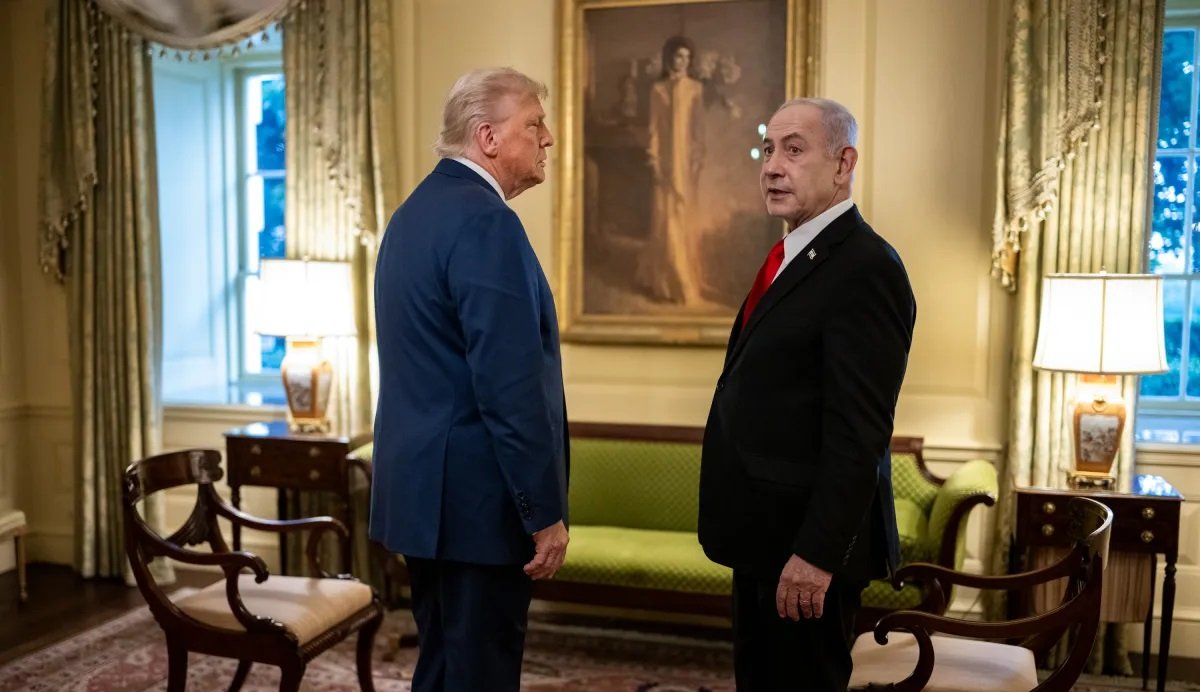
BAKU, Azerbaijan, August 10. Israeli Prime Minister Benjamin Netanyahu’s opposition to U.S. President Donald Trump’s Gaza plan has brought renewed attention to growing differences between Washington and Tel Aviv over the future of the conflict.
Netanyahu’s position is particularly notable because it came after Trump announced "historic" Gaza disarmament agreement and made clear that the group’s removal of its military capabilities would be central to any lasting settlement in Gaza.
The development has raised questions about whether the disagreement represents a temporary dispute over Gaza or reflects a broader strategic gap between the Trump administration and Netanyahu’s government.
Speaking to Americandiary24, Middle East affairs expert Rufiz Hafizoglu said that despite the tensions between Trump and Netanyahu, the strategic alliance between the United States and Israel is unlikely to be fundamentally disrupted TurkicWorld reports via americandiary24.
“As long as the State of Israel exists and the interests of major geopolitical powers do not change, Israel will remain one of the United States’ closest allies. This is a reality,” Hafizoglu said.
According to the expert, Washington is unlikely to remove Israel from its list of key allies despite the increasingly visible disagreements between Trump and Netanyahu.
Why are Trump and Netanyahu increasingly at odds?
Hafizoglu argued that the current tensions should not be viewed solely through the prism of Trump’s Gaza proposal.
In his assessment, Israel’s military campaign in the region, particularly the war in Gaza, has significantly affected the country’s international standing. He noted that positions toward Israel have also become more openly debated in parts of the U.S. political establishment.
According to Hafizoglu, Israel may have achieved significant military gains in the Middle East, including in its confrontation with Iran, but its political position remains much more complicated.
The expert stressed that his criticism is directed at the policies of Netanyahu’s government rather than at the Israeli public.
In his view, Netanyahu’s decision-making has at times gone beyond Washington’s preferred approach, creating additional complications for U.S. relations with other countries in the region.
Iran war adds another layer to the dispute
Hafizoglu also linked the current tensions between Washington and Tel Aviv to the broader regional confrontation involving Iran.
He argued that Israel succeeded in drawing the United States more deeply into the confrontation with Iran while subsequently reducing its own direct exposure to some of the consequences of the conflict.
In Hafizoglu’s assessment, this has created additional challenges for Washington, particularly because of the vulnerability of U.S. military facilities and American interests across the Middle East.
“The result was that Iran and the United States were left facing each other, while Arab countries and the U.S. presence in Arab countries became targets,” he said.
The expert believes that such developments have contributed to a decline in U.S. influence in parts of the region and have complicated Washington’s broader Middle East strategy.
Changing regional balance
Hafizoglu also pointed to what he sees as a changing regional security environment.
He argued that Iran no longer represents the same level of threat it once did, while Hezbollah has also lost some of its previous capabilities. At the same time, Hamas has been pushed toward negotiations over a ceasefire and disarmament.
In this changing environment, the expert believes Turkey’s growing role, particularly through developments in Syria, could emerge as a new security concern for Israel.
He suggested that Netanyahu could also use concerns about Turkey and regional security as a political issue during a future election campaign.
Will the tensions damage the U.S.-Israel alliance?
Despite the growing disagreements, Hafizoglu does not expect the strategic U.S.-Israel alliance to collapse in the foreseeable future.
Instead, the current dispute can be viewed as a growing difference between two close allies over how the Middle East should be managed and what should come after the Gaza war.
The Trump administration appears increasingly focused on ending the conflict, securing Hamas’s disarmament and moving toward a new political framework for Gaza. Netanyahu’s government, meanwhile, continues to emphasize Israel’s security requirements and its broader regional interests.
How far the disagreement will go may depend on the future of the Gaza ceasefire process, Hamas’s disarmament, and the degree of pressure the Trump administration is prepared to place on Netanyahu.
For now, the dispute does not appear to signal the end of the U.S.-Israel alliance. Instead, it may mark a new phase in the relationship, in which Washington and Tel Aviv increasingly have to negotiate their differences over the future of the Middle East while maintaining their broader strategic partnership.