



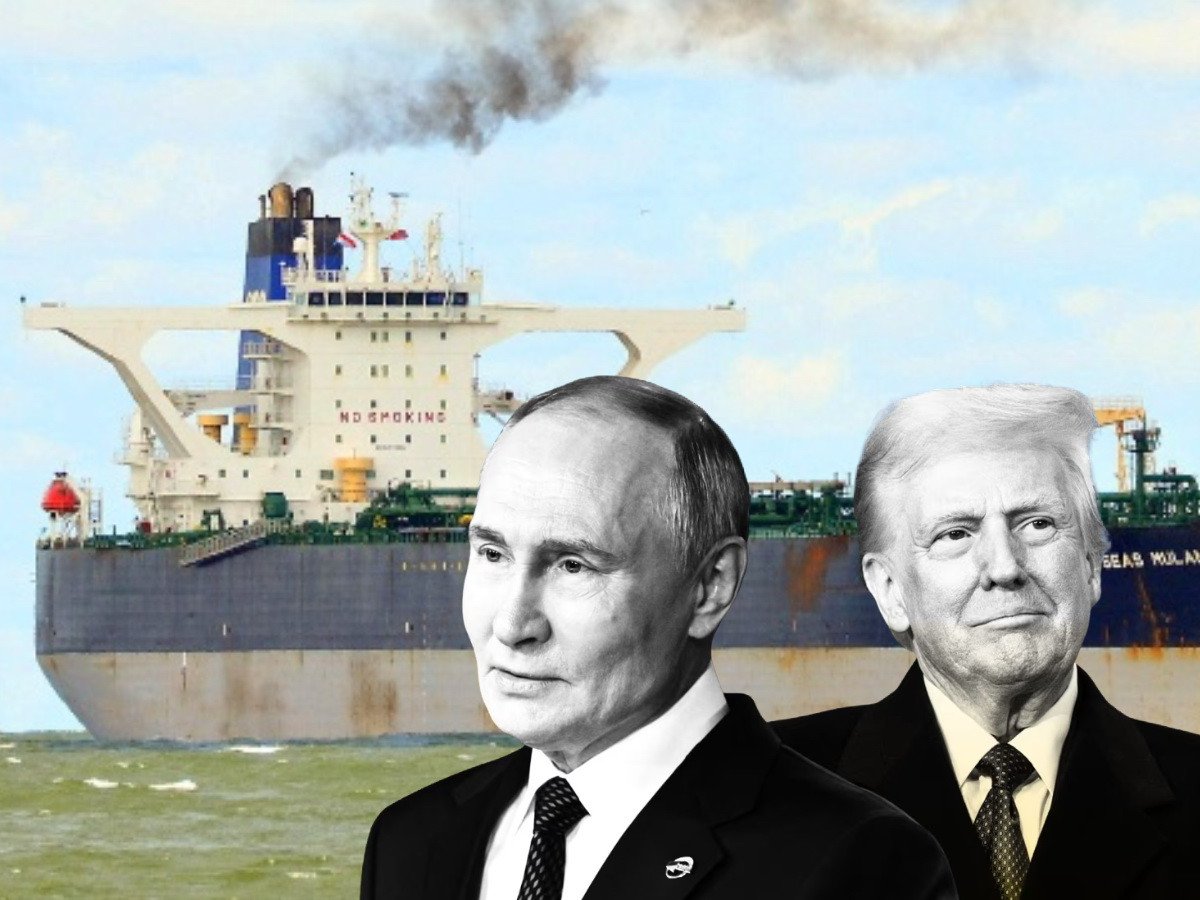
BAKU, Azerbaijan, January 9. The seizure of the oil tanker Marinera by U.S. forces on January 7, 2026, while it was sailing under the Russian flag, is not just another diplomatic flare-up. Its consequences run far deeper. The incident marks the opening of a qualitatively new phase in the evolution of the international order—one in which the balance between law and force has been disrupted, and global maritime jurisdiction has been stress-tested for the first time since World War II.
At first glance, the dispute looks like a familiar argument over jurisdiction and sanctions. In reality, it is a probe of the outer limits of American hegemony and a test of Russia’s willingness to defend its flag not merely as a symbol, but as an institution. The Marinera affair has become a case study in systemic shift, revealing how international law is losing its neutrality and turning into a functional extension of power politics.
From Technical Maneuver to Geopolitical Challenge
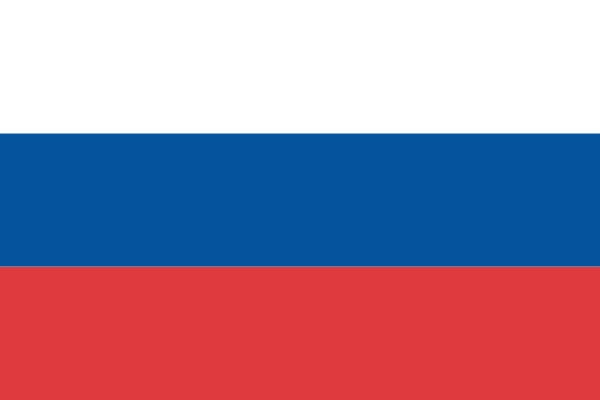
On January 7, U.S. forces seized the tanker Marinera after a two-week pursuit in international waters. Russia’s Ministry of Transport stated that the vessel had received temporary authorization on December 24, 2025, to sail under the Russian flag—issued in full compliance with the 1982 UN Convention on the Law of the Sea.
Under that convention, the high seas are governed by the principle of freedom of navigation: no state has the right to use force against a vessel registered under another state’s jurisdiction.
Formally, this argument is airtight. In practice, however, Washington has leaned on Article 110 of the convention, which allows warships to stop and inspect vessels under certain conditions—specifically if a ship is deemed to have “no nationality.” That clause became the linchpin of the American interpretation.
U.S. Vice President J.D. Vance put it bluntly: “This was a fake Russian tanker. They tried to pass it off as Russian to evade sanctions. We control Venezuela through financial flows and energy resources—you can sell oil only if it serves America’s interests.”
The statement was almost programmatic. Washington openly acknowledged that maritime law is now subordinate to the logic of sanctions enforcement. This is the essence of the Marinera precedent: the United States is legitimizing intervention in international shipping not in the context of armed conflict, but under the banner of “financial regulation.”
A Legal Architecture of Clashing Norms
Russia’s case rests on Article 92 of the UN Convention, which grants vessels exclusive jurisdiction under the flag they fly, with narrow exceptions: piracy, slave trading, unauthorized broadcasting, or lack of nationality.
Washington counters that the vessel—formerly known as Bella 1 and later renamed Marinera—was in fact Venezuelan and had illegally changed jurisdiction on the high seas, something maritime law explicitly forbids.
Normally, such a change occurs in port and under the supervision of both parties. Here, the reflagging did look like a sanctions-evasion maneuver, and the temporary registration in Taganrog like a legal fiction. That interpretation allowed the U.S. to classify the ship as effectively stateless.
Legally, both sides have arguments—but their logics are mutually exclusive. Russia invokes the sanctity of the flag; the United States invokes the exceptions.
The result is a sovereignty dilemma: who gets to decide where the line lies between a legitimate flag and a fictitious one? The answer determines not only the fate of the Marinera, but the future of a maritime legal system built on the presumption of non-interference.
Sanctions Realism and Post-Global Navigation
Since 2022, as energy sanctions tightened, Russia has assembled what is commonly called a “shadow fleet”—more than 500 tankers registered through offshore schemes and sailing under third-country flags.
According to the International Energy Agency, these vessels account for up to 15 percent of global seaborne oil trade. That segment has become especially vulnerable to U.S. secondary sanctions.
The seizure of the Marinera shows that Washington has moved from financial pressure to physical coercion, creating a precedent for de facto extraterritorial enforcement of sanctions law. Where the United States once relied on asset freezes and financial blockades, it is now operating in a space long considered beyond sovereignty: the open sea.
This shift fits a broader American strategy focused on controlling global chokepoints—energy routes, financial networks, digital infrastructure. It amounts to a doctrine of “sanctions interventionism,” in which rule-breaking is framed as a threat to global order and the use of force is relocated into the economic domain.
Russia’s Response: Strategic Pause, Asymmetric Risk
Moscow’s reaction has been measured, avoiding direct confrontation. Official statements emphasized humane treatment of the crew—two Russians, twenty Ukrainians, and nine Georgian citizens—and adherence to international law. Neither Vladimir Putin nor Sergey Lavrov commented publicly.
That silence signals calculated patience. The Kremlin appears to be gauging how the incident will affect Washington’s posture on Ukraine. If a future Trump administration eases pressure on Kyiv in favor of territorial concessions to Moscow, Russia may let the matter fade. If sanctions intensify, the Marinera could become the trigger for a new phase of confrontation.
Inside Russia, however, parliamentary and media rhetoric tells a different story. Lawmaker Alexei Zhuravlev called for “sinking a couple of American boats,” even hinting at nuclear options “within the doctrine.” Such statements reflect a public appetite for displays of force, cultivated by years of anti-American propaganda. Strategically, though, the Kremlin is still opting for controlled ambiguity—keeping room to bargain.
The Domino Risk
The real danger is that the Marinera becomes a template. If the European Union follows the U.S. lead, mass detentions of shadow-fleet tankers could inflict billions of dollars in losses and cripple Russia’s oil exports.
The fallout would extend beyond Russia. Major shipping lanes through the Suez Canal and the Baltic rely heavily on vessels with murky registration. Disrupting them would destabilize global logistics.
Seen this way, the Marinera seizure is not just a diplomatic incident but a stress test for the global energy security regime. For now, the European Commission has stopped short of synchronizing with Washington, leaving member states to decide individually. Yet the mere possibility of coordination is enough to rattle markets, bake escalation risk into prices, and force shipping companies to reroute.
The incident cannot be viewed in isolation. It is part of a larger strategic theater in which the United States, Russia, China, and Europe are renegotiating control over energy, currency, and maritime flows. In this theater, the seizure of a ship is less an act than a symbol—operating on multiple levels at once.
Tankers as the New Geopolitical Currency
Over the past three years, Russia’s shadow fleet has become a central tool for bypassing sanctions: thousands of voyages a year, hundreds of anonymous shell companies, tens of billions of dollars moving through an economic twilight zone beyond Western jurisdiction.
By IEA estimates, in 2025 alone these routes delivered more than $90 billion to Russia’s budget—roughly 37 percent of its total foreign-trade revenue.
For the United States, that scale is intolerable. Since 1945, American power has rested less on territorial control than on control of flows—financial, energy, informational. Flows enable coercion without war. When Russia built a parallel maritime network outside the dollar’s logic, Washington saw not mere sanctions evasion, but a challenge to the architecture of power itself.
The seizure of the Marinera signals that the United States no longer intends to tolerate gray zones in the global economy. Just as Caribbean pirates were once declared outlaws, today Washington is outlawing the floating assets of an alternative world—one where the dollar is optional and jurisdiction is fluid.
From this point on, any tanker can be declared “stateless” if it violates U.S. sanctions policy. This is a new form of extraterritorial sanctions enforcement: the right to seize without war, legitimized by the rhetoric of combating “illegal oil.”
The Symbolism of Force: Why the United States “Dared”
The line that has already turned into a catchphrase—“The Russians thought the Americans wouldn’t dare. And then they did”—is not just an expression of surprise. It is an admission of a new asymmetry of nerve.
Washington deliberately crossed a line that Moscow had considered unthinkable since 1945. Not for oil. Not for Venezuela. But to demonstrate that the old taboos are gone.
For the first time since the Cuban Missile Crisis, the United States has publicly challenged the immunity of the Russian flag—something that for decades had been treated as untouchable. Even at the height of the Cold War, no American ship ever detained a Soviet vessel on the high seas.
That principle is now broken. And it was broken deliberately, in full view of the world.
The paradox is that Washington chose an almost perfectly “convenient” target: formally non-Russian, legally ambiguous, but symbolically loaded. The move does not amount to an act of war, yet it looks unmistakably like a test of Moscow’s tolerance threshold.
Russia is expected to respond—but cannot. The United States violated not the letter of the law, but its meaning, and did so with surgical precision, leaving Moscow trapped in a zone of strategic ambiguity.
The “Marinera Case” as a Diplomatic Chess Trap
The Marinera episode is a textbook example of a diplomatic double bind.
If Moscow stays silent, it tacitly accepts defeat.
If it responds with force, it casts itself as the violator of international law.
Washington has offered Russia precisely the kind of trap from which there is no painless exit.
Vice President Vance effectively handed the Kremlin a face-saving formula by insisting that “this is not about Russia, it’s about Venezuela.” But behind that phrasing lies a carefully calibrated move:
– If Russia concedes that the vessel could indeed have been Venezuelan, it relinquishes its own flag.
– If it insists otherwise, it shifts the dispute into a legal arena where the United States holds the upper hand—from maritime tribunals to UN sanctions committees.
This is the core of the American strategy: force Moscow to operate on чужое правовое поле, a legal terrain designed by others, where every act of resistance can be framed as rule-breaking.
Washington is not acting by the logic of strikes, but by the logic of juridical strangulation—where nothing is formally violated, yet sovereignty itself is steadily hollowed out.
The Time Moscow Is Losing
At the moment of the seizure, the Kremlin chose to wait.
No statement from Putin. Silence from Lavrov. A postponed meeting of Russia’s Security Council.
The pause is deliberate. Moscow is assessing whether the Marinera case can be leveraged as a bargaining chip in a larger game—above all, a potential settlement in Ukraine.
The calculus is straightforward. If Trump, under pressure from hawks, hardens the U.S. position on Ukraine, Russia could transform this incident into a pretext for asymmetric retaliation—ranging from the seizure of American assets to demonstrative naval maneuvers in the Atlantic.
For now, however, the Kremlin is playing restraint. The risk of turning a single episode into a strategic catastrophe is simply too high.
Moscow understands that even if the incident triggers mass detentions of the “shadow fleet,” there will be no return to the old equilibrium. Washington did not “make a mistake”—it tested how far it could go.
From now on, any Russian vessel—even one that is fully compliant on paper—will be treated with suspicion.
International Fallout and the Politics of Distrust
The global response has been muted. The UN confined itself to boilerplate language about the “need to respect international law.”
China, India, and Turkey issued no formal protests—an omission that speaks volumes. Even Russia’s traditional partners are unwilling to openly defend its jurisdiction, wary of secondary sanctions.
Europe’s silence has been especially telling. The European Commission stated that EU member states are “free to decide individually” whether to follow the U.S. lead—a diplomatic euphemism for waiting on a signal.
Europe, like global financial markets, is watching Moscow closely. If Russia remains silent, a chain reaction becomes likely. If it responds sharply, it risks near-total isolation of its maritime exports.
Among analysts at the International Institute for Strategic Studies, a new term has begun to circulate: “Shadow Fleet Syndrome”—a growing mistrust toward any oil tanker linked to sanctioned jurisdictions.
In effect, the Marinera incident could usher in a de facto segregation of global shipping: “clean” and “gray” flags distinguished not by registry, but by political loyalty.
The Psychology of Geopolitical Humiliation
The psychological impact should not be underestimated.
For Moscow, this is not merely the loss of a vessel. It is a humiliating symbol of vulnerability—one that punctures the myth of the Russian flag’s inviolability.
Defeats in the realm of symbols are often more dangerous than battlefield losses. Tankers do not fire weapons, but they sustain economic sovereignty.
The seizure of the Marinera was less an attack on a ship than on the very idea of Russia’s sovereign space within the global economy. If left unanswered, it will become precedent—and then practice.
A Symptom of a Crumbling Order
The Marinera case will enter history not as a minor sanctions dispute, but as a crystallization point for a new maritime politics—one in which international law loses its universality and coercion becomes normalized.
The old order, built on freedom of navigation as enshrined in the 1982 UN Convention on the Law of the Sea, is in systemic crisis. That framework assumed the state flag was absolute and the ocean neutral. In the twenty-first century, flags have become tools of camouflage, and neutrality a luxury few states can afford.
The seizure of the Marinera marks the first clear expression of maritime protectionism—a policy in which force replaces consensus and sanctions logic becomes a global regulator.
Any vessel passing near the shores of U.S. allies must now account not only for treaty law, but for Washington’s political mood.
The sea—once the last universal space—has been drawn into the same geopolitical segmentation that already defines the internet, energy markets, and financial flows. An era has begun that experts are calling oceanic fragmentation: the division of the world’s oceans into zones of political trust.
The Domino Effect: Economic and Strategic Consequences
If the United States holds its ground and the EU follows suit, the Marinera case will become an economic fault line for the entire maritime industry.
According to the International Transport Forum at the OECD, more than 17 percent of global commercial tonnage is now tied to vessels in the “gray registry”—tankers, container ships, and bulk carriers owned through layered jurisdictions. Their detention could trigger cascading effects, tripling insurance premiums and disrupting logistics from Singapore to Rotterdam.
For Russia, the consequences would be severe. More than half of its oil and refined-product exports move through such structures. A mass blockade would amount to de facto energy isolation. Attempts to compensate via land routes—through Kazakhstan, Iran, or Turkey—would quickly run into hard capacity limits.
But the shock would not stop with Russia. The global oil market is notoriously inelastic. A reduction of just 2–3 million barrels per day, the International Energy Agency warns, would drive prices up by 20–25 percent.
That means U.S. actions aimed at Russia would inevitably hit Washington’s allies as well—especially Europe, where the 2025 recession has already exposed deep dependence on energy imports.
In this sense, the Marinera becomes a catalyst for globalization’s backlash: an attempt to impose tighter control that instead breeds chaos, turning sanctions into a form of self-inflicted damage.
American Logic: Between Strategy and Revenge
To grasp the political psychology behind what is unfolding, this episode has to be read not as a bureaucratic decision but as an act of strategic signaling.
The seizure of the tanker was not only a tool of sanctions pressure; it was also a display of personal will by U.S. President Donald Trump, riding a wave of confidence after the operation to detain Venezuelan leader Nicolás Maduro.
The domestic American context matters no less than the international one.
Republican Senator Lindsey Graham, one of Trump’s closest allies, has already floated legislation imposing 500-percent tariffs on countries that continue to purchase Russian resources. This is not merely an economic measure; it is a blueprint for a new model of global coercion built on U.S. sanctions sovereignty.
Psychologically, the Marinera episode also carries the weight of personal revanche. According to diplomatic sources, after the so-called “Valdai incident” involving Ukrainian drones, Trump interpreted Vladimir Putin’s explanations as an attempt at manipulation—and did not forget the slight.
In that context, the seizure of the tanker reads as an act of political retaliation, wrapped in institutional legality. Washington effectively moved the conflict from an emotional register into a systemic one, where law and grievance align.
That is why the U.S. response was immediate—and Russia’s was paralyzing. Where one side acts from confidence, the other is forced to weigh the consequences of every word.
Moscow Between Law and Resolve
Russia’s leadership now finds itself in a position where every move carries a loss.
Use force, and escalation is legitimized. Stay silent, and humiliation is normalized.
It is no accident that Moscow’s rhetoric is split: the Foreign Ministry speaks of “careful monitoring,” the State Duma of a “tough response,” while the Kremlin itself maintains silence as a strategic pause.
The domestic effect is predictable. A militarized public consciousness demands action. Years of patriotic mobilization have created a social appetite for “retribution.”
When Zhuravlev talks about the option of “sinking a couple of American boats,” he is not expressing a personal view. He is articulating a public archetype—the sense that the world is once again divided between those who “dare” and those who “don’t.”
Strategic reality, however, is unforgiving. Russia is too deeply embedded in global energy networks to afford a maritime confrontation.
Its response, therefore, is likely to be hybrid: legal maneuvers and political-economic countermeasures rather than military moves. This could include a series of “mirror” detentions of foreign vessels on formal grounds, or an initiative to revisit provisions of the UN Convention concerning ships under temporary registration.
Global Projection: The Sea as a New Sanctions Battlefield
After Marinera, one conclusion is hard to avoid: sanctions have ceased to be merely an instrument and have become a space.
The sea, once a neutral medium of global trade, is turning into a geopolitical filter through which only the “approved” are allowed to pass.
This marks the onset of an era of sanctions sovereignty, in which the United States converts international law into a mechanism for preserving energy dominance.
At the same time, a new category of threat is taking shape: state-level energy piracy. It has nothing to do with classic piracy, but rests on politically sanctioned seizures disguised as legal procedures.
Such practices erase the old boundary between legitimate enforcement and aggression, eroding the authority of the UN and international tribunals alike.
Possible Scenarios
1. Escalation.
The EU aligns with Washington, triggering a wave of shadow-fleet seizures. Russia responds with counter-detentions, creating a closed loop of blockades. Oil prices break $130 a barrel. Developing economies face energy shortages. International maritime law loses de facto force, and the world enters a phase of sanctions militarism.
2. Stabilization.
Through third-party mediation—most likely China or Turkey—the U.S. and Russia agree on a “silent protocol”: no new seizures, no public statements. A formal return to the status quo follows, but trust is irreparably damaged. Global shipping shifts to a dual-certification system, with flag “cleanliness” verified by an international consortium under G7 oversight.
3. Institutional Break.
Against a backdrop of collapsing trust, an alternative maritime regime emerges—an “Asian Convention on Freedom of Navigation” uniting China, India, Iran, Turkey, and Russia. The result would be a split in global maritime law, echoing the fractures of Bretton Woods and BRICS. Over time, this would complete the desecularization of the international order, where law finally yields to geoeconomics.
Strategic Takeaways
For Russia.
Build an independent system of maritime insurance and certification, free from London and New York. Promote, within BRICS, an international maritime arbitration framework outside the UN. Strengthen escort capabilities along key routes—from Suez to the Indian Ocean.
For the United States.
Washington won the tactical round but risks losing strategically. If sanctions begin to fracture global logistics, American corporations will suffer as well. The U.S. needs a transparent code governing the use of sanctions force to preserve legitimacy in the eyes of allies.
For Europe.
The EU must decide whether it remains a subject of maritime policy or becomes its appendage. Without a clear position from Brussels, strategic autonomy will evaporate.
For the Global Order.
The Marinera case is the first warning shot in the disintegration of the international maritime system. A revision of the 1982 Convention is needed to account for new risks—sanctions, energy security, cyber threats. Without it, the ocean will become a theater of political piracy, and international law its stage set.
Conclusion
The seizure of the Marinera was neither a mistake nor an accident. It marks the opening of a new chapter in global politics, one in which laws are replaced by interpretations and sovereignty by the right of the strong to define the weak.
The incident makes one thing clear: the era of universal norms is over.
The world is entering a period in which the sea once again becomes a battlefield—not of guns, but of jurisdictions; not of fleets, but of meaning. And whoever gains control over the interpretation of law will command not only trade routes, but the future of the international order itself.