




BAKU, Azerbaijan, December 16. Western observers often attribute qualities to the Russian political elite that it neither possesses nor sincerely pursues. While it projects grand ideological narratives — of a “Holy Orthodox Empire,” “traditionalist conservatism,” “Eurasianism,” or even the so-called “Fourth Political Theory” — these are, in reality, smoke screens and ideological camouflage, TurkicWorld reports.
The messianic rhetoric produced by Kremlin mouthpieces — such as the pseudo-philosopher Alexander Dugin — serves as a distraction from the true nature of Russia’s ruling class. To understand the psychology of the Russian elite, one must grasp the social and cultural context of its formation. The current generation of post-Soviet elites largely emerged from the third-tier ranks of disillusioned Communist Party (CPSU) and KGB members — many with ties to organized crime. Their rise to power in the 1990s was largely accidental, lacking any legitimate legal foundation, democratic mandate, or coherent religio-political ideology.
This lack of foundational legitimacy explains the obsession of Putin-era ideologists and political technologists with finding a “national idea” — a concept that could justify the existing establishment’s continued rule and the hereditary transfer of power and wealth.
It is essential to understand that the Kremlin's sociological surveys, which claim massive public support for Putin and his party, are manufactured propaganda tools. When Yevgeny Prigozhin and his Wagner fighters marched toward Moscow in 2023, they were met with applause and flowers from ordinary citizens — while Moscow’s central squares remained eerily empty. No crowds spontaneously rallied to defend their “beloved president” from the so-called traitors.
In truth, Russia’s political class suffers from a collective imposter syndrome. They are acutely aware of their lack of real legitimacy — and that awareness breeds fear and paranoia, which in turn shape all of their political decisions. This is a time-serving mentality, typical of political opportunists in Russia.
To sharpen the analogy: if the Bolshevik elite were ideological fanatics who seized a house and murdered its owners — later indoctrinating the children of those victims — then the Yeltsin-Putin elite represents the degenerate descendants of those fanatics. Addicted to vice, they now pawn off the remaining family heirlooms and would sell the house itself if it allowed them to indulge their appetites a little longer in exchange for a safe haven.
From the beginning, this elite has not governed Russia as a sovereign nation-state, but rather as criminals running a looted asset — seeking guarantees from foreign powers to protect their neo-feudal privileges in exchange for surrendering some or even all of Russia’s sovereignty.
Initially, they tried to strike such deals with the British and Americans, offering investment opportunities in Russia’s hydrocarbon sector. Later, similar arrangements were proposed to Germany, Austria, and other influential European states: access to the Russian domestic market, investment deals, and cheap energy supplies — in exchange for recognition of the Kremlin’s neo-feudal regime and its zone of influence, human rights violations and all.
This is crucial: the Yeltsin-Putin elite does not manage Russia as a sovereign nation but treats it like a seized corporation, attempting to convert a “troubled asset” into discreet bank accounts in jurisdictions with friendly law enforcement.
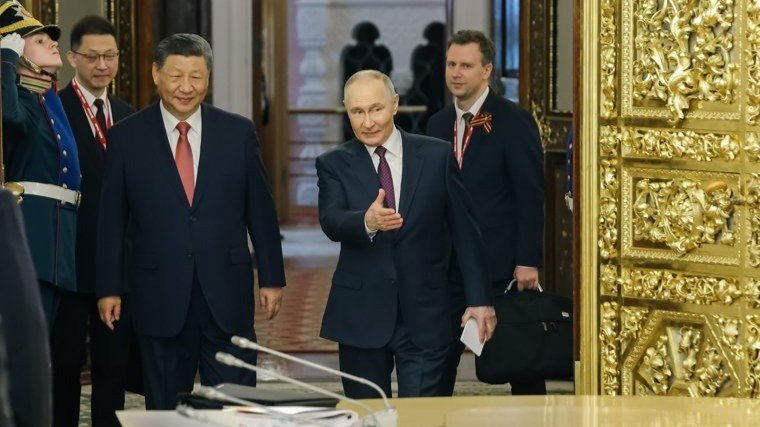
Now, this same logic has been applied to China. Russia’s ruling class is selling off its people, resources, and geopolitical agency for pennies, in exchange for imagined guarantees from the “Red Emperor” in Beijing — hoping to maintain their privileges and a degree of autonomy within the emerging Pax Sinica.
This kind of governance is both immoral and strategically dangerous — not only for the Russian people and their neighbors but for the global community as a whole. It threatens the integrity of the international system. That is why this elite must be removed from power.
This is not merely a Russian tragedy — it is a global security challenge, especially for the United States and its allies. The time-serving, extractive mismanagement of Russia has handed a strategic windfall to one of America’s primary geopolitical rivals — the People’s Republic of China.
The West cannot confront this threat effectively without the active involvement of the conscious, resistance-minded segment of Russian society — the part that has, for generations, fought against both the original Communist fanatics and their corrupt heirs.