

BAKU,TurkicWorld: Abdulhamid Hamid Al-Kba / Writer and researcher specializing in Central Asia and Azerbaijan affairs
The relations between the Republic of Uzbekistan and the United Arab Emirates represent a successful model of bilateral partnerships between the countries of Central Asia and the Arab Gulf.
They began as a historical friendship based on shared cultural and religious ties through ancient trade routes and the common Islamic heritage. They then gradually evolved into a comprehensive strategic partnership focusing on economic development, investment, and innovation.With the declaration of 2025-2027 as a new era for economic partnership, the two countries aim to increase the volume of trade tenfold by 2030 and raise investments to 50 billion dollars.
This ambitious goal reflects a shared vision for sustainable development, while acknowledging the geopolitical and economic challenges that may face its implementation. Historical Foundations and the Transition to Strategic Partnership The roots of the relations go back centuries, linked to historical trade routes.
As for modern official relations, they began with the recognition of Uzbekistan’s independence. The starting point was the historic visit of His Highness Sheikh Mohammed bin Rashid Al Maktoum, Vice President of the UAE, Prime Minister, and Ruler of Dubai, to Tashkent in October 2007 — the first visit by a high-level Emirati official at this level. This was reciprocated by the late Uzbek President Islam Karimov with an official visit to the UAE on 17-18 March 2008, at the invitation of the late Sheikh Khalifa bin Zayed Al Nahyan.
The visit resulted in the signing of agreements in trade, investment, tourism, and counter-terrorism, laying the foundations of mutual trust. In April 2019, the two countries signed a strategic partnership agreement in government modernization, which was expanded in 2020 to include business incubators, manufacturing, and the economy.
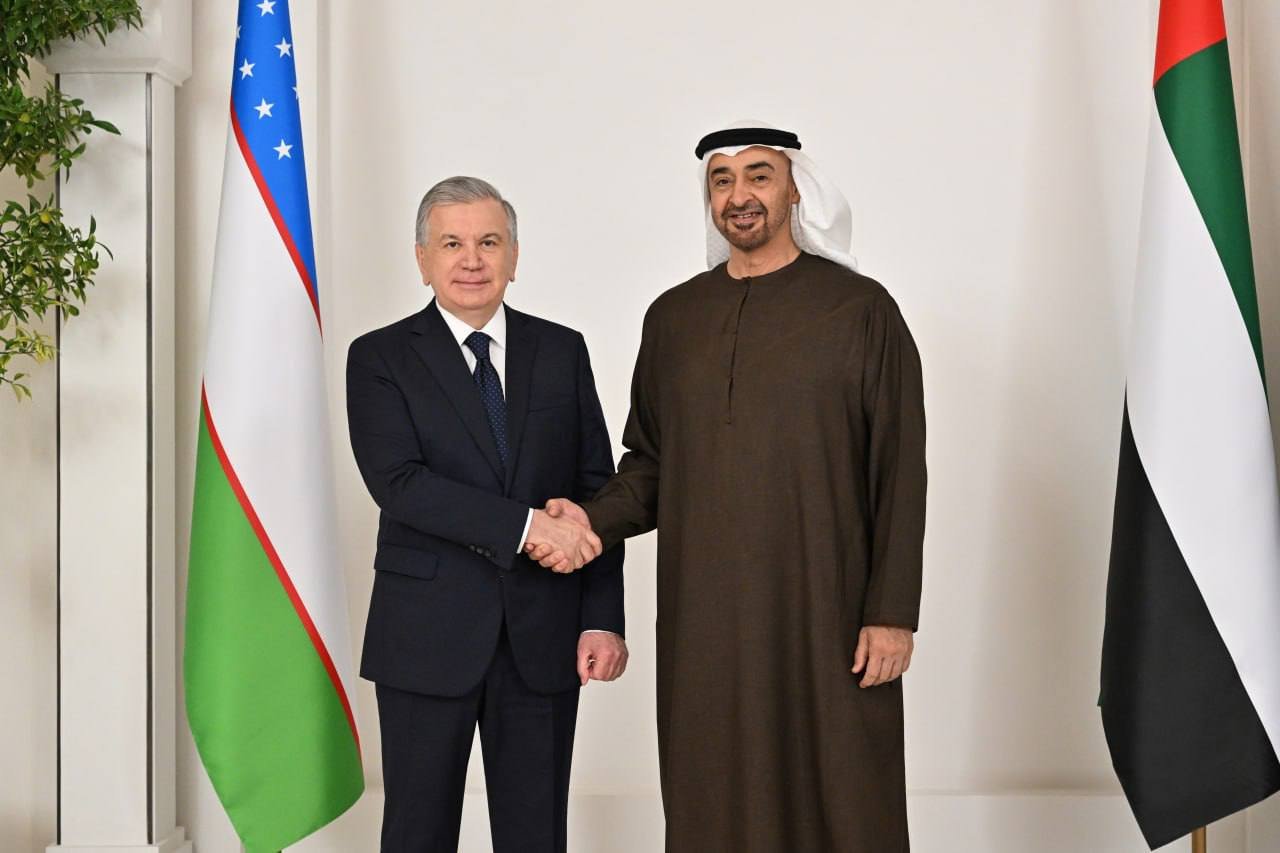
The UAE implemented 147 government initiatives in Uzbekistan, including the training of more than 2,000 Uzbek government employees. In 2023, the two sides agreed to strengthen cooperation in food security, renewable energy, tourism, and natural resources.The relations reached their peak on 15 January 2025 during the visit of President Shavkat Mirziyoyev to Abu Dhabi, where he met with Sheikh Mohammed bin Zayed Al Nahyan.
The two presidents signed a declaration establishing a strategic partnership and several government agreements on investment protection, financial and technical cooperation, and standardization, in addition to memoranda of understanding in investment, industry, agriculture, and culture. At that time, 2025-2027 was declared a new era focusing on six main areas: artificial intelligence, digitalization, green energy, urban planning, tourism, and private sector business.
Economic Dimensions: Remarkable Growth with Challenges
Economic cooperation forms the backbone of the partnership. The volume of trade exchange between the two countries in 2025 reached approximately 1.255 billion dollars, with a growth of 52% compared to 2024.
In the first two months of 2026, it recorded 196.6 million dollars with a growth of 21.1%. The UAE is Uzbekistan’s largest Arab trading partner, accounting for more than 50% of its trade with Arab countries.
Uzbekistan exports gold, minerals, and fruits, while the UAE exports electronics, machinery, and perfumes.Emirati investments in Uzbekistan reached 1.3 billion dollars in 2024 and 1.5 billion dollars in 2025, with a portfolio of joint projects exceeding 20 billion dollars, including about 100 projects.
More than 421 companies with Emirati capital are operating in Uzbekistan, and more than 2,300 Uzbek companies are operating in the UAE.The company Masdar stands out in the field of renewable energy, with investments exceeding 2 billion dollars and aiming to develop more than 2 gigawatts. It has completed the Noor Navoi solar power station (100 MW), the Zarafshan wind power station (500 MW), in addition to solar projects in Samarkand, Jizzakh, and Sherabad, and the Guzar project (300 MW solar + 75 MW/h battery storage), for which Masdar completed the financial close on 15 January 2026 with a value exceeding 225 million dollars.DP World also manages logistics centers in Tashkent and Navoi, and the two countries signed a memorandum of understanding in the mining sector in January 2026.Cultural and Humanitarian Cooperation and Future Prospects Cooperation extends to cultural and humanitarian fields. President Mirziyoyev proposed launching a joint program to train cadres in artificial intelligence in cooperation with Mohamed bin Zayed University, alongside memoranda in the academic field and government training.On 13 April 2026, the UAE Minister of Economy and Tourism, Abdullah bin Touq Al Marri, met with a high-level Uzbek delegation headed by Deputy Prime Minister Jamshid Khojayev in Dubai. The two sides discussed enhancing cooperation in the new economy, tourism, aviation, financial technology, transport, and renewable energy, with a focus on implementing 100 joint projects, the transport corridor through Afghanistan, Islamic finance, and a comprehensive economic partnership agreement.This partnership therefore represents a real strategic opportunity, as Uzbekistan provides natural resources and a vital geo-economic location in Central Asia, while the UAE offers expertise in economic diversification and innovation. The cooperation contributes to strengthening food security and clean energy and opens new markets through trade corridors.From a positive perspective, this model is a good example of South-South cooperation, based on mutual trust and shared interests away from major geopolitical rivalries, and enhances the resilience of both economies in the face of climate change and digitalization.
It also supports Uzbekistan in its path of economic reforms and diversification.However, the goal of increasing trade tenfold remains highly ambitious and may be affected by fluctuations in global commodity prices or disruptions in transport corridors.
Implementation also requires enhancing transparency and building local capacities to ensure sustainable benefits for the Uzbek people and to avoid excessive dependence on foreign investments. True success depends on effective implementation and continuous adaptation to global changes.
Conclusion The Emirati-Uzbek relations embody an ongoing success story, from official visits to a strategic partnership that promises a prosperous future.
With the careful and balanced implementation of the ambitious plans, the two countries will achieve sustainable growth that benefits their peoples and contributes to regional stability. This partnership is not just numbers and agreements, but a shared vision that combines heritage with innovation.