

BAKU, Azerbaijan, November 12.
Abdulhamid Hamid Al-Kba
Opinion writer specializing in Central Asia and Azerbaijan
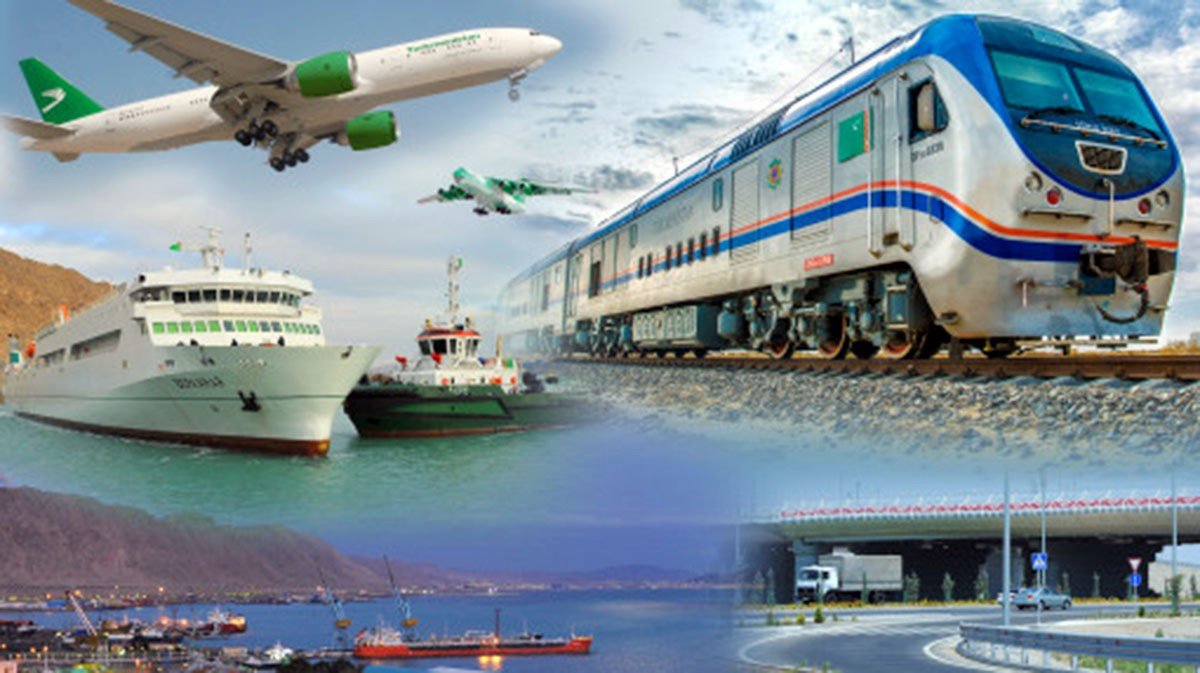
At a time when Central Asian countries are accelerating efforts to redraw the maps of trade and logistics, official figures from Ashgabat have opened a window onto what is actually taking shape on the ground. This is not simply a declaration of success, but a more nuanced picture that warrants closer examination: notable growth in the transport and communications sector, significant disparities across different modes of transport, and a geographic position that offers real potential yet still requires continuous work to turn into a tangible economic advantage.
In the first ten months of 2026, Turkmenistan’s transport and communications sector recorded 13.6 percent growth in the volume of work and services completed, according to data presented by Deputy Chairman of the Cabinet of Ministers Batyr Annayev at a government meeting chaired by President Serdar Berdimuhamedov. The strongest performance came in air transport and communications services. Yet this rate, significant as it is, was 5.5 percentage points lower than the level recorded in the same period of 2024, based on calculations drawn from official figures. The numbers remind us that growth is rarely a straight upward line, and that comparison with previous levels remains essential for understanding the true trajectory.
In an economy that still relies heavily on natural gas exports and hydrocarbon resources, the efficiency of transport infrastructure takes on added importance—not only to support the movement of goods and passengers, but also to advance economic diversification and expand revenue sources through trade and logistics services. Any relative slowdown in this sector therefore remains an indicator worth monitoring.
From an analytical perspective, the performance details reveal a more precise picture. Freight transportation plans across all modes of transport were fulfilled at 108.5 percent, while passenger transportation plans reached 101.9 percent. Compared with the same period in 2025, the freight plan fulfillment rate improved by 7.9 percentage points, whereas the passenger transportation indicator declined by 3.1 points. Among individual agencies, the State Service Türkmenhowaýollary recorded the highest growth at 18.3 percent, followed by the Ministry of Communications at 15.1 percent and the Ministry of Automobile Transport at 14.9 percent. The Ministry of Railway Transport posted 7.4 percent growth, while the State Service for Maritime and River Transport recorded just 1.4 percent.
Annual trends therefore show improvement in railway transport of 1.4 percentage points year-on-year and 4.6 points compared with 2024, along with acceleration in road transport. Air transport improved by 8 percentage points year-on-year, yet remained 36.2 points below its 2024 level. The maritime and river transport indicator declined by 7.2 points year-on-year and 12.6 points relative to 2024, while communications services slowed by 4.9 points from the previous year even though the rate stayed slightly above the 2024 level. These figures do not conceal the disparities: strong growth in some areas is matched by slowdowns in others, making a balanced assessment essential. It remains important to distinguish between growth in the volume of services compared with the previous year and rates of annual plan fulfillment, so that the indicators do not become mixed for the reader.
After hearing the report, President Serdar Berdimuhamedov stressed the importance of continuing to modernize the transport infrastructure and the technical base of the communications sector. He instructed that the necessary measures be taken to increase the volume of passenger and freight transportation, make more effective use of digital systems, and expand the range of services. This guidance comes in the context of Turkmenistan’s geographic position, which gives it a clear advantage. Situated on the eastern coast of the Caspian Sea, the country links the landlocked states of Central Asia with the South Caucasus and markets further west, while its southern borders with Iran and Afghanistan open potential routes toward the Middle East and South Asia. The Organisation for Economic Co-operation and Development describes Turkmenistan as a critical node of the Trans-Caspian Transport Corridor, noting its role in developing links between Central Asia and Europe.
This position places the country at the intersection of two major axes. The east-west direction connects China and Central Asia with the Caspian Sea, Azerbaijan, Georgia and Türkiye as part of the Trans-Caspian International Transport Route, also known as the Middle Corridor. The north-south direction links Kazakhstan with Iran through Turkmen territory, providing an outlet to Gulf markets. The Turkmenbashi International Seaport stands as a central point on these routes, serving as a maritime gateway for Central Asian cargo moving across the Caspian. The World Bank included Turkmenistan among the nine countries covered by its September 2026 assessment of the Trans-Caspian corridor, highlighting the potential of coordinated infrastructure investment to expand trade and improve connectivity between Asia and Europe, with estimates that such investments could more than triple trade volumes by 2040. At the same time, Ashgabat is developing its domestic infrastructure to support this role. The Ashgabat–Turkmenbashi railway is set to undergo comprehensive modernization and forms an important bridge between the country’s eastern and western networks; it also connects with international routes such as Lapis Lazuli, TRACECA, and the North-South and East-West corridors. In parallel, the highway network continues to expand. The 600-kilometre Ashgabat–Turkmenabat high-speed highway was fully completed and commissioned in April 2026, while maritime infrastructure development proceeds. The aim of these investments is to turn the geographic advantage into a tangible economic advantage that encourages freight operators to rely more heavily on this interconnected network.
Yet the real challenge is not limited to expanding infrastructure. It lies in the ability to convert that infrastructure into competitive logistics services. Commercial corridors are measured not only by the length of railways or the handling capacity of ports, but by transit speed, transport costs, the flexibility of customs procedures, and the regularity of services. In an environment where transport options are advancing in Kazakhstan and Azerbaijan, Ashgabat will need to offer clear operational value that makes it a sustainable choice for shipping companies.
In the end, the January–October 2026 figures reflect genuine progress in Turkmenistan’s transport and communications sector, yet they also remind us that growth remains uneven and that some modes are still far from earlier levels. The strategic location exists, government plans are clear, and investments in railways, roads and ports continue. Success will not be measured solely by the annual percentage rate, but by the country’s ability to transform its position into a reliable and sustainable corridor that serves regional and international trade over the long term. This requires continuity in modernization and coordination with partners, rather than reliance on short-term performance indicators alone.