







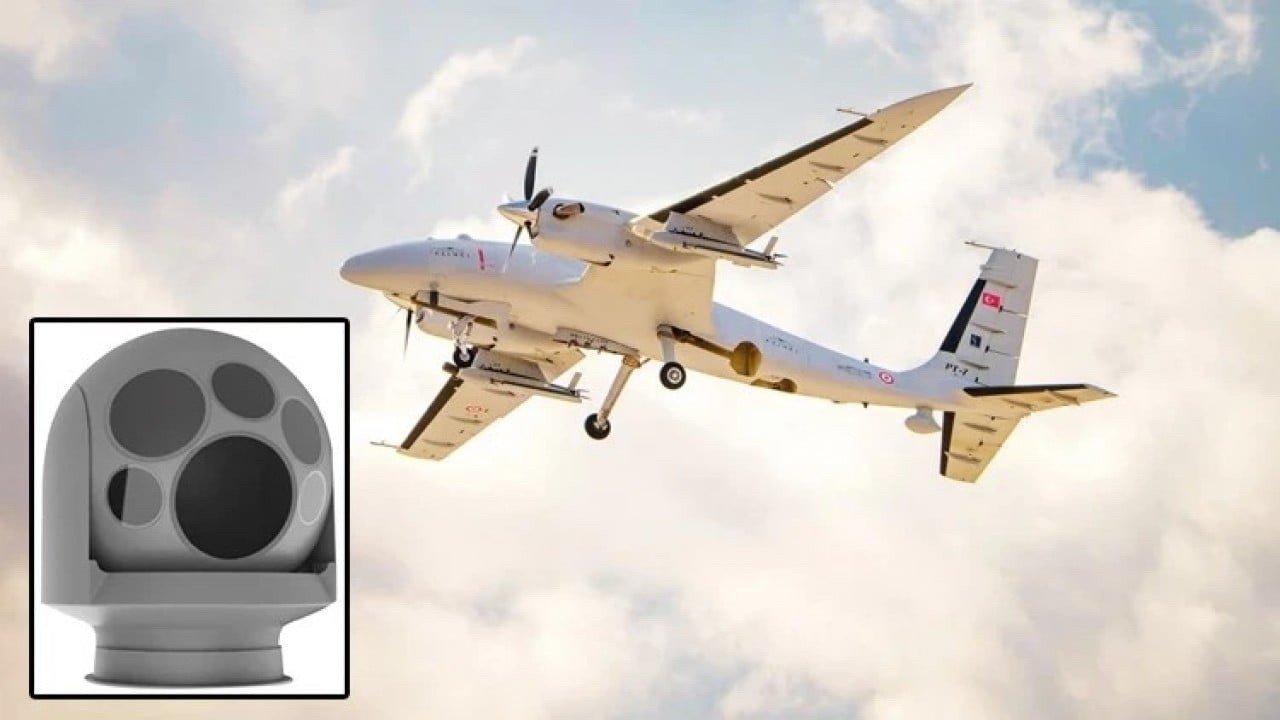
BAKU, Azerbaijan, December 18. How Turkey’s development of indigenous electro-optical and intelligence systems—exemplified by the ASELFLIR-600—is reshaping the regional balance of power and the architecture of strategic deterrence in the Eastern Mediterranean and the Middle East, and to what extent this technological leap signals Ankara’s transition from limited defense autonomy to a self-contained intelligence-strike ecosystem.
Strategic Autonomy as a Structural Answer to Technology Denial
The development and successful testing of the ASELFLIR-600 electro-optical system is not an isolated engineering feat. At a systemic level, it represents the materialization of Turkey’s long-standing doctrine aimed at reducing external technological dependence in the most sensitive segments of its defense industry. This doctrine took shape well before Canada’s embargo on WESCAM components, but the restrictions imposed after the 44-day Azerbaijan–Armenia war served as a catalyst, accelerating the institutionalization of Turkey’s push for technological sovereignty TurkicWorld reports citing BakuNetwork.
International experience suggests that export controls on dual-use technologies rarely achieve their stated political objectives. According to OECD and SIPRI data, between 2010 and 2023 more than 60 percent of countries subjected to high-tech supply restrictions either localized production of analogues or diversified supply chains, thereby reducing strategic vulnerability. Turkey fits squarely within this pattern—but stands out for the speed and scale of its response. In less than five years, Ankara moved from critical dependence in electro-optics to producing a domestic family of systems comparable to mid- and upper-tier Western counterparts.
Crucially, this is not a simple case of import substitution. ASELFLIR-600 is embedded in a broader institutional framework in which the defense industry functions as an extension of state strategy rather than as an autonomous commercial sector. The statement by Haluk Görgün, head of Turkey’s Defense Industry Agency, that the ecosystem can operate “without delays or external instructions” should be read as a politico-strategic formula—one that reflects a consensus across military, industrial, and political decision-making levels.
In this sense, Turkey is effectively replicating a model previously associated with Israel, South Korea, and to some extent France, where technological autonomy in defense is treated as an element of national sovereignty rather than a byproduct of alliance commitments.
From Sensor to Strike: Technology Inside the Kill Chain
Technically, the ASELFLIR-600 is a multifunctional stabilized electro-optical module weighing roughly 120 kilograms, optimized for heavy long-endurance unmanned platforms. Its combination of an HD daylight channel, infrared sensors, and a SWIR module enables all-weather, round-the-clock operation, while its resolution allows not only detection but also classification of targets at operationally meaningful ranges.
Its strategic significance, however, lies less in individual specifications than in its integration into the full intelligence-strike cycle. A laser designator enabling the employment of guided munitions at ranges of up to 35 kilometers shifts ASELFLIR-600 from a purely reconnaissance asset into the ISR-Strike category, where data collection, processing, and weapons employment converge into a single chain with minimal time lag.
SIPRI assessments consistently show that reducing the time between target detection and engagement has become the decisive factor in modern warfare—outweighing standalone metrics such as range or payload. In this context, integrating ASELFLIR-600 with the Bayraktar Akıncı creates a qualitatively new capability, designed to operate in contested airspace and complex electronic-warfare environments.
With a service ceiling of around 12 kilometers and endurance of up to 24 hours, the Akıncı functions less as a tactical UAV than as a pseudo-strategic platform, occupying the space between manned aviation and space-based surveillance. Its altitude, combined with long-range optics, expands the effective reconnaissance radius to levels previously associated with AWACS aircraft or satellites—at a fraction of the operational cost and political risk.
The Aegean as a Test Case for Regional Balance
The Aegean has long been one of the most sensitive theaters in Greek-Turkish relations. NATO and national defense data show that it accounts for the highest number of incidents involving airspace violations, air force maneuvers, and naval signaling. Against this backdrop, Turkey’s acquisition of a platform capable of sustained electro-optical surveillance at distances of 140–150 kilometers carries less tactical than psychological and politico-strategic weight.
Stationing Akıncı drones in western Anatolia, near İzmir, would in theory allow monitoring of large swaths of mainland Greece, including infrastructure and military facilities deep inside the country. This does not imply an immediate shift in rules of engagement, but it does create a new asymmetry in situational awareness. RAND Corporation research suggests that information dominance in the early stages of a crisis significantly increases the ability to impose favorable de-escalation terms on an adversary.
For Athens, this translates into a choice: either invest in enhanced counter-intelligence and counter-drone capabilities, or adapt air-defense and electronic-warfare doctrines to address new classes of threats. Given the constraints of defense budgets—documented in NATO statistics for 2022–2024—such adaptation would inevitably require resource reallocation and political decisions extending beyond purely military planning.
The Israeli Vector: From Partnership to Cautious Distance
Israel has traditionally served as a technological benchmark for Turkey’s defense industry, particularly in UAVs and electronics. Yet bilateral relations in recent years have been marked by political volatility, despite the persistence of economic and limited technological ties.
Public hints in pro-government Turkish media about the theoretical ability to observe Israeli territory—often framed through references to distances between Damascus and Haifa—should not be read as direct military threats. In strategic-studies literature, such signaling is typically interpreted as capability demonstration, aimed at expanding negotiating space and elevating status within the regional hierarchy.
For Israel, Turkey’s emergence as a producer of high-performance electro-optical systems narrows a technological gap that long functioned as an informal guarantee of asymmetry. Israeli think tanks have repeatedly emphasized that superiority in the ISR domain is a cornerstone of national security. Any erosion of that edge, even a relative one, necessitates reassessment of long-term scenarios and investment priorities.
A Layered Intelligence Architecture: Air Meets Space
ASELFLIR-600 gains added significance in the context of Turkey’s expanding dual-use satellite constellation. In recent years, Ankara has placed multiple observation satellites into orbit, enhancing its strategic reconnaissance and monitoring capabilities. Integrating UAV-borne sensors with space-based assets into a unified command-and-control system enables a layered ISR architecture in which each tier compensates for the limitations of the others.
International experience—from U.S. and Chinese programs to NATO initiatives—shows that network-centric approaches are becoming the dominant model in military planning. Pentagon and IMF data indicate that investments in sensor integration and analytics platforms are growing faster than spending on individual weapons systems. Turkey’s trajectory suggests a deliberate embrace of this logic: not merely producing discrete systems, but constructing a coherent decision-making ecosystem.
Arms Control, Export Regimes, and the Erosion of Barriers
The rise of ASELFLIR-600 and its integration into heavy UAV platforms raises broader questions about the transformation of international arms-control and dual-use export regimes. Formally, electro-optical systems do not fall under strict constraints like the MTCR or nuclear nonproliferation treaties. In practice, however, they are becoming critical components of modern deterrence and power projection.
UN and OECD statistics over the past decade point to a clear trend: mid-tier powers are investing less in delivery platforms alone and more in sensors, command systems, and data-processing algorithms. The rationale is straightforward. Control over information—and the ability to act on it rapidly—creates strategic advantages that traditional diplomatic tools struggle to neutralize.
Turkey’s case is instructive precisely because it exposes the limits of export embargoes as instruments of political pressure. Canada’s WESCAM decision, rooted in normative foreign-policy logic, effectively accelerated the emergence of an alternative technological hub. Similar dynamics have played out in Iran, India, and China, where restrictions spurred domestic R&D and production ecosystems. In this sense, ASELFLIR-600 is not an anomaly but a confirmation of a broader pattern: the fragmentation of the global technology landscape is becoming irreversible.
For Western control regimes, this presents a strategic dilemma. Strengthening autonomous defense ecosystems among regional powers reduces the manageability of international security, yet tightening restrictions only hastens localization and diversification. As a NATO member, Turkey occupies a uniquely ambiguous position in this configuration—blurring the line between alliance integration and national sovereignty, and signaling a future in which intelligence autonomy becomes as politically consequential as military hardware itself.
Scenario Analysis: From Managed Equilibrium to Accumulative Escalation
Assessing the strategic implications of ASELFLIR-600 requires moving beyond linear forecasts. In the short term, the most plausible scenario is one of adaptive balance. Greece and Israel are likely to reinforce electronic warfare capabilities, counter-drone systems, and concealment measures without pursuing a symmetrical buildup of comparable platforms. This aligns with a logic of managed rivalry, in which each actor seeks to reduce vulnerabilities without triggering abrupt or destabilizing moves.
The medium-term scenario points to a cumulative effect. As Turkey’s intelligence capabilities expand, they are likely to reshape behavioral patterns during crises. Greater situational awareness increases Ankara’s confidence in decision-making, reducing reliance on external intelligence inputs and allied consultations. According to CSIS analysts, rising autonomy in the ISR domain frequently precedes a more assertive foreign policy posture—even when actions formally remain within the bounds of international law.
The least likely, yet strategically consequential, scenario involves technological escalation. In the event of a sharp deterioration in the regional environment—whether in the Eastern Mediterranean or the Middle East—the combination of long-range optics, unmanned platforms, and satellite-derived data could enable preemptive or demonstrative actions designed to compel de-escalation. Historical experience, from the Persian Gulf to the Korean Peninsula, suggests that such capability demonstrations often mark bifurcation points, after which security architectures are reconfigured.
Strategic Implications for the International Security Architecture
At the global level, Turkey’s technological leap fits into a broader decentralization of military power. SIPRI and IMF data show that since the early 2010s, defense R&D spending outside the traditional Western core has risen by more than 40 percent. Technological superiority is no longer the preserve of a small group of states.
For NATO, this trend creates an inherent tension. On one hand, a stronger ally nominally enhances the alliance’s aggregate capacity. On the other, Turkey’s growing strategic autonomy complicates collective decision-making—particularly in crises where Ankara’s interests diverge from those of other members. In this context, ASELFLIR-600 is not merely a technical system but a marker of structural change within the alliance itself.
For regional actors in the Middle East and the Eastern Mediterranean, Turkey’s experience offers a template. It demonstrates that targeted investment in sensors and integration platforms can yield a qualitative leap in capability without the prohibitive costs of maintaining large fleets of manned aircraft. This lesson is especially salient for middle-income states facing constrained defense budgets and multidirectional threat environments.
Conclusions and Strategic Takeaways
The emergence and testing of ASELFLIR-600 should be understood as part of Turkey’s systemic transition toward a model of strategic autonomy anchored in control over key elements of the intelligence-strike cycle. Its significance extends well beyond technical specifications, reshaping regional balances and altering the logic of deterrence.
For Greece and Israel, the central challenge is not an immediate military threat but the gradual erosion of information asymmetry that has long underpinned their defense doctrines. Addressing this shift calls less for symmetrical technological responses than for comprehensive adaptation of strategic planning—encompassing counterintelligence, electronic warfare, and diplomatic mechanisms for crisis prevention.
For Western governments and international institutions, the Turkish case underscores the need to rethink approaches to export controls and technological risk management. Restrictive policies that ignore long-term consequences increasingly produce the opposite of their intended effect, accelerating the rise of alternative centers of competence.
More broadly, ASELFLIR-600 symbolizes a transition to an era in which decisive advantage lies not in the possession of individual weapons systems, but in the capacity to integrate data, make decisions, and act autonomously under conditions of uncertainty. That, ultimately, is its true strategic significance—not as a threat, but as a signal of how international security itself is being transformed.