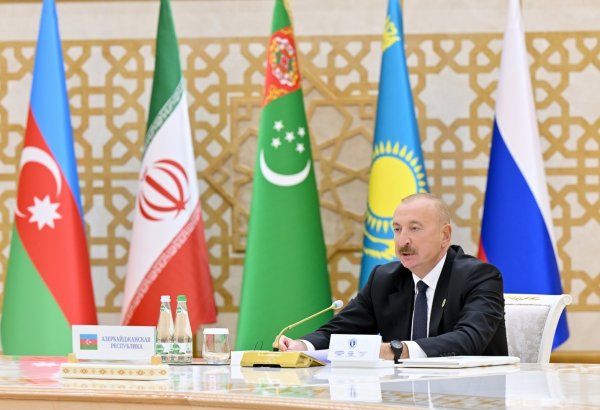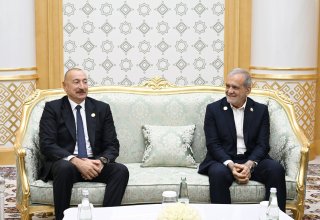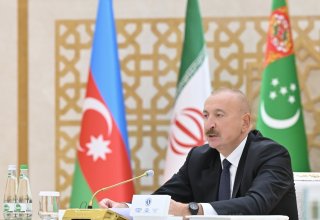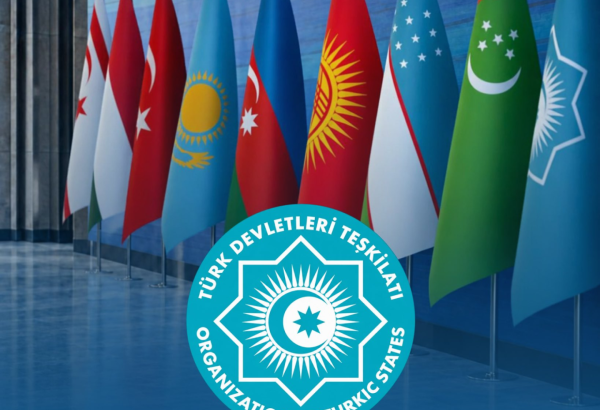
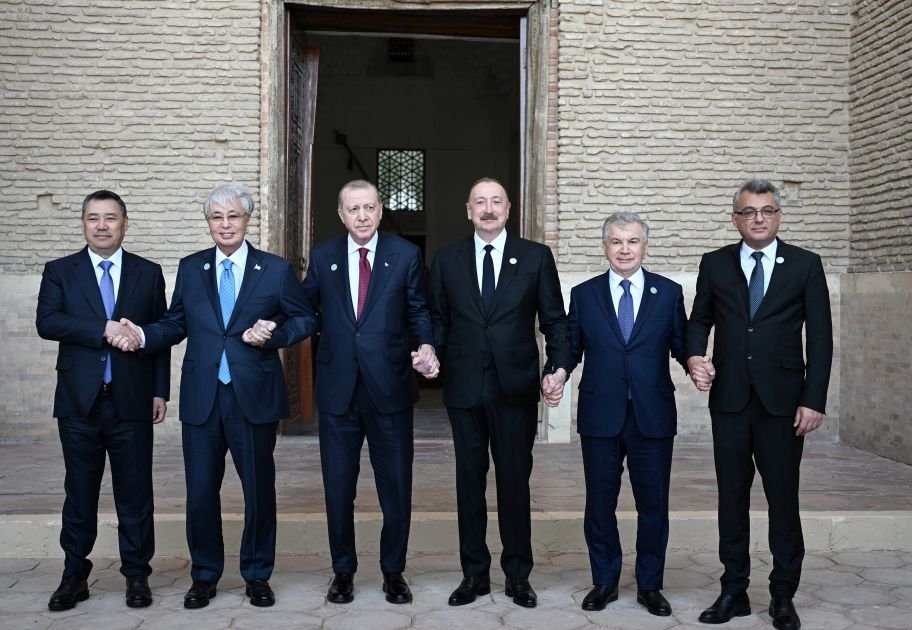
BAKU, Azerbaijan, May 16. An informal summit of the heads of state of the Organization of Turkic States was held today in the Kazakh city of Turkestan with the participation of President Ilham Aliyev.
TurkicWorld reports, as cited by Azernews, that the event attracted considerable attention not only across the Turkic world, but also from the broader international community. This growing interest reflects several important geopolitical trends, most notably the gradual transformation of the OTS into one of the most promising centers of regional cooperation across Eurasia amid the deepening crisis of traditional global governance mechanisms.
In recent years, the Organization of Turkic States has significantly expanded its agenda beyond cultural and humanitarian cooperation. Today, the organization increasingly focuses on economic integration, transport connectivity, energy security, logistics, digitalization and coordinated geopolitical dialogue.
Against the backdrop of global instability, sanctions, disruptions in supply chains and growing competition over international transport routes, the importance of regional integration mechanisms has sharply increased. In this context, the OTS is attempting to position itself as a pragmatic platform capable of connecting Central Asia, the South Caucasus and Europe through mutually beneficial economic cooperation.
"Today, the international standing of the Organization of Turkic States is growing, and its role and position in global affairs are strengthening," said President of Azerbaijan Ilham Aliyev during his speech at the informal Summit of the Heads of State of the Organization of Turkic States held in Turkistan.
The Turkic bloc occupies more than 4.25 million square kilometers and is home to roughly 160 million people. Collectively, these countries command significant energy resources, transport corridors, and geopolitical leverage across Eurasia. In recent years, the OTS has increasingly positioned itself not only as a cultural initiative but as a strategic actor in regional politics.
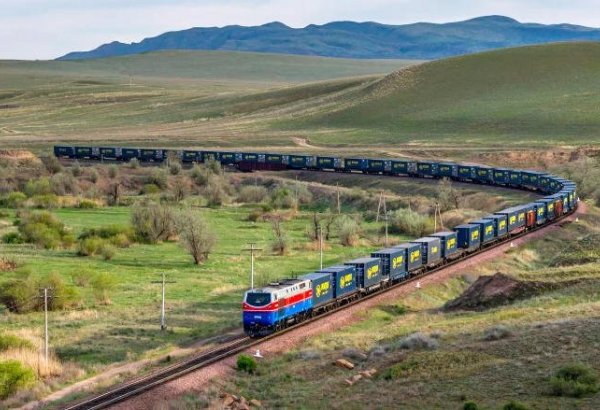
The current geopolitical environment - marked by shifting alignments due to global power rivalries, energy transitions, and new connectivity projects - gives the OTS greater potential influence. The Middle Corridor initiative, linking China to Europe via the Caspian region and Türkiye, places OTS members at the heart of Eurasian trade reconfiguration. Through coordinated transport and customs strategies, OTS nations could become a critical bridge between East and West.
The OTS maintains an active dialogue with major international organizations, including the United Nations, OSCE, Organization of Islamic Cooperation, and the World Customs Organization.
In a comment for AzerNEWS, a Professor of Erzincan Binali Yilidirim University Ainur Nogayeva said that it is important to note that the foundation of what is today known as the Organization of Turkic States was laid precisely in Nakhchivan in 2009.
"Nakhchivan became the starting point for the creation of a new union of the Turkic world. At that time, the presidents of Azerbaijan, Kazakhstan, Kyrgyzstan and Türkiye agreed to establish the Cooperation Council of Turkic-Speaking States, and later this structure transformed into the Organization of Turkic States," she noted.
As Nogayeva highlighted, Baku today is one of the locomotives of the OTS not only in the political dimension, but above all in transport, energy and logistics.
If, for example, Türkiye acts as the industrial and military center of the Turkic space, and Kazakhstan as the resource and transit giant of Central Asia, then Azerbaijan is becoming the main "bridge" between Central Asia, the Caucasus and Europe.
"As for practical steps, they are connected first of all with the Middle Corridor. The route from China to Europe through Kazakhstan and the Caspian Sea to Azerbaijan, Georgia, Türkiye and further to Europe is an important link. President Ilham Aliyev directly called the Middle Corridor a "catalyst for regional economic growth and integration," an expert emphasized.
What is Azerbaijan doing in this regard? It is modernizing the Port of Baku and expanding railway infrastructure, focusing attention on the development of the Baku–Tbilisi–Kars Railway, digitalization of customs and logistics, as well as creating joint logistics mechanisms with Kazakhstan and Georgia.
Regarding which sectors of the Azerbaijani economy will be most affected in the future by cooperation and knowledge exchange within OTS forums, energy integration should first be mentioned.
According to Azerbaijan’s Ministry of Energy, tens of millions of tons of oil from Kazakhstan and Turkmenistan have been exported through the Baku–Tbilisi–Ceyhan Pipeline, while tens of billions of cubic meters of gas are supplied through Türkiye to Europe.
Nogayeva said that Azerbaijan is turning into an energy hub and transit node, as well as a "backup route" for Europe outside Russia.
The second important new direction is green energy. Within the framework of the OTS, discussions are underway on the export of green electricity, the creation of a unified energy market, and the establishment of an energy bridge linking Central Asia, Azerbaijan, Türkiye and Europe.
This is especially important in light of decarbonization, EU climate policy and beyond, as well as growing electricity consumption by data centers and artificial intelligence technologies.
According to the expert, the sectors expected to benefit the most in Azerbaijan are logistics and transportation, as the country continues to increase transit revenues while expanding ports, railway networks, warehouse infrastructure and digital logistics systems.
Against the backdrop of the energy crisis, Europe is interested in diversifying supplies, while Azerbaijan is becoming one of the few stable routes outside Russia and Iran, Nogayeva added.
The analyst also emphasized that current OTS forums increasingly focus on practical issues such as digitalization and artificial intelligence.
"If previously Turkic cooperation was mainly cultural and humanitarian, now the center of gravity is shifting toward economics, transit, energy, investments and technologies," she stated.
A. Nogayeva also stressed that the importance of the Middle Corridor increased significantly after the beginning of the war in Ukraine, sanctions and crises in global supply chains.
"The OTS is trying to create an alternative route outside Russia, partially outside Iran, with access to Europe and China. That is why interest in the corridor is growing both from the European Union and from China" she explained.
The expert further underlined that OTS forums also have practical diplomatic significance.
"The forums create direct contacts between ministries, joint projects, investment platforms, coordination of infrastructure and energy agreements. Diplomacy is becoming not declarative, but infrastructural," Nogayeva said.
Nogayeva added that the Turkic states oppose bloc thinking and focus attention on urgent global challenges that require immediate solutions rather than confrontation.
As President Ilham Aliyev stated during his speech at the summit in Turkistan, "The Turkic world, which is our family, should become one of the influential geopolitical centers of power of the 21st century."
Author: Ulviyya Poladova