






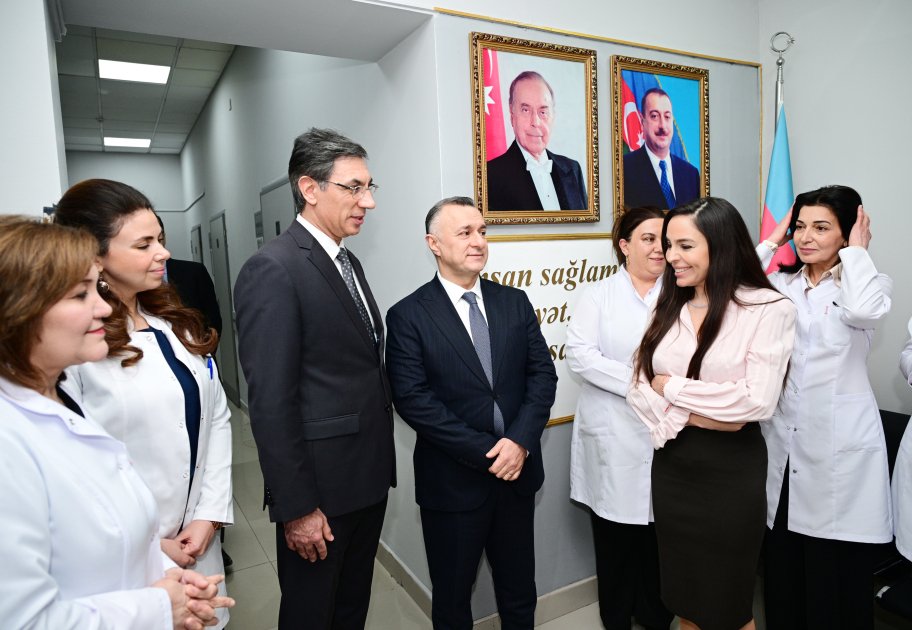
BAKU, Azerbaijan, March 5. On March 5, Leyla Aliyeva visited the Baku City Narcology Center, TurkicWorld reports.
Leyla Aliyeva was provided with detailed information regarding the center's operations and history.
The Baku City Narcology Center, established in 1980, was the first specialized narcological medical institution in Azerbaijan. It originally operated as the Baku City Narcology Dispensary. At that time, when narcology was separated from psychiatry as part of the broader fight against alcoholism, the establishment of independent narcological institutions began, with this center being the first to open in the country. The facility underwent a major renovation by the Ministry of Health in 2012. Following a decree by the Ministry of Health dated August 11, 2020, the "Baku City Narcology Center" was reorganized as a public legal entity. The center currently consists of 16 rooms, including registration, reception, seven physician offices, a manipulation room, and six administrative offices.
Serving all 12 districts of the capital, the center employs 18 doctors, 25 nurses, and 27 other staff members. It has the capacity to serve between 200 and 300 citizens daily.
The center currently has 17,557 people registered in the capital. Of these, 14,753 are registered for mental and behavioral disorders resulting from drug use, 1,416 for alcohol-related disorders, and 1,388 for disorders resulting from toxic substance use. On average, 20 people suffering from drug addiction apply to the center daily, while applications for alcoholism are less frequent. Acute cases of alcoholism are referred to inpatient care, while mild cases receive outpatient treatment at the center. Additionally, the center conducts screenings for Syphilis, HIV, and Hepatitis B and C.
A new location has been allocated for the center, and it will be relocated there in the near future.
During her visit, Leyla Aliyeva toured the registration, reception, physician, head nurse, and manipulation rooms. She spoke with the medical personnel and joined them for photographs.