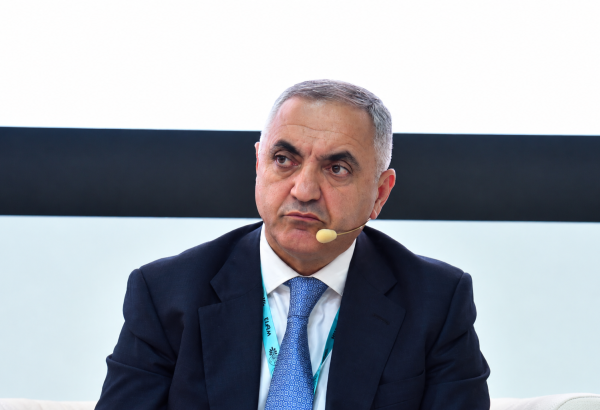







BAKU, Azerbaijan, October 2. Kazakhstan is taking a systematic approach to AI development, working simultaneously across all layers of the AI economy, Deputy Prime Minister and Minister of Artificial Intelligence and Digital Development Zhaslan Madiyev said at the AI & Digital Bridge 2026 forum in Astana.
According to Madiyev, Kazakhstan is currently implementing a number of large-scale projects related to digital infrastructure, including the Data Center Valley, fiber-optic networks, AI and digital platforms, and cloud solutions.
"But it’s important to understand that currently we are at the very beginning of the development of AI technology, and according to various estimations, the total addressable market for artificial intelligence exceeds $50 trillion right now," Madiyev said.
He said that at the initial stage of AI development, Kazakhstan considers it important to develop the full AI economy stack, covering five main layers: energy infrastructure, chipsets, access to cloud platforms, large language models (LLMs), including local and sovereign models, and the application layer.
"So it’s important to move forward with all the layers, because right now we don’t see where the highest value added and margins will be among all those five layers. That’s why Kazakhstan has chosen to move forward with all five layers, so that Kazakhstan does not miss out in the future when AI becomes a normal part of business activities," he said.
Madiyev stressed that Kazakhstan’s approach to digital and AI sovereignty does not mean developing all components independently.
"It’s important to collaborate with other countries, with the big tech companies from all over the world, and be diversified in that sense," he said.
In particular, Kazakhstan is not currently a producer of chips, Madiyev noted, adding that the country needs to maintain relations with both Western and Eastern markets to ensure access to critical technologies, as well as maintain cooperation with regulators and agencies responsible for export controls.
At the same time, Kazakhstan needs to develop its own capabilities in areas such as large language models and cloud solutions, including the incorporation of Kazakh content and cultural context into AI models, according to Madiyev.
"You need to have your Kazakh content, the cultural context, in those models in order to know how to train, how to fine-tune those models, to build up the competence," he said.
Madiyev said capacity-building programs would be needed to develop these competencies and support the transition toward the application layer of the AI economy.
"Because we believe that the application layer is the thing that Kazakhstan can take the highest benefit of and scale throughout the economy and people’s daily lives," he said.